

Advanced Blood Transport Solutions Drive Growth in the Blood Transport Boxes Market

Growing investments in healthcare infrastructure are contributing to the adoption of blood transport boxes across developing economies. New hospitals, diagnostic laboratories, blood banks, and specialized medical facilities require dependable transportation equipment to improve blood supply management and healthcare delivery.
Market Overview
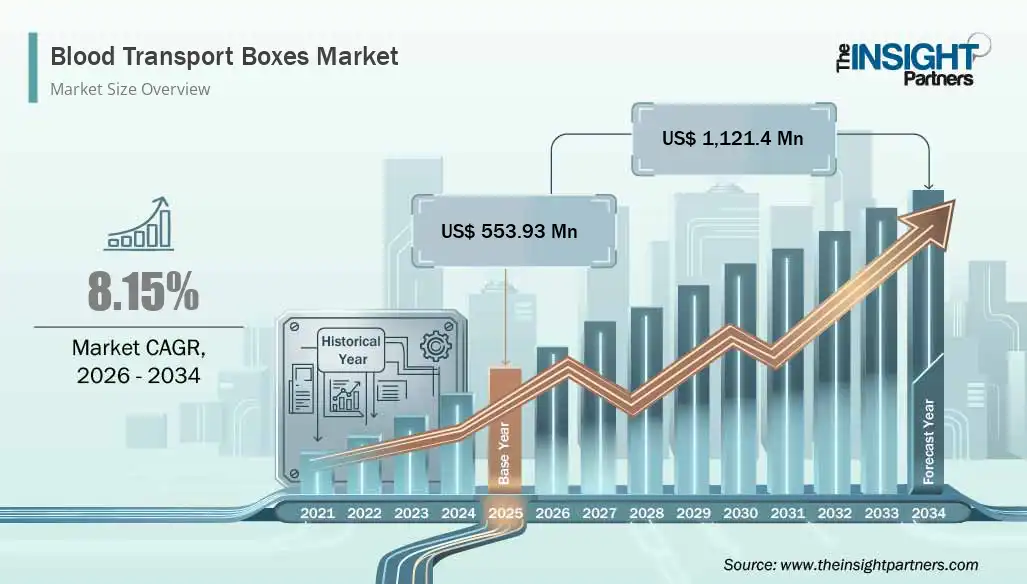
The Blood Transport Boxes Market Size was valued at US$ 553.93 million in 2025 and is expected to reach US$ 1121.4 million by 2034; it is estimated to record a CAGR of 8.15% during 2026-2034.
The report is segmented by Type (Passive Cooling Blood Transportation Box, Active Cooling Blood Transportation Box). The report is segmented by Application (Blood Bank Centers, Hospitals, Clinical and Research Laboratories, Other). The global analysis is further broken-down at regional level and major countries. The Report Offers the Value in USD for the above analysis and segments.
Get a Sample PDF: https://www.theinsightpartners.com/sample/TIPRE00025491
The market is gaining momentum as healthcare organizations increasingly emphasize the safe handling and transportation of blood and blood components. Blood transport boxes help maintain controlled storage conditions during movement between collection centers, blood banks, hospitals, and diagnostic facilities. Growing demand for transfusions, improvements in cold-chain logistics, and increasing investment in healthcare transportation infrastructure are creating opportunities for manufacturers. The availability of passive and active cooling technologies is also supporting the development of products for different transportation requirements.
Blood Transport Boxes Market Growth Drivers
Increasing Demand for Blood and Blood Products
The rising demand for blood and blood products is a major factor supporting the growth of the Blood Transport Boxes Market. Blood transfusions are required during surgical procedures, emergency treatments, accident-related injuries, cancer care, and the management of several medical conditions. As healthcare facilities handle increasing requirements for blood components, the need for reliable transportation and temperature-control solutions is also expanding. Blood transport boxes help healthcare providers move blood products safely between collection centers, storage facilities, and hospitals.
Growth in Blood Donation Activities
Increasing awareness of blood donation and the expansion of organized donation campaigns are creating opportunities for the market. Blood donation drives, community health initiatives, and collection programs help improve the availability of blood for medical requirements. These activities often involve transporting collected blood from donation locations to processing centers and blood banks. Reliable transport boxes support the safe movement of collected blood and help healthcare organizations manage transportation across different locations.
Advancements in Cold-Chain Transportation
Continuous advancements in cold-chain technologies are supporting the adoption of improved blood transport boxes. Temperature-controlled containers help maintain suitable conditions during transportation and reduce the risk of temperature-related damage to blood products. Manufacturers are developing solutions with improved insulation, temperature-monitoring capabilities, and active cooling systems. These innovations are particularly relevant for healthcare organizations transporting blood over long distances or through locations with challenging transportation infrastructure.
Blood Transport Boxes Market Trends
Increasing Adoption of Active Cooling Technologies
Active cooling blood transport boxes are gaining attention because they provide temperature management through integrated cooling systems. These solutions can support transportation requirements that involve longer distances or more demanding temperature-control conditions. Improvements in cooling technology, monitoring systems, and portable equipment design are encouraging manufacturers to develop advanced transportation solutions for blood banks and healthcare facilities.
Integration of Temperature Monitoring Systems
The growing emphasis on blood safety is encouraging the adoption of transportation solutions with temperature-monitoring capabilities. Monitoring systems can help healthcare personnel track storage conditions during transit and identify temperature variations. The integration of digital monitoring technologies may improve transportation visibility, support operational efficiency, and help healthcare organizations maintain better control over blood product handling.
Expansion of Healthcare Logistics Infrastructure
The development of healthcare logistics networks is creating additional opportunities for blood transport box manufacturers. Hospitals, blood banks, diagnostic laboratories, and healthcare distribution organizations require dependable transportation solutions to support the movement of medical supplies and blood products. Investments in healthcare infrastructure and cold-chain transportation are increasing the importance of specialized storage and transport equipment.
Top Players in the Blood Transport Boxes Market
-
B Medical Systems
-
Thermo Fisher
-
Terumo BCT
-
Sarstedt
-
Haier Bio-Medical
-
Badu Technology
-
Fresenius Kabi
-
Labcold
-
Greiner Bio-One
Market Segmentation
The Blood Transport Boxes Market is segmented as follows:
By Type
-
Passive Cooled Blood Transport Boxes
-
Active Cooled Blood Transport Boxes
By Application
-
Blood Bank Centers
-
Hospitals
-
Clinical and Research Laboratories
-
Others
Future Outlook
The Blood Transport Boxes Market is expected to witness continued growth as healthcare organizations strengthen blood storage, handling, and transportation systems. Increasing demand for transfusions, expansion of blood donation programs, and improvements in cold-chain logistics are expected to support market development. Technological advancements in active cooling, temperature monitoring, and portable transportation equipment may further improve product capabilities. With the market projected to reach US$1,121.4 million by 2034, manufacturers are likely to focus on product innovation, reliable temperature management, and solutions that meet the evolving requirements of blood banks and healthcare facilities.
Related Reports –
Medical Cryogenic Storage Equipment Market Trends, Size & Forecast by 2034
Bioprocess Containers Market Key Players Analysis, Opportunities, and Growth Forecast by 2031
About Us
The Insight Partners, we provide comprehensive analysis and insights into market trends that empower businesses to make informed decisions. Our reports are designed to equip stakeholders with the necessary information to navigate the complexities of various industries, including healthcare, technology, and finance. We are dedicated to delivering high-quality research that enables our clients to achieve their strategic objectives.
Contact Us:
Contact Person: Ankit Mathur
E-mail: ankit.mathur@theinsightpartners.com
Phone: +1-646-491-9876
Also Available in : Korean German Japanese French Chinese Italian Spanish














