

Global Natural Refrigerants Market Size and Forecast: Rising Demand for Eco-Friendly Cooling and Low-GWP Refrigeration Solutions

"
According to the latest report published by Data Bridge Market Research, the Natural Refrigerants Market
CAGR Value
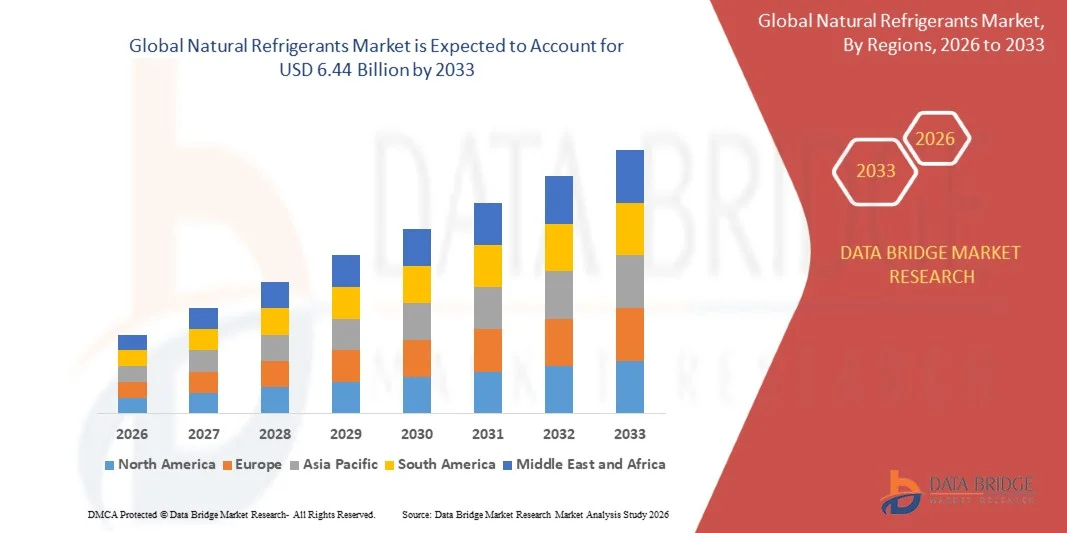
As per Data Bridge Market Research Analysis the Natural Refrigerants Market was valued at USD 2.58 billion in 2025 and is projected to reach USD 6.44 billion by 2033, growing at a CAGR of 12.10% from 2026 to 2033.
The idea of this Natural Refrigerants Market research document is high level analysis of major market segments and recognition of opportunities in Natural Refrigerants Market industry. Experienced and innovative industry experts estimate strategic options, figure out winning action plans and help out businesses make critical bottom-line decisions. Precious market insights with the new skills, latest tools and innovative programs can be achieved via this Natural Refrigerants Market document which helps them accomplish business goals. Competitive analysis studied in this market report assists to get ideas about the strategies of key players in the market.
Stay informed with our latest keyword market research covering strategies, innovations, and forecasts. Download full report: https://www.databridgemarketresearch.com/reports/global-natural-refrigerants-market
Natural Refrigerants Market Segmentation and Market Companies
Segments
- By Type: The global natural refrigerants market can be segmented into ammonia, carbon dioxide, hydrocarbons, and others. Ammonia is widely used in industrial refrigeration systems due to its excellent thermodynamic properties and energy efficiency. Carbon dioxide, also known as R-744, is gaining popularity in commercial refrigeration applications as it is non-toxic and has low environmental impact. Hydrocarbons such as propane and isobutane are being increasingly used as natural refrigerants in domestic refrigeration and air conditioning units.
- By Application: Based on application, the natural refrigerants market can be categorized into refrigeration systems, air conditioning, heat pumps, and others. Refrigeration systems account for a significant share in the market, driven by the increasing demand for cold storage facilities and refrigerated transportation. Air conditioning is another key application segment, with the automotive industry adopting natural refrigerants to comply with environmental regulations and reduce greenhouse gas emissions.
- By End-Use Industry: The market can also be segmented by end-use industry into industrial, commercial, residential, and others. The industrial sector dominates the natural refrigerants market, with industries such as food processing, pharmaceuticals, and chemicals relying heavily on refrigeration systems for preserving perishable goods. The commercial segment is witnessing growth due to the expansion of supermarkets, convenience stores, and hotels opting for natural refrigerants to minimize their carbon footprint.
Market Players
- The Linde Group: A leading player in the natural refrigerants market, offering a wide range of solutions including ammonia and carbon dioxide refrigeration systems. The company focuses on innovation and sustainability to meet the evolving needs of customers.
- DowDuPont: Known for its expertise in developing hydrocarbon refrigerants that are energy-efficient and environmentally friendly. The company invests heavily in research and development to enhance the performance of natural refrigerants.
- Emerson Electric Co.: A key player providing integrated solutions for natural refrigerants in various applications such as commercial refrigeration and air conditioning. The company's commitment to energy efficiency and environmental stewardship drives its growth in the market.
- The Coca-Cola Company: A notable player in the natural refrigerants market, particularly in the beverage industry, where it has adopted carbon dioxide as a refrigerant in its vending machines and coolers. The company emphasizes sustainability and corporate responsibility in its refrigeration practices.
The global natural refrigerants market is poised for significant growth due to the increasing awareness about environmental protection and the shift towards eco-friendly refrigeration solutions. With key players investing in research and development to enhance the performance of natural refrigerants, the market is expected to witness further advancements in technology and product offerings.
The global natural refrigerants market is experiencing a notable shift towards sustainable and environmentally friendly refrigeration solutions as businesses and consumers alike become more conscious of their ecological footprint. This transition is primarily driven by stringent regulations aimed at reducing greenhouse gas emissions and protecting the ozone layer. As a result, there is a growing demand for natural refrigerants such as ammonia, carbon dioxide, and hydrocarbons across various industries and applications.
One of the key trends shaping the natural refrigerants market is the increasing adoption of carbon dioxide (R-744) in commercial refrigeration applications. Carbon dioxide is considered a viable alternative to traditional synthetic refrigerants due to its low environmental impact and non-toxic properties. Additionally, advancements in technology have made it more feasible for businesses to implement carbon dioxide-based refrigeration systems, further driving the market growth in this segment.
Another significant trend in the natural refrigerants market is the emphasis on energy efficiency and sustainability among market players. Companies like The Linde Group, DowDuPont, Emerson Electric Co., and The Coca-Cola Company are investing heavily in research and development to enhance the performance of natural refrigerants and develop innovative solutions that meet the evolving needs of customers. This focus on innovation not only ensures superior product offerings but also reinforces the commitment to environmental stewardship and corporate responsibility.
Furthermore, the natural refrigerants market is witnessing a surge in demand from the industrial sector, particularly in industries such as food processing, pharmaceuticals, and chemicals. The need for efficient refrigeration systems to preserve perishable goods and maintain product quality has propelled the adoption of natural refrigerants in these sectors. Additionally, the commercial segment, encompassing supermarkets, convenience stores, and hotels, is also contributing to market growth as businesses seek to minimize their carbon footprint and align with sustainable practices.
Looking ahead, the global natural refrigerants market is expected to witness continued expansion, driven by factors such as regulatory initiatives promoting eco-friendly refrigeration solutions, increasing consumer awareness about environmental sustainability, and ongoing technological advancements in natural refrigerant systems. Market players will continue to focus on innovation and sustainability, collaborating with stakeholders to develop cutting-edge solutions that cater to the evolving needs of various industries and applications. Overall, the future of the natural refrigerants market looks promising, with opportunities for growth and development in the coming years.The global natural refrigerants market is witnessing a notable shift towards sustainable and eco-friendly refrigeration solutions driven by the increasing awareness of environmental protection. Businesses and consumers are increasingly conscious of their ecological footprint, leading to a growing demand for natural refrigerants such as ammonia, carbon dioxide, and hydrocarbons across various industries and applications. The market is experiencing a trend towards the adoption of carbon dioxide (R-744) in commercial refrigeration applications due to its low environmental impact and non-toxic properties. Advancements in technology have made it more feasible for businesses to implement carbon dioxide-based refrigeration systems, further boosting market growth in this segment.
Furthermore, there is a notable emphasis on energy efficiency and sustainability among key market players such as The Linde Group, DowDuPont, Emerson Electric Co., and The Coca-Cola Company. These companies are heavily investing in research and development to enhance the performance of natural refrigerants and develop innovative solutions to meet the evolving needs of customers. This focus on innovation not only ensures superior product offerings but also underscores their commitment to environmental stewardship and corporate responsibility.
Moreover, the industrial sector, including industries like food processing, pharmaceuticals, and chemicals, is driving significant demand for natural refrigerants. The need for efficient refrigeration systems to preserve perishable goods and maintain product quality has propelled the adoption of natural refrigerants in these sectors. Additionally, the commercial segment, comprising supermarkets, convenience stores, and hotels, is also contributing to market growth as businesses aim to minimize their carbon footprint and align with sustainable practices.
Looking ahead, the global natural refrigerants market is expected to continue its expansion supported by regulatory initiatives promoting eco-friendly refrigeration solutions, increasing consumer awareness of environmental sustainability, and ongoing technological advancements in natural refrigerant systems. Market players will continue to focus on innovation and sustainability, collaborating with stakeholders to develop cutting-edge solutions that cater to the evolving needs of various industries and applications. Overall, the future of the natural refrigerants market looks promising, with opportunities for growth and development in the coming years.
Frequently Asked Questions About This Report
What is the projected revenue from Natural Refrigerants Market software licenses by 2033?
What will be the most lucrative part of the Natural Refrigerants Market value chain in 2033?
What is the revenue split between Segment A and Segment B in the Natural Refrigerants Market?
What is the role of Mobile Apps in the Natural Refrigerants Market value chain?
What are the dominant pricing models in the Natural Refrigerants Market (Fixed vs. Dynamic)?
What is the influence of social media on Natural Refrigerants Market demand?
Which region is the most price-sensitive in the Natural Refrigerants Market industry?
What role does government funding play in the Natural Refrigerants Market growth?
What is the estimated market valuation for Natural Refrigerants Market in 2026?
What is the Investor Sentiment regarding the Natural Refrigerants Market industry in 2026?
What is the projected market size of the Natural Refrigerants Market in 2025?
Browse More Reports:
Global Long-Term Evolution (LTE) Internet of Things (IoT) Market
Global Pasta Filata Cheese Market
Global Retinal Dystrophy Treatment Market
Global Bone Conduction Hearing Aids Market
Global Carotenoids Market
Global Coconut Water and Milk Market
Global Edible Films and Coatings Market
Global Fat Reduction Market
Global Next-Generation Targeted Oncology Drug Market
Global Orange Mint Essential Oils Market
Global Smart irrigation Market
Global Static Volume Volumentric Display Market
Global Building Analytics Market
Global Cyanotic Heart Disease Market
Global Minimally Invasive Medical Robotics, Imaging and Visualization Systems and Surgical Instruments Market
Contact Us:
Data Bridge Market Research
US: +1 614 591 3140
UK: +44 845 154 9652
APAC : +653 1251 979
Email:- corporatesales@databridgemarketresearch.com"














