


What Are App Development Services and What Do They Include?
Imagine a small business managing customer orders through phone calls and WhatsApp messages while tracking payments and inventory in spreadsheets. As orders increase, mistakes and delays become harder to manage. In such situations, app development services can help bring everyday business activities into one organized digital solution.
From practical project experience, one important lesson is that successful app development starts with understanding the problem, not simply writing code. Google's Android development guide also provides useful guidance on building apps with attention to quality and different device requirements. The right approach helps businesses choose features and technology that fit their actual needs.
What Are App Development Services?
App development services involve creating software applications for specific business or user requirements. These applications may run on Android and iOS devices, web browsers, desktop computers, or internal business systems.
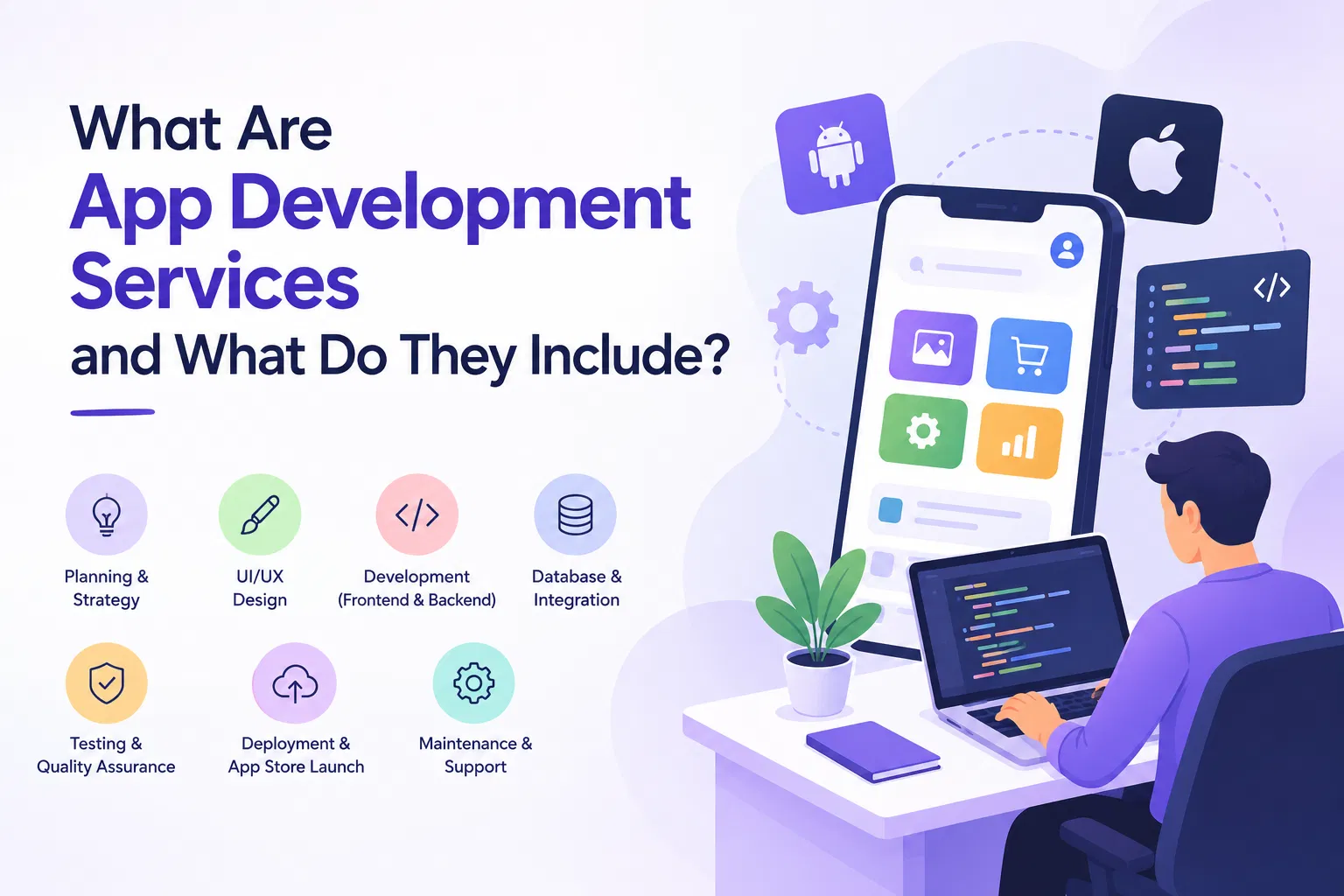
Depending on the project, the work may include product planning, UI/UX design, frontend and backend development, database management, API integration, quality assurance, deployment, and ongoing support.
For example, a restaurant might need an application for online ordering and reservations. A logistics company may need a tool for tracking deliveries, assigning drivers, and updating customers. An enterprise may require an internal application that connects employees with existing business software.
The scope of app development services depends on the problem being solved. A simple application may require only a few essential features, while a complex product could involve multiple user roles, payment systems, third-party integrations, and detailed reporting.
What Do App Development Services Include?
1. Requirement Analysis and Project Planning
Every successful application begins with a clear understanding of what it needs to accomplish.
During this stage, the development team discusses the business goals, intended users, essential features, technical requirements, budget, and expected timeline. It also identifies potential challenges, such as integrating with an existing CRM or handling sensitive customer information.
Suppose a business wants to build a booking application. Before development starts, the team needs to understand how customers choose appointments, how employees manage availability, and what happens when someone cancels or reschedules.
These details shape the application’s functionality and prevent avoidable changes later.
2. UI/UX Design
User interface (UI) design focuses on how an application looks, while user experience (UX) design considers how easily people can use it.
This stage may include wireframes, interactive prototypes, navigation flows, visual design, and usability testing. The objective is to help users complete their tasks without confusion.
For example, an online shopping application should make it easy to search for products, review prices, add items to a cart, and complete checkout. If customers struggle to understand the process, even a technically sound app may fail to meet its goals.
A good mobile app development company considers accessibility, readable text, clear feedback, and consistent navigation rather than focusing only on attractive screens.
3. Frontend and Backend Development
Frontend development builds the screens and interactions users see. Backend development handles the behind-the-scenes processes, such as business logic, authentication, databases, and communication between systems.
Consider an application that allows customers to place orders. The frontend displays products and checkout screens, while the backend processes orders, updates inventory, and communicates with the payment provider.
Both parts need to work together reliably. Depending on the project, developers may also build APIs that allow the application to exchange information with accounting software, CRM platforms, shipping services, or other systems.
4. Android and iOS App Development
Businesses often need to decide which platforms their application should support.
Android app development focuses on applications designed for Android devices. iOS app development creates applications for Apple's mobile operating system. The choice depends on the target audience, required device features, budget, and business objectives.
With native app development, teams build specifically for the intended platform. This can be suitable when an application depends heavily on platform-specific features or requires particular performance characteristics.
Hybrid or cross-platform approaches can allow teams to reuse portions of the code across platforms. The exact level of reuse depends on the framework, application architecture, and features involved.
A mobile application development company should explain these trade-offs before recommending a technology rather than assuming one approach suits every project.
5. Database and Third-Party Integration
Many applications need to communicate with external systems. These may include payment gateways, maps, messaging platforms, inventory software, analytics tools, or customer relationship management systems.
Database development helps store and organize information such as customer accounts, transactions, product records, and appointments. Integrations allow the application to exchange information with other services.
For instance, an appointment application could connect to a calendar service and send confirmation emails after a booking. Without properly planned integrations, employees might have to enter the same information into several systems.
Developers should also consider API limits, service costs, access permissions, and what happens when an external service becomes unavailable.
6. Testing and Quality Assurance
Before an application reaches users, it needs to be tested under realistic conditions.
Quality assurance can include functional testing, usability checks, performance testing, security reviews, and compatibility testing across supported devices and operating system versions.
A payment application, for example, should be tested for successful payments, declined transactions, interrupted connections, duplicate submissions, and refunds where applicable.
Testing is not simply about finding crashes. It helps confirm that important workflows behave as expected and that the application handles unusual situations sensibly.
Google's official Android development guidance covers application architecture, testing, accessibility, and quality across different device types. These are useful considerations when planning an application that needs to remain reliable as its features and user base grow.
7. Deployment and App Store Publishing
Once testing is complete, the application is prepared for release. This may involve configuring production environments, setting up monitoring, preparing store listings, and completing the relevant platform review requirements.
Android applications distributed through Google Play and iOS applications distributed through Apple's App Store follow different publishing processes. Approval and release timing can vary, so businesses should include publishing requirements in their project plans.
A controlled rollout can help teams identify problems before an application reaches a wider audience. For larger products, it may also be useful to prepare customer support documentation and internal training before launch.
8. Maintenance and Ongoing Support
An application is not finished simply because it has been published.
Operating systems change, dependencies require updates, users report issues, and business requirements evolve. Maintenance may include bug fixes, security updates, performance improvements, compatibility work, backups, and new features.
For example, a retailer might initially launch an application with product browsing and checkout. After reviewing customer feedback, the business could add wish lists, loyalty rewards, or improved delivery notifications.
Clear maintenance arrangements help businesses understand who will handle updates, how quickly critical issues will be addressed, and what ongoing support will cost.
What Types of Applications Can Businesses Build?
App development services can support several types of products, depending on the intended audience and functionality.
-
Customer-facing mobile apps: Used for shopping, booking, payments, subscriptions, and customer support.
-
Enterprise applications: Help employees manage approvals, inventory, reporting, field operations, or internal workflows.
-
Web applications: Run through a browser and can support customer portals, dashboards, and online services.
-
Native applications: Built for a particular platform when platform-specific functionality or performance is important.
-
Hybrid or cross-platform applications: Use technologies that can share code across supported platforms, depending on the implementation.
-
Custom mobile applications: Designed around specific business processes instead of relying entirely on generic, off-the-shelf software.
The right choice depends on how people will use the product, what systems it must connect to, and how the business expects it to evolve.
Why Do Businesses Invest in App Development Services?
Businesses invest in applications for practical reasons, not simply to follow a technology trend.
A well-designed application can make services easier to access, reduce repetitive administrative work, and provide employees with more organized information. It can also create new ways for customers to interact with a brand, such as managing orders, receiving updates, or accessing account details.
The value depends on the problem being solved. An internal application that reduces repeated data entry may be more useful to one company than a public-facing app with dozens of features.
Before committing to development, businesses should identify a measurable goal. That might be reducing the time required to process an order, increasing successful bookings, or helping employees find information faster.
These goals give the team a clear way to evaluate whether the application is delivering value after launch.
How to Choose the Right App Development Partner
Choosing a development partner involves more than comparing prices. Businesses should look for a team that understands their requirements and can explain its recommendations clearly.
When evaluating mobile app developers India or an app development company India, consider the following:
-
Relevant experience: Ask for examples of projects with similar workflows, users, or integrations.
-
Clear scope: Confirm the features, deliverables, milestones, and responsibilities included in the proposal.
-
Technical decisions: Understand why the team recommends native, hybrid, or web-based development.
-
Security and testing: Ask how the team protects data, tests important workflows, and handles vulnerabilities.
-
Communication: Establish how progress, delays, feedback, and scope changes will be managed.
-
Post-launch support: Clarify maintenance costs, update responsibilities, and ownership of source code.
Businesses comparing mobile app development services India should also ask what happens when requirements change. A transparent process for handling new features and unexpected technical issues can prevent disagreements during development.
Appsquadz provides mobile application development and software solutions for businesses with different technical needs. When evaluating a potential partner, discuss the business objectives first and use those objectives to determine the right scope of work.
What Should You Prepare Before Starting an App Project?
You do not need a complete technical specification to begin, but a few decisions can make early discussions more productive.
Start by identifying the main problem the application should solve. Then describe the people who will use it, the three or four actions they need to perform, and any existing systems the application must connect to.
Next, separate essential features from optional ideas. This makes it easier to plan a minimum viable product, test it with real users, and decide what to build next based on feedback.
Finally, consider the costs beyond initial development, including hosting, third-party services, maintenance, security updates, and future improvements.
A smaller application with a clear purpose can be a sensible starting point. The aim is to build something useful, learn from actual usage, and expand when there is a sound reason to do so.
Conclusion
App development services cover the complete journey of turning a business idea into a working digital product, from planning and design to development, testing, deployment, and maintenance.
The exact services required depend on the application's purpose, intended users, technical complexity, and long-term goals. Businesses that define their needs early, choose suitable technology, and plan for ongoing support are better positioned to make informed development decisions.
Before starting a project, focus on the problem you want to solve and the outcome you want to achieve. That is the foundation for building an application that people can use confidently and that the business can maintain over time.
FAQ’s
Q1. What do app development services include?
Ans. App development services typically include requirement analysis, UI/UX design, frontend and backend development, database setup, API integration, testing, deployment, and ongoing maintenance. The exact scope depends on the project's requirements.
Q2. How much do app development services cost?
Ans. The cost depends on the number of features, platform choices, design complexity, integrations, security requirements, and maintenance needs. Request an itemized estimate based on your specific requirements rather than relying on a generic price.
Q3. How long does it take to develop an app?
Ans. A straightforward application may take a few months, while a complex product can take considerably longer. Design approvals, integrations, testing, and changes to the original scope can all affect the timeline.
Q4. What is the difference between native and hybrid app development?
Ans. Native app development uses technologies designed for a particular platform, such as Android or iOS. Hybrid and cross-platform approaches can reuse code across platforms, although the implementation and capabilities vary by framework.
Q5. How do I choose a mobile app development company?
Ans. Evaluate relevant project experience, technical expertise, communication, pricing transparency, testing practices, security measures, and post-launch support. Also confirm source-code ownership and the responsibilities covered by the contract.

 English
 Arabic
 French
 Spanish
 Portuguese
 Deutsch
 Turkish
 Dutch
Dutch
 Italiano
 Russian
 Portuguese (Brazil)
 Greek
Greek
 Hrvatski
 Cehoslowakia
