

What Is the Difference Between ER Collet Chucks, Hydraulic Chucks, and Shrink-Fit Holders?
Choosing the right toolholder is an important part of achieving accuracy, stability, and productivity in CNC machining. Even when a high-quality cutting tool is used, the wrong toolholding system can contribute to excessive runout, vibration, poor surface finish, tool wear, and inconsistent machining results.
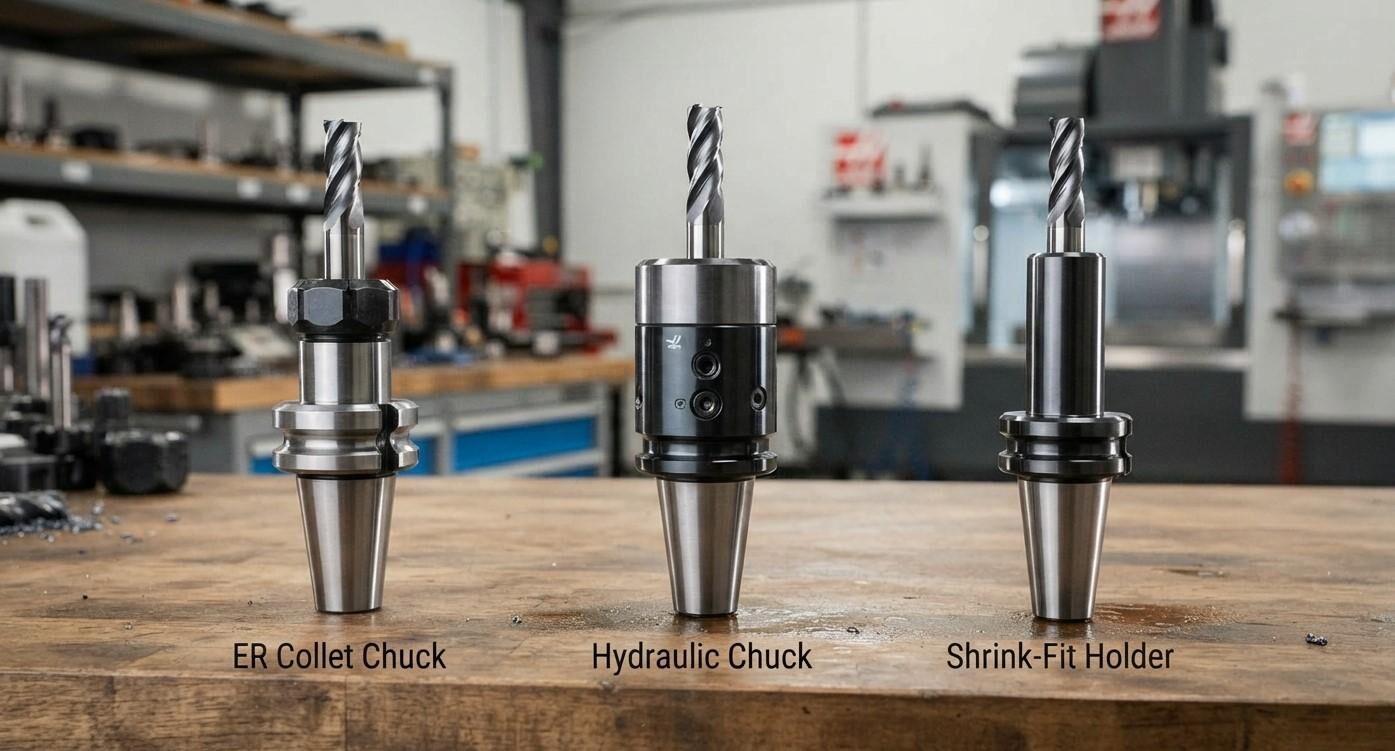
Three commonly used CNC toolholding systems are ER collet chucks, hydraulic chucks, and shrink-fit holders. Each system uses a different method to secure the cutting tool and offers specific advantages for different machining applications.
For workshops and manufacturers looking for dependable machining solutions, Khokhawala Trading LLC is an Industrial Tools Supplier in Dubai offering industrial tooling solutions for a wide range of engineering and manufacturing requirements.
This guide explains the differences between ER collet chucks, hydraulic chucks, and shrink-fit holders and helps you understand which option may be suitable for your CNC machining application.
Table of Contents
-
What Is an ER Collet Chuck?
-
What Is a Hydraulic Chuck?
-
What Is a Shrink-Fit Holder?
-
Key Differences Between the Three Systems
-
ER Collet Chucks: Advantages and Applications
-
Hydraulic Chucks: Advantages and Applications
-
Shrink-Fit Holders: Advantages and Applications
-
Comparison Table
-
How to Choose the Right Toolholder
-
Common Toolholder Selection Mistakes
-
Frequently Asked Questions
-
Conclusion and CTA
1. What Is an ER Collet Chuck?
An ER collet chuck is one of the most widely used toolholding systems in CNC machining. It uses a slotted collet that is compressed inside a tapered holder by tightening a retaining nut.
As the nut is tightened, the collet contracts around the cutting tool shank and holds it securely.
One of the biggest advantages of an ER system is flexibility. Different collets can be used in the same chuck to accommodate a range of tool shank diameters.
Advantages of ER Collet Chucks
-
Wide range of tool compatibility
-
Relatively economical
-
Easy tool changes
-
Suitable for general machining
-
Available in different ER sizes
-
Useful for milling, drilling, reaming, and other operations
Limitations
ER collet chucks have more components than shrink-fit holders, including the collet and nut. Their actual performance also depends heavily on collet quality, cleanliness, correct assembly, and tightening.
For general-purpose machining where flexibility and cost are important, ER collet chucks are often a practical choice.
2. What Is a Hydraulic Chuck?
A hydraulic chuck uses internal hydraulic pressure to clamp the cutting tool around its shank.
When the locking mechanism is tightened, pressure inside the holder causes an internal sleeve or membrane to grip the tool uniformly around its circumference.
This design provides good concentricity and vibration-damping characteristics.
Advantages of Hydraulic Chucks
-
Low runout
-
Excellent concentricity
-
Good vibration damping
-
Fast tool changes
-
Consistent clamping
-
Suitable for precision machining
-
Good surface-finish performance
Hydraulic chucks are particularly useful for finishing operations where vibration control and tool positioning are important.
Limitations
Hydraulic chucks can have higher initial costs than conventional ER systems. They may also be less suitable for certain extremely heavy cutting applications where maximum mechanical gripping force is the primary requirement.
3. What Is a Shrink-Fit Holder?
A shrink-fit holder uses thermal expansion and contraction to clamp a cutting tool.
During tool installation, the holder is heated so that its internal bore expands slightly. The cutting tool is then inserted into the bore. As the holder cools, the bore contracts around the tool shank, creating a strong and uniform grip.
Unlike an ER collet chuck, a shrink-fit holder does not require a collet and nut around the tool.
Advantages of Shrink-Fit Holders
-
High rigidity
-
Excellent concentricity
-
Slim profile
-
Strong tool clamping
-
Good balance characteristics
-
Suitable for high-speed machining
-
Excellent access to narrow and deep work areas
Limitations
The main disadvantage is the need for suitable heating equipment and a controlled tool-changing process.
Shrink-fit holders also require properly sized tool shanks and careful attention to cleanliness and heating procedures.
4. Key Differences Between the Three Systems
Although all three systems are designed to secure cutting tools, their operating principles are very different.
ER collet chucks use mechanical compression.
Hydraulic chucks use hydraulic pressure.
Shrink-fit holders use thermal expansion and contraction.
These differences affect flexibility, rigidity, vibration control, setup time, cost, and machining performance.
5. ER Collet Chucks: Advantages and Applications
ER collet systems are commonly selected when versatility is more important than achieving the absolute highest level of precision.
Best Applications
ER collet chucks are suitable for:
-
General CNC milling
-
Drilling
-
Reaming
-
Tapping with suitable configurations
-
Job-shop machining
-
Prototype production
-
General-purpose machining
-
Applications requiring frequent tool changes
Why Choose ER?
The ability to change collets makes ER systems highly flexible. A single holder can accommodate different tool shank sizes within the supported range.
For workshops that use many different cutting tool diameters, this can reduce the number of complete toolholders required.
6. Hydraulic Chucks: Advantages and Applications
Hydraulic chucks are designed for precision and stability. Their internal hydraulic mechanism provides uniform pressure around the tool shank.
Best Applications
They are commonly considered for:
-
Precision finishing
-
Reaming
-
Fine milling
-
High-accuracy machining
-
Operations sensitive to vibration
-
Surface-finish applications
-
Applications requiring repeatable tool positioning
Why Choose Hydraulic?
The hydraulic mechanism can help damp small vibrations during machining. This makes hydraulic chucks particularly attractive when surface quality and dimensional consistency are important.
They can also provide convenient tool changes without requiring a heating system.
7. Shrink-Fit Holders: Advantages and Applications
Shrink-fit holders are widely associated with high-precision and high-speed CNC machining.
Their compact design and direct gripping method provide a rigid connection between the holder and cutting tool.
Best Applications
Shrink-fit holders are especially useful for:
-
High-speed milling
-
Precision machining
-
Mold and die manufacturing
-
Aerospace component machining
-
Deep cavity machining
-
Five-axis machining
-
Finishing operations
-
Applications requiring slim tool access
Why Choose Shrink-Fit?
The slim holder profile can provide better access to restricted machining areas. The rigid connection can also help maintain tool stability during demanding machining operations.
8. Comparison Table
| Feature | ER Collet Chuck | Hydraulic Chuck | Shrink-Fit Holder |
|---|---|---|---|
| Clamping Method | Mechanical collet | Hydraulic pressure | Thermal expansion |
| Flexibility | Excellent | Good | Limited to matching shank |
| Tool Changes | Fast | Fast | Requires heating/cooling |
| Rigidity | Good | Very Good | Excellent |
| Runout Control | Good to very good | Excellent | Excellent |
| Vibration Control | Moderate | Excellent | Very Good |
| Profile | Relatively larger | Slim | Very slim |
| High-Speed Use | Good | Very Good | Excellent |
| Initial Cost | Lower | Higher | Higher |
| Equipment Required | Wrench/torque system | Wrench | Heating system |
| General Machining | Excellent | Good | Good |
| Precision Finishing | Good | Excellent | Excellent |
| Deep Cavity Access | Moderate | Good | Excellent |
Actual performance varies according to holder quality, tool shank condition, machine spindle, setup, and application.
9. How to Choose the Right Toolholder
There is no single toolholder that is best for every CNC machining operation.
Choose ER When Flexibility Matters
An ER collet chuck is often appropriate when your workshop uses many different tool diameters and needs an economical, versatile toolholding solution.
Choose Hydraulic When Vibration Control Matters
A hydraulic chuck can be a good option when precision finishing, low runout, and vibration damping are priorities.
Choose Shrink-Fit When Rigidity and Access Matter
Shrink-fit holders are particularly attractive for high-speed machining, deep cavities, five-axis work, and applications where a slim and rigid tool assembly is beneficial.
Consider the Cutting Tool
The tool diameter, shank tolerance, length, material, and cutting conditions should all be considered before selecting a holder.
Consider Tool Projection
Longer tool assemblies are generally more susceptible to deflection and vibration. Select the shortest practical toolholder and tool combination that can reach the machining feature.
Consider Machine Speed
If the CNC machine operates at high spindle speeds, holder balance and the complete tool assembly become increasingly important.
Consider Total Cost
Do not consider only the purchase price. Heating equipment, collets, maintenance, tool-change time, tool life, and machining productivity can all influence the total cost of a toolholding system.
10. Common Toolholder Selection Mistakes
Several common mistakes can reduce the performance of even high-quality toolholders.
Using the Wrong Tool Size
The holder must match the cutting tool shank correctly. Incorrect sizing can lead to poor gripping and increased runout.
Ignoring Cleanliness
Chips, dirt, oil, and other contaminants can interfere with proper tool seating and negatively affect accuracy.
Using Excessive Tool Stick-Out
Long projection increases the possibility of tool deflection and vibration. Use only the reach necessary for the application.
Selecting a Holder Only by Price
The cheapest option may not provide the best overall value. Consider accuracy, tool life, setup time, machining performance, and maintenance requirements.
Neglecting Holder Inspection
Worn collets, damaged tapers, contaminated bores, or damaged hydraulic mechanisms can affect machining performance.
11. Frequently Asked Questions
Which is better: ER collet, hydraulic, or shrink-fit?
None is universally better. ER systems are highly versatile, hydraulic chucks are excellent for precision and vibration control, while shrink-fit holders are known for rigidity, balance, and slim access.
Are shrink-fit holders more accurate than ER collet chucks?
High-quality shrink-fit systems can provide excellent concentricity and low runout. However, actual performance depends on the holder, cutting tool, machine spindle, cleanliness, and setup procedure.
Are hydraulic chucks suitable for high-speed machining?
Yes, suitable hydraulic chucks can be used for high-speed applications when their speed rating and balance specifications are appropriate for the machine and complete tool assembly.
Why are ER collet chucks so popular?
Their main advantage is versatility. Different collets allow one holder to accommodate multiple tool shank sizes, making ER systems practical for general-purpose machining.
Do shrink-fit holders require special equipment?
Yes. A dedicated heating system is normally used to expand the holder during tool insertion and removal.
Which holder is best for finishing?
Hydraulic and shrink-fit holders can both be excellent choices for finishing. Hydraulic systems are particularly attractive when vibration damping is important, while shrink-fit systems offer high rigidity and a slim profile.
Can one toolholder system be used for every machining operation?
It is possible in some workshops, but using different holders for different applications can often provide better overall performance. The best choice depends on the machining operation, tool, material, speed, accuracy requirements, and production conditions.
12. Conclusion and CTA
ER collet chucks, hydraulic chucks, and shrink-fit holders each provide distinct benefits for CNC machining.
ER collet chucks are versatile, economical, and suitable for a wide range of general machining operations. Hydraulic chucks provide excellent precision and vibration-damping characteristics, making them useful for finishing and high-accuracy applications. Shrink-fit holders offer high rigidity, excellent concentricity, and a slim profile that makes them valuable for high-speed, deep-cavity, and precision machining.
The right choice should be based on your machine, cutting tools, workpiece material, machining strategy, required accuracy, spindle speed, and production requirements.
For dependable industrial tooling solutions, Khokhawala Trading LLC can help businesses identify suitable CNC toolholding options for their applications. As an Industrial Tools Supplier in Dubai, Khokhawala Trading LLC supports workshops, manufacturers, and engineering businesses with practical tooling solutions designed around their machining needs.
Choose the right toolholding system for your application and improve CNC machining accuracy, stability, productivity, and tool performance.

 English
 Arabic
 French
 Spanish
 Portuguese
 Deutsch
 Turkish
 Dutch
Dutch
 Italiano
 Russian
 Romaian
 Portuguese (Brazil)
 Hrvatski
 Cehoslowakia