


Tank Farm Management Systems: The Digital Path to Safer Refineries
Tank Farm Management Systems: The Digital Path to Safer Refineries
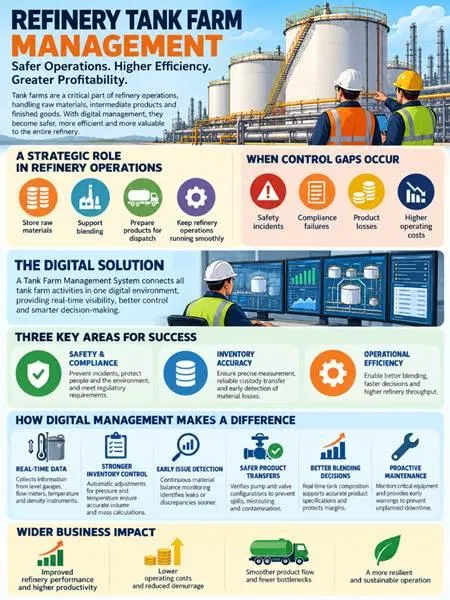
Refinery tank farms are not simply storage locations where materials wait for their next destination. They form a vital part of refinery operations, handling feedstocks, intermediate streams, and finished products throughout production. From blending to preparing products for shipment, tank farms help keep refinery activities moving. When coordinated effectively, refineries can improve production flow, protect margins, and maintain a reliable supply chain. Yet even minor weaknesses in control can escalate quickly, leading to safety incidents, compliance problems, product losses, and avoidable costs. With stricter regulations and rising expectations, upgrading tank farm management is no longer merely a future option. It is becoming a practical operating necessity.
A central element of this shift is adopting Tank Farm Management Systems (TFMS), which connect tank farm activities within a shared digital environment. Traditional methods often rely on manual inspections, isolated applications, and spreadsheet records. Such approaches can make it harder for teams to maintain a consistent view of what is happening across the refinery. A TFMS consolidates important information in one place, giving personnel real time visibility into inventory levels, product transfers, and compliance tasks. By connecting these activities, tank farms can move beyond storage and become intelligent operational assets that contribute to refinery performance.
The effectiveness of tank farm operations largely depends on three connected priorities: safety and compliance, accurate inventory control, and operational efficiency. Together, these priorities shape regulatory performance, resource management, and financial results.
Safety remains fundamental because conditions within tank farms can become hazardous very quickly when safeguards break down. Events such as overfilled tanks, leaks, or incorrect product transfers can damage the environment, disrupt production, and expose personnel to serious risks. Preventing these situations requires more than inspections and standard alarms. Digital management platforms can strengthen oversight by providing continuous monitoring, multiple layers of control, and detailed audit records. These capabilities make activities easier to track, verify, and manage.
Inventory accuracy is equally important in bulk storage environments. A measurement variance may appear insignificant, but repeated inaccuracies can create substantial financial impact. Manual entry and disconnected systems may make it difficult to account for changing density, temperature differences, and custody transfer calculations. When these issues remain unresolved, unexplained material differences or losses may continue unnoticed until they become larger operational and financial problems.
Blending and product handling efficiency also have a direct effect on refinery results. To convert lower cost inputs into higher value products, refinery teams need reliable and timely information about tank conditions, quantities, and product characteristics. Without accurate information at the right moment, decisions can be delayed or based on incomplete details. That can increase the possibility of off spec material, rework, schedule disruption, and reduced throughput.
Modern TFMS platforms help solve these challenges by continuously gathering and processing information from field devices such as flow meters, level gauges, temperature sensors, and density instruments. Rather than leaving data divided among systems, the platform combines information and turns it into practical visibility. This helps personnel recognize conditions faster, respond effectively, and make better decisions.
Another significant advantage of TFMS technology is improved inventory precision together with more straightforward custody transfer management. Automated corrections for pressure and temperature variations can improve volume and mass calculations, supporting accurate and equitable transactions. Continuous material balance monitoring can highlight unusual differences earlier, giving operators time to examine leaks, equipment faults, or product losses before serious disruptions.
Digital controls can further improve the way product transfers are managed. Before movement starts, the system can verify pump and valve configurations to confirm that the planned route is correct. This reduces the potential for spills, misrouting, and contamination. Connecting transfer controls with schedules can improve equipment utilization and reduce waiting periods.
The benefits of digital tank farm management extend beyond immediate operational control. Real time visibility into tank composition can give refinery teams better information when developing blending strategies. With a clearer understanding of what each tank contains, planners can work toward required product specifications without consuming more costly inputs than necessary. Greater visibility supports better planning and helps protect refinery margins.
These improvements can also strengthen performance across the wider facility. Better forecasts of tank availability and coordination of inbound and outbound logistics can maintain product movement and reduce bottlenecks. Better coordinated turnaround activities improve asset use and can help limit unnecessary expenses, including demurrage.
Ongoing monitoring of important equipment, including pumps, valves, and measurement instruments, also encourages a more proactive maintenance strategy. Instead of waiting for failures to happen, maintenance teams can identify early warning signs and address developing issues before they cause unexpected downtime. Simulation capabilities add preparation by allowing operators to examine operating situations, evaluate disruptions, and improve stability.
Ultimately, introducing a digital Tank Farm Management System is about more than replacing outdated technology. It signals a broader transformation in how refinery operations are organized, monitored, controlled, and improved. Manual processes and disconnected tools may no longer deliver the visibility and coordination required in modern refineries. This integrated approach also gives decision makers a clearer view, supporting faster responses when conditions change unexpectedly during critical operations. A unified TFMS can help turn complex, higher risk tank farm operations into more transparent, efficient, and value creating assets.
For refineries focused on improving safety, strengthening compliance, controlling operating expenses, and protecting long term profitability, digital tank farm management is becoming an important foundation for more resilient and sustainable operational performance.
Book a free demo @ https://toolkitx.com/blogsdetails.aspx?title=Refinery-tank-farms-management:-the-digital-imperative-for-safety-and-profit

 English
 Arabic
 French
 Portuguese
 Deutsch
 Turkish
 Dutch
Dutch
 Italiano
 Russian
 Romaian
 Portuguese (Brazil)
 Greek
Greek
 Hrvatski
 Cehoslowakia