


Identifying Hidden Workplace Hazards in Oil and Gas Operations
Identifying Hidden Workplace Hazards in Oil and Gas Operations
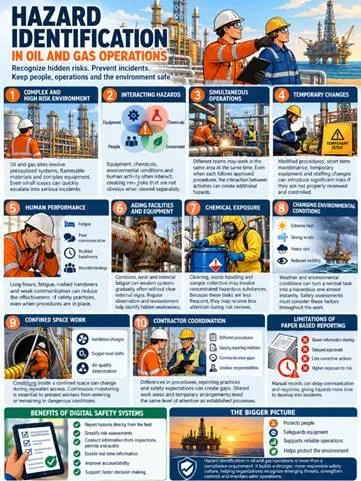
Oil and gas facilities operate in environments where safety cannot be handled as a routine checklist or viewed only as a compliance requirement. It affects dependable production, worker protection, and business continuity. Organizations may devote effort to inspections, audits, and assessments, but formal activities cannot reveal all sources of danger. Some hazards stay hidden until an incident brings them to light. Safety awareness comes from understanding how work happens and how exposure changes when circumstances change. On these sites, risk can develop rapidly as conditions evolve.
Hazard identification involves systematically recognizing anything that could cause harm, including equipment, hazardous materials, work practices, and human actions. In oil and gas environments, these hazards often connect rather than occur separately. Machinery, chemicals, weather, workplace conditions, and employee decisions can combine to create risks that are difficult to see in isolation. Strong identification therefore requires more than documenting well known hazards. It requires examining how everyday circumstances affect exposure and potential outcomes.
The nature of these worksites creates considerable risk because operations can involve pressure, flammable materials, and complex industrial systems. If warning signs are ignored or treated as insignificant, a small problem can quickly become a serious incident. Minor abnormalities may lead to injuries, environmental damage, operational disruption, or legal consequences. Thorough hazard identification gives organizations an opportunity to recognize concerns earlier and introduce preventive measures before a threat develops into an event.
Even mature safety programs can leave less obvious risks undiscovered. Simultaneous operations are a clear example. Several teams may carry out different activities in the same area simultaneously, with each team following an approved procedure. However, the interaction between those tasks may create hazards that would not appear when either activity is reviewed separately. Once work overlaps, the risk picture can change, making careful coordination essential.
Temporary changes in operations can produce similar blind spots. Modified procedures, short term maintenance, temporary equipment arrangements, and staffing changes may receive less attention because they are not permanent. Yet brief conditions can introduce vulnerabilities when their effects are not evaluated properly. Without suitable review and controls, a temporary setup may create hazards that remain unnoticed.
Human performance also plays a significant role in safety. Long hours, fatigue, hurried handovers, poor communication, and misunderstandings between workers can weaken effective safety practices. These influences may be harder to recognize than mechanical problems, but they can contribute to incidents. When communication failures and behavioral factors are not examined, weaknesses can remain within the hazard management process.
Older facilities and aging equipment create additional challenges. Corrosion, ongoing wear, and material fatigue can slowly reduce system integrity without producing obvious signs from the outside. Routine inspections may not always reveal deterioration before it becomes serious. Observation and reassessment can expose hidden weaknesses before they develop into major failures.
Chemical exposure needs attention during non routine work. Tasks such as cleaning, waste handling, and collecting samples can expose employees to concentrated hazardous substances that may not be part of normal production. Because these jobs occur less frequently, they can receive less attention during risk reviews. Consequently, occasional tasks may not have controls as thoroughly considered as those applied to familiar work.
Environmental conditions can change the risk of a task within minutes. Severe heat, storms, high winds, heavy rain, and poor visibility can transform an activity into a hazardous one. When these factors are treated as background issues instead of active contributors to risk, established controls may become less reliable. Safety evaluations need to reflect environmental conditions throughout the progress of work.
Confined space activities require attention beyond the initial authorization. Conditions within a confined area can change during repeated access, even when the space appeared acceptable at the beginning. Ventilation can fluctuate, oxygen conditions can change, and air quality can worsen over time. Such developments may not be detectable from outside the space. Ongoing monitoring helps reduce the chance of workers entering or staying in unsafe conditions.
Gaps can also emerge when contractors and company personnel work together. Differences in procedures, reporting methods, communication practices, and safety expectations may create unclear areas of responsibility. Temporary electrical setups, bypassed protective systems, or improvised connections can add risk when introduced without adequate evaluation. Shared work areas and temporary arrangements deserve the same scrutiny as established operating processes.
Paper based reporting can slow the response to identified hazards. Manual documentation may delay communication, approvals, and corrective measures. During that interval, conditions at the worksite can change, reducing the value of a response that arrives too late. Slower information flow can leave people exposed to a risk that might otherwise have been controlled sooner.
Digital safety systems provide a more connected approach to these challenges. They can enable workers to report hazards from the field, simplify risk assessments, and connect information from inspections, permits, and audits within an accessible workflow. More immediate information can improve accountability and support faster decisions as site conditions change. Earlier visibility allows organizations to address concerns before they become serious.
Ultimately, hazard identification in oil and gas operations is about more than satisfying compliance expectations. It adds an essential layer of protection for workers, equipment, operations, and the environment around them. Looking beyond obvious hazards and maintaining continuous awareness can support a stronger, more responsive overall safety culture. As workplace conditions change, this mindset helps teams recognize developing threats, reinforce controls, and keep operations safer.
Book a Free Demo @ https://toolkitx.com/blogsdetails.aspx?title=Oil-and-Gas-Hazard-Identification:-The-10-Most-Overlooked-Risks

 English
 Arabic
 French
 Spanish
 Portuguese
 Deutsch
 Turkish
 Dutch
Dutch
 Italiano
 Russian
 Romaian
 Greek
Greek
 Hrvatski
 Cehoslowakia