


Strengthening Lockout/Tagout: From Energy Isolation to Digital Control
Strengthening Lockout/Tagout: From Energy Isolation to Digital Control
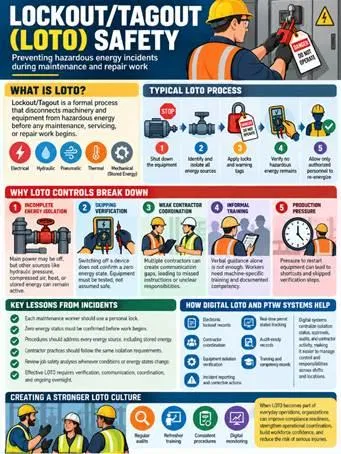
Lockout/Tagout (LOTO) is a critical workplace control designed to prevent one of the most dangerous events during maintenance: hazardous energy being released without warning. Despite established procedures, incidents linked to LOTO failures can still occur in manufacturing plants, refineries, utilities, and food processing environments.
The weakness is often not a missing procedure. More commonly, controls are poorly applied, information is overlooked, or an isolation is accepted without proving it effective. As a result, more organizations are turning to digital safety systems to improve visibility, responsibility, and control throughout the isolation process.
Understanding LOTO
Lockout/Tagout is a structured process used to disconnect machinery from hazardous energy before servicing, maintenance, or repair begins. Depending on the equipment, that energy may come from electrical systems, hydraulic pressure, compressed air, heat, or stored mechanical force.
A standard LOTO process involves stopping the equipment, identifying and isolating every energy source, applying locks and warning tags, checking that hazardous energy has been eliminated, and ensuring that re energization can only be carried out by authorized personnel. These steps help protect workers while reducing equipment damage and operational disruption.
Why LOTO Controls Break Down
Industrial incidents repeatedly reveal familiar weaknesses in LOTO practices across departments, work areas, and shifts.
1. Incomplete Energy Isolation
A team may disconnect the primary electrical supply but fail to recognize another active hazard, such as hydraulic pressure, compressed air, residual heat, or stored mechanical energy. Leaving just one source uncontrolled can result in a sudden release while maintenance work is underway.
2. Skipping Verification
Turning a switch off does not prove a zero energy state. Workers need to verify the isolation directly. Depending on labels, assumptions, or verbal confirmation instead of testing can allow hazardous energy to remain unnoticed.
3. Weak Contractor Coordination
Multiple contractors can introduce gaps in communication and responsibilities. Outside workers may overlook site specific LOTO requirements, fail to apply suitable personal locks, or misunderstand who controls isolation and re energization at the worksite.
4. Informal Training
A brief verbal explanation cannot establish competency on its own. Workers need equipment specific guidance, documented understanding, and clear instructions about locks, isolation, and authorized re energization.
5. Production Pressure
Pressure to restart equipment can encourage shortcuts. Workers may hurry through verification or assume another person has completed a required isolation step.
Key Lessons From Industrial Incidents
Repeated LOTO incidents highlight several essential practices:
- Every maintenance worker involved should apply a personal lock.
- Zero energy must be confirmed before work begins.
- Procedures need to identify all energy sources, including stored energy.
- Contractor activities should follow the same isolation expectations as site personnel.
- Job safety analyses should be reassessed whenever conditions or energy states change.
Effective LOTO is not simply paperwork. It depends on verification, communication, coordination, and oversight from task start until equipment is safely returned to service.
How Digital LOTO and PTW Systems Help
Paper based processes can make isolation conditions, approvals, audits, and contractor involvement harder to track across locations or shifts. Digital Permit to Work (PTW) and LOTO systems can place these activities in one centralized workflow, giving teams clearer visibility and control. This can make responsibilities easier to review before work starts and after isolation changes.
Digital systems can support the management of:
- Electronic lockout records
- Real time permit status
- Contractor coordination
- Audit ready documentation
- Equipment isolation verification
- Training and competency records
- Incident reporting and corrective actions
An integrated HSE system can improve communication between operations, maintenance, and safety teams while reducing administrative delays.
Creating a Stronger LOTO Culture
Preventing hazardous energy incidents requires LOTO to become part of everyday work, not a compliance activity performed only when required. Regular audits, refresher training, consistent isolation practices, and digital monitoring can help reinforce reliable safety behavior.
Structured energy isolation can strengthen compliance readiness, coordination, and worker confidence. Most importantly, stronger LOTO controls can help reduce the likelihood of severe injuries that may affect employees, operations, and business continuity.
Read More @ https://toolkitx.com/blogsdetails.aspx?title=loto-failures-real-industrial-incidents

 English
 Arabic
 Spanish
 Portuguese
 Deutsch
 Turkish
 Dutch
Dutch
 Italiano
 Russian
 Romaian
 Portuguese (Brazil)
 Greek
Greek
 Hrvatski
 Cehoslowakia