


Key HSE Officer Responsibilities for Safer Operations
Key HSE Officer Responsibilities for Safer Operations
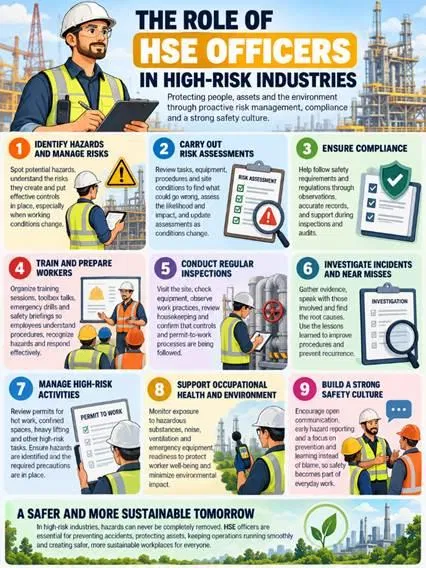
In industries where mistakes can be severe, including construction, oil and gas, utilities, and offshore work, safety has to be part of the job from the beginning, not as something checked after the work is finished. A missed hazard or weak decision may lead to injury, damaged equipment, environmental impact, or costly downtime. This is why Health, Safety, and Environment (HSE) professionals have an important place in these operations. Their responsibilities go beyond reminding people about procedures or checking compliance. They help organizations spot threats before they develop, improve workplace conditions, and safeguard employees, assets, and the environment through planning and oversight on every job.
A major HSE responsibility is recognizing hazards, evaluating related risks, and establishing effective controls. This matters when conditions shift without warning. Routine work may become dangerous when equipment, surroundings, weather, procedures, or other factors change. HSE officers help teams notice those developments early so tasks can proceed more safely and under control. By watching for changes, they can also identify situations where current precautions are no longer adequate and where stronger safeguards are needed before work begins, whenever conditions shift or new risks appear, and throughout the task to keep controls effective.
Risk assessment is a core part of the role. HSE professionals examine activities, equipment, procedures, and workplace conditions to find circumstances that could lead to harm. They then assess the likelihood of an incident and the severity of its outcome. Risks may involve machinery, chemicals, work at height, restricted spaces, or complex industrial operations. Because conditions and activities change, assessments also need regular review. The findings help determine suitable precautions, controls, and working methods as the basis for practical safety decisions and effective control measures.
Another responsibility is supporting compliance with safety requirements and regulations. High risk workplaces function within strict expectations designed to protect workers and maintain controlled operations. HSE officers help uphold those expectations by observing activities, maintaining accurate records, and supporting inspections and audits. Compliance is about more than avoiding penalties. Clear requirements create consistency, reduce uncertainty, and provide a reliable structure for safer work. When employees understand expectations and see them applied consistently, they are better positioned to make sound choices across activities, workplace expectations, documentation, and site practices.
Training is also a major part of effective HSE management. A procedure offers little protection when workers do not know how or when to use it. HSE officers therefore coordinate training, toolbox discussions, emergency exercises, and safety briefings to keep employees prepared. These activities strengthen hazard awareness, reduce unsafe behavior, and improve responses when unexpected events arise and reinforce readiness for change.
Regular workplace inspections provide another way to control risk. On site, HSE officers can observe how tasks are performed and identify weaknesses before they become serious. They examine equipment, watch work practices, assess housekeeping, and verify that existing controls are being followed as intended. They can also check permit to work arrangements, access points, and overall workplace organization as part of routine workplace oversight, verification, and control, and confirm expectations are being applied in practice. Their presence reinforces that safety belongs in daily operations, not only formal reviews.
When an incident or near miss occurs, HSE officers are central to the investigation. They collect evidence, speak with those involved, and reconstruct events to identify what went wrong and why. The purpose is not simply to assign blame. It is to understand the failure and reduce the chance of repetition. Investigation findings can guide changes to procedures, controls, and future safety practices and use those lessons to strengthen prevention.
Some jobs demand extra protection because they carry greater risk. Hot work, confined space activities, and heavy lifting are commonly managed through permit to work systems. Before work begins, HSE officers review permits to confirm hazards are identified and necessary precautions are ready. Measures can include equipment isolation, atmospheric monitoring, emergency planning, and clear communication arrangements. By creating this deliberate check before work starts, the process adds another protective barrier around high risk activities before potentially dangerous work is approved and before workers begin the task.
The role also covers occupational health concerns and environmental conditions. HSE professionals may monitor issues involving hazardous substance exposure, workplace noise, ventilation, and the readiness of emergency equipment. Attention to these areas helps protect workers’ well being while reducing the potential for harmful effects on the environment and nearby communities and nearby areas.
An HSE officer’s impact is not limited to enforcing written rules. They also help create a culture where people feel comfortable raising concerns, reporting hazards early, and prioritizing prevention and learning over blame. When safety becomes part of everyday decisions, employees are more likely to recognize their responsibility for a safer workplace through open communication, prevention, and accountability.
Where hazards cannot be removed entirely, HSE officers remain vital to responsible operations. Their efforts help prevent accidents, protect equipment and assets, and support smoother work. With suitable systems, resources, and organizational support, they can focus on one central objective: recognizing problems early, preventing incidents, and helping create workplaces that are safer and more sustainable while supporting dependable operations, strong safety performance, and sustainable working conditions over time for everyone.
Book a free demo @ https://toolkitx.com/blogsdetails.aspx?title=Key-responsibilities-of-an-HSE-officer-in-high-risk-industries:-what-every-safety-leader-must-know

 English
 Arabic
 French
 Spanish
 Portuguese
 Deutsch
 Turkish
 Dutch
Dutch
 Italiano
 Russian
 Romaian
 Portuguese (Brazil)
 Greek
Greek
 Cehoslowakia