


How HSE Management Systems Strengthen Workplace Safety and Performance
How HSE Management Systems Strengthen Workplace Safety and Performance
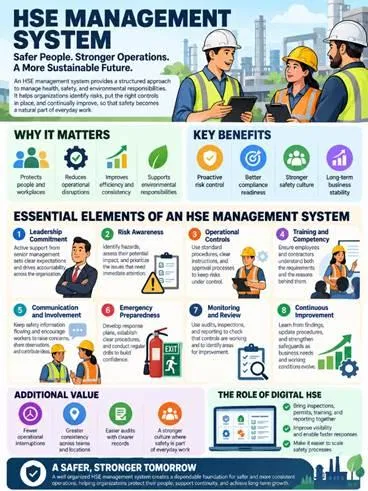
Workplaces are constantly changing. Teams grow or shrink, operations spread across different locations, and responsibilities shift as business priorities develop. At the same time, organizations are under pressure to move quickly while maintaining efficiency and consistency. In this environment, health, safety, and environmental (HSE) responsibilities cannot be treated as secondary concerns. They require the same attention as productivity and business performance. Organizations that make HSE part of their long term strategy instead of reacting only when problems appear are in a stronger position to protect people, avoid disruption, and maintain stable operations.
A structured HSE management system gives businesses a framework for putting this approach into action. It establishes a consistent method for identifying workplace hazards, applying safeguards, and reviewing performance over time. Rather than placing emphasis on correcting problems after an incident, the system encourages prevention, awareness, and ongoing improvement. When safety activities are built into ordinary workflows, employees are more likely to treat them as part of the job rather than requirements that matter only after something has gone wrong.
At its core, an HSE management system brings workplace safety, employee well being, and environmental duties together within one structure. Instead of relying on separate procedures, scattered records, and disconnected activities, organizations can align policies, responsibilities, workflows, and information. This improves coordination across HSE work and lowers the risk of important processes being managed in isolation without shared direction.
Regular evaluation is another strength. Organizations can review how tasks are being carried out, recognize hazards that are changing, and determine whether existing controls are still providing expected protection. Repeating these reviews helps shift the organization away from reacting to incidents and toward recognizing and controlling risks before they become incidents.
Several areas determine how well an HSE management system functions.
Leadership commitment is among the most important. When senior leaders support safety initiatives and remain actively involved, employees receive a clear message that HSE is a clear organizational priority. Defined responsibilities, visible accountability, and consistent management participation strengthen that message across the workplace. Without leadership commitment, even a well designed system can slowly turn into a paperwork task instead of something that influences everyday behavior.
Risk awareness provides another essential foundation. Organizations need a reliable process for identifying hazards, understanding their possible outcomes, and deciding which concerns require attention. Formal risk assessments create that structure by highlighting potential threats, considering their likely severity, and helping guide decisions about appropriate controls.
Understanding risks is only the beginning. Those risks must also be managed through practical operational controls. Standard procedures, straightforward work instructions, and clear approval steps for higher risk work help turn safety expectations into consistent action. Applying these controls reliably is especially important where a seemingly minor error may lead to serious consequences.
Training and competency are equally important. Employees and contractors need to understand not only what procedures say, but also why those requirements exist. Ongoing learning helps workers remain capable and prepared as workplace expectations, technologies, and responsibilities develop over time.
Communication and employee participation are just as significant. Safety conversations, regular safety meetings, and easy to use reporting methods keep information moving. When workers are encouraged to raise concerns, share observations, and suggest improvements, safety becomes a shared responsibility rather than something simply passed down as an instruction from management.
Emergency preparedness is another essential part of HSE management. Clear response plans, established procedures, and regular drills give teams greater confidence when unexpected situations arise. Preparation can reduce confusion, minimize delays, and help contain the effects of an incident.
An effective system also needs consistent measurement and review. Audits, inspections, and reporting activities show whether controls work as intended and reveal where changes are needed. Without regular oversight, weaknesses can remain unnoticed until they contribute to a more significant operational problem.
Continuous improvement brings the different parts of the system together. Lessons from inspections, near misses, audits, and incidents can be used to revise procedures and reinforce existing safeguards. As organizations grow and workplace conditions change, their HSE practices must change with them. This allows the system to remain aligned with current operational and business requirements while remaining effective.
A mature HSE management system can create value beyond meeting compliance expectations. It can help reduce interruptions, improve consistency across teams and locations, and make audits more manageable through clearer records and stronger accountability. Most importantly, it helps establish a workplace culture where safety is practiced throughout the day rather than remaining limited to written policies and formal documents.
As organizations move away from manual activities and disconnected processes, digital HSE platforms can add further value. Combining inspections, permits, training, reporting, and related safety activities within one integrated environment can increase visibility, enable faster responses, and make safety processes easier to scale without creating unnecessary complexity.
Ultimately, an organized HSE management system provides a reliable foundation for safer, more consistent operations. When safety is incorporated directly into everyday work, organizations can better protect their people, support continuity, and create conditions that contribute to lasting business performance and growth.
Book a free demo @ https://toolkitx.com/blogsdetails.aspx?title=HSE-management-system-explained:-elements,-benefits,-examples-and-how-to-implement-it-right

 English
 Arabic
 French
 Spanish
 Portuguese
 Turkish
 Dutch
Dutch
 Italiano
 Russian
 Romaian
 Portuguese (Brazil)
 Greek
Greek
 Hrvatski
 Cehoslowakia