


HSE Challenges That Can Impact Safety, Productivity, and Business Performance
HSE Challenges That Can Impact Safety, Productivity, and Business Performance
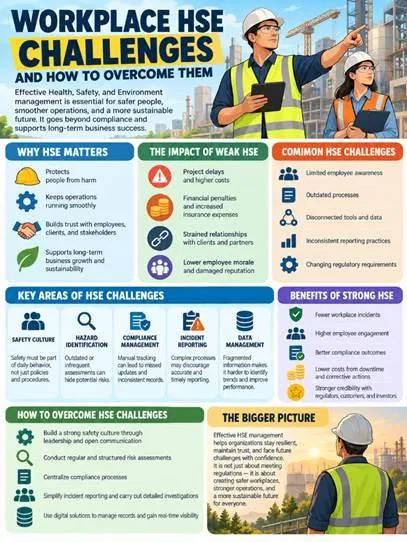
Today's organizations face constant pressure to deliver results while responding to operational demands and shifting industry expectations. As workplaces grow more complex and exposure to potential hazards rises, Health, Safety, and Environment (HSE) management can no longer be treated as a narrow compliance task. It now influences business performance, operational continuity, and sustainability. Safety and environmental responsibility therefore need to be woven into everyday planning and decision making rather than handled separately.
In construction, manufacturing, energy, and large industrial projects, HSE practices have a direct effect on both worker protection and operational efficiency. A strong safety approach aims to do more than prevent accidents. It supports steady operations, reduces interruptions, and builds confidence among employees, contractors, customers, and other stakeholders. When safety controls become part of normal workflows, organizations are better positioned to protect productivity and respond to unexpected events. Weak, inconsistent, or neglected controls can allow small weaknesses to grow into serious operational risks.
The impact of ineffective HSE management can extend well beyond the event that first exposes the problem. Safety failures can disrupt schedules, increase operating expenses, and create added financial burdens through penalties and increased insurance costs. They may also damage working relationships with clients, contractors, and business partners. Internally, poor safety practices can affect employee morale, weaken trust in leadership, and create uncertainty across the workplace. Once credibility has been damaged, restoring a positive reputation may require considerable time, effort, and resources.
Better HSE performance starts with understanding the barriers that stand in the way of effective safety management. Organizations may deal with low employee awareness, aging procedures, disconnected systems, uneven reporting habits, or difficulties created by changing regulatory expectations. Such obstacles can hide operational hazards and reduce the effectiveness of existing safeguards.
These challenges become especially important during routine work. They shape how hazards are spotted, how incidents are reviewed, and how information from earlier events is converted into preventive action. More importantly, they affect the real safety experience of workers rather than the compliance level shown in an inspection or audit. Addressing these issues should therefore go beyond meeting regulatory expectations. The objective should be to build an environment in which safety actively supports reliable, efficient, and high-quality operations.
Organizations that consistently prioritize strong HSE practices can benefit across multiple areas. Reduced incidents, stronger employee involvement, better compliance, and fewer costs linked to downtime and corrective work are potential gains. Consistent safety performance can also improve confidence among regulators, customers, investors, and other stakeholders.
Putting HSE improvements off can create avoidable operational consequences. Workplace incidents can lead to investigations, interrupt ongoing work, generate financial losses, and affect organizational reputation. The consequences may continue after the immediate problem has been addressed. Repeated issues can limit future opportunities and create additional difficulty for businesses trying to protect their position and competitiveness in the market.
One of the most persistent HSE challenges is developing a strong safety culture. Safety cannot depend only on policies, manuals, and procedures. It must appear in everyday decisions, actions, and attitudes across the workforce. When employees see safety as less important than productivity or assume that responsibility belongs only to management, the potential for incidents can increase. Leadership plays a central role in shaping culture. Regular communication, visible commitment, and a workplace where concerns can be raised easily can strengthen accountability and participation.
Another challenge involves identifying hazards and managing risk effectively. Threats may remain unnoticed when assessments are outdated, incomplete, or performed too rarely. Frequent and structured evaluations linked closely to actual work activities can help organizations detect dangers earlier and take corrective measures before those risks contribute to an incident.
Managing compliance can become increasingly difficult for organizations with multiple projects or operating locations. Manual methods may result in missed changes, inconsistent records, and limited visibility into requirements. A centralized approach can strengthen accountability, keep documentation organized, and simplify audit preparation.
Incident reporting presents another common obstacle. Complicated reporting methods and unclear expectations can discourage employees from recording issues promptly or accurately. Simpler reporting workflows, combined with thorough investigations, can improve the quality of information collected, uncover underlying causes, and reduce the likelihood of similar incidents happening again.
Safety records can also become difficult to manage when information is scattered across different systems, files, and formats. In such conditions, keeping data complete and consistent is harder. Without a unified view, organizations may have difficulty spotting trends, tracking results, and making sustained improvements. Digital record management can help overcome these limitations by improving access to information, promoting consistency, and enabling more informed decisions.
To manage these ongoing issues, many organizations are turning to digital HSE solutions. Modern platforms can bring greater organization, visibility, and efficiency to safety management activities. Moving away from manual methods toward connected cloud based systems can streamline workflows, improve compliance oversight, and offer real time visibility into performance. It can also help organizations shift from reacting after incidents to recognizing and controlling risks earlier.
In a demanding business environment, effective HSE management is now a fundamental element of responsible operations. Organizations that combine engaged leadership, reliable processes, and modern technology can create safer workplaces while strengthening operational performance. The benefits extend beyond compliance, supporting resilience, reinforcing trust, and helping businesses face future challenges with greater confidence.
Book a free demo @ https://toolkitx.com/blogsdetails.aspx?title=Common-HSE-Challenges-in-the-Workplace-And-How-Modern-Organizations-Overcome-Them

 English
 Arabic
 French
 Spanish
 Portuguese
 Deutsch
 Turkish
 Dutch
Dutch
 Italiano
 Russian
 Romaian
 Portuguese (Brazil)
 Greek
Greek
 Cehoslowakia