


How Chemical Work Permits Improve Safety in Hazardous Work
How Chemical Work Permits Improve Safety in Hazardous Work
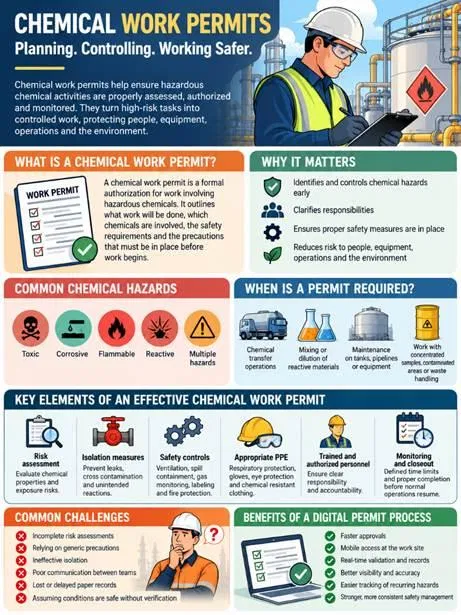
In industrial workplaces that regularly handle hazardous chemicals, a small mistake can rapidly turn into a serious event. Chemical plants, refineries, and similar facilities need tight controls because unsafe handling can expose people and operations to significant danger. A poor decision, skipped step, or overlooked precaution can result in toxic exposure, fire, environmental contamination, equipment damage, or costly operational delays. General safety instructions alone may not address the exact risks of every chemical task. These activities need advance planning, active supervision, and controlled execution. Chemical work permits provide that structure by making hazardous tasks subject to assessment, authorization, monitoring, and formal completion.
A chemical work permit is a formal authorization for carrying out work involving hazardous chemicals. It goes beyond broad workplace rules by focusing on the particular risks created by the planned job. The permit records what needs to be done, identifies the chemicals involved, and states the relevant safety requirements and procedures. It also defines precautions that must be established before work begins, including equipment isolation, lockout arrangements, environmental protection, monitoring, and approval from qualified personnel. As part of a wider Permit to Work system, it creates a clear barrier against starting hazardous work before the necessary safeguards have been reviewed and accepted.
The importance of this process is clear because chemical hazards can be serious in several different forms. Materials used in industrial operations may be toxic, corrosive, flammable, reactive, or capable of presenting multiple hazards simultaneously. Some substances can release harmful gases, cause severe burns, ignite rapidly, or react unexpectedly when conditions change. Without a formal permit process, hazards may remain unidentified, controls may be inadequate, and workers may approach the job without sufficient preparation. Responsibility for individual safeguards can also become unclear, while compliance with established procedures may weaken. A properly managed permit process helps close these gaps by recognizing hazards early, assigning duties, verifying controls, and planning for possible emergencies. This strengthens protection for workers, equipment, operations, and the surrounding environment.
Formal permit control is not necessary for every routine chemical activity. It becomes particularly important when the level of risk goes beyond ordinary handling. Chemical transfer, mixing or dilution of reactive substances, and maintenance work on tanks, pipelines, or processing equipment may require controlled authorization. Tasks involving concentrated samples, contaminated areas, or chemical waste treatment and neutralization can also demand closer supervision. Whenever a job creates potential exposure to inhalation hazards, splashes, unexpected reactions, or releases into the environment, permit based control should be considered.
An effective chemical work permit should function as a working safety control, not merely as paperwork. The process starts with a thorough hazard and risk assessment that considers the chemicals, workplace conditions, and possible exposure scenarios. Required isolation measures are then established to limit leaks, cross contamination, and unintended reactions. The permit should specify the engineering and administrative safeguards needed for the job, such as ventilation, spill containment, gas detection, correct labeling, and fire protection. PPE is selected to match the identified hazards, including appropriate respiratory protection, gloves, eye protection, and chemical resistant clothing. Permit issuers and supervisors should be trained and authorized so responsibilities remain clear. Continuous monitoring, defined permit durations, and proper closeout help confirm that safeguards remain effective until the work is complete and normal operations can resume safely.
A permit system, however, cannot prevent incidents when its requirements are ignored or poorly implemented. Problems may arise from incomplete risk assessments, generic precautions, weak isolation, or assumptions that conditions are safe without checking them. Breakdowns in communication between departments or work teams can further increase the possibility of mistakes. Paper based processes may add practical difficulties because documents can be misplaced, approvals may take longer, and records can be difficult to locate or review when necessary.
Digital permit systems can reduce many of these weaknesses by improving speed, visibility, consistency, and accuracy throughout the workflow. Automated approval steps, mobile access, real time checks, and electronic records can help teams keep permits updated and confirm that required safety actions have been completed at the job site. Digital systems can also make it easier to identify recurring patterns, recognize repeated hazards, and strengthen preventive safety practices.
Ultimately, a chemical work permit is much more than an administrative requirement. It creates a structured process for preparing hazardous work, identifying risks, confirming authorization, establishing controls, and maintaining oversight. When applied correctly, it helps chemical activities proceed in a planned and controlled way while supporting worker safety, operational continuity, and environmental protection. Digital permit solutions can reinforce that process by improving visibility, consistency, coordination, and recordkeeping across hazardous operations. By keeping critical information visible and responsibilities clearly defined, the process can make hazardous chemical work easier to coordinate, easier to verify, and less dependent on assumptions during preparation, execution, supervision, and final return to normal operations and documented closeout.
Book a free demo @ https://toolkitx.com/blogsdetails.aspx?title=Chemical-work-permit-%E2%80%93-definition,-requirements-and-best-practices

 English
 Arabic
 French
 Portuguese
 Deutsch
 Turkish
 Dutch
Dutch
 Italiano
 Russian
 Romaian
 Portuguese (Brazil)
 Greek
Greek
 Hrvatski
 Cehoslowakia