RWA Tokenization Platform Development Cost in 2027: What Could Influence the Budget Beyond Smart Contract Development?
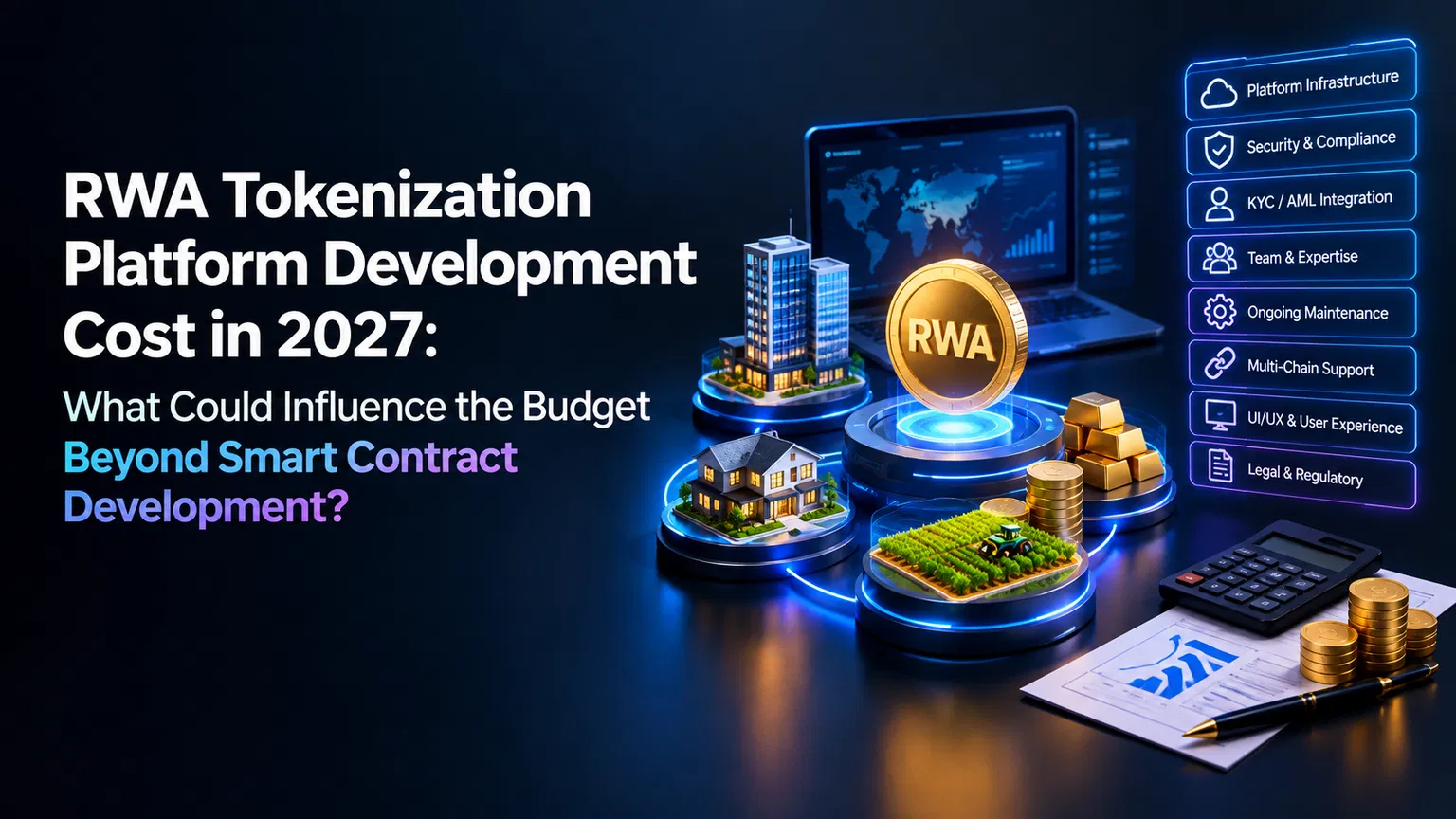
Real-world asset tokenization is moving from an experimental blockchain use case toward a broader financial infrastructure model. Real estate, private credit, commodities, funds, artwork, infrastructure projects, and other assets can be represented through blockchain-based tokens. As businesses consider launching these platforms in 2027, development cost is becoming an important planning factor.
Many businesses initially associate RWA tokenization platform development cost with smart contract creation. Smart contracts are certainly an important part of the system, but they represent only one portion of the overall budget. Investor onboarding, asset verification, compliance systems, custody, wallet infrastructure, trading functions, data services, security audits, administrative tools, and post-launch maintenance can all affect the final expenditure.
For a business working with an RWA tokenization development company, understanding these cost factors before development begins can make budgeting more practical. The final amount can differ considerably depending on the asset class, jurisdiction, platform functions, blockchain network, compliance requirements, user volume, and integration requirements.
What Is RWA Tokenization Platform Development?
RWA tokenization refers to representing ownership, economic rights, claims, or interests connected to physical or financial assets through blockchain tokens. Depending on the legal structure, a token may represent a direct ownership interest, a beneficial interest, debt exposure, revenue rights, or another contractual claim.
RWA tokenization development involves creating the technical infrastructure needed to issue, manage, distribute, transfer, and monitor these asset-linked tokens. A typical platform can include an issuer dashboard, investor portal, wallet connection, token contracts, compliance modules, asset records, payment functions, transaction monitoring, reporting tools, and administrative controls.
The development budget therefore depends on much more than writing token contracts. A simple token issuance portal may require a modest development scope, while a full investment platform serving institutions and retail users can involve several interconnected systems.
Why Smart Contract Development Is Only One Cost Component
Smart contracts control many blockchain-based functions, including token issuance, transfers, supply restrictions, investor permissions, distributions, and corporate actions. Their complexity depends on the asset model and regulatory requirements.
For example, a basic fungible token can have a relatively simple contract structure. A regulated property token may require investor restrictions, transfer permissions, wallet whitelisting, holding limits, distribution logic, redemption rules, and administrative controls.
Security testing can add another cost layer. Contract reviews, automated testing, manual code review, penetration testing, and independent security audits may all be considered before launch.
However, a platform cannot operate through contracts alone. The surrounding software, legal processes, financial connections, user management, and data infrastructure can represent a considerable part of the project budget.
1. Asset Type Can Influence the Development Budget
The type of asset being tokenized is one of the first factors that can affect cost.
Real estate tokenization may require property documentation, ownership records, valuation information, rental income calculations, investor restrictions, and distribution mechanisms. Private credit may require loan schedules, repayment tracking, interest calculations, borrower information, and payment records.
Commodity tokenization can introduce custody records, inventory information, physical verification, and storage-related data. Funds may require subscription processes, NAV calculations, investor eligibility checks, redemption procedures, and periodic reporting.
Therefore, two businesses may request RWA tokenization development while having completely different technical requirements. An RWA tokenization company usually needs to evaluate the asset model before estimating the complete development budget.
2. Legal and Compliance Requirements
Legal and regulatory requirements can have a major effect on the overall project cost. Tokenized assets may fall under different regulatory categories depending on the asset, investor type, country, ownership structure, and distribution model.
A platform may require identity verification, KYC procedures, AML monitoring, sanctions screening, investor classification, transaction restrictions, jurisdiction controls, and record keeping.
The technical system may also need rules that prevent transfers between unauthorized wallets or investors who do not satisfy certain conditions. These requirements can increase both development and testing work.
A business operating across several jurisdictions may face additional requirements because investor eligibility, securities regulations, tax reporting, and transfer rules can differ between countries.
3. Investor Onboarding Infrastructure
Investor onboarding is another area that can influence the budget beyond smart contract development.
A complete platform may include account registration, email verification, identity checks, document submission, KYC review, accreditation or investor classification, wallet registration, payment verification, and approval workflows.
Third-party identity providers may also charge based on verification volume. Therefore, businesses need to consider both integration costs and ongoing service charges.
For an RWA tokenization platform development company, investor onboarding often becomes an important part of the project specification because the token system needs to work alongside identity and compliance systems.
4. Asset Verification and Data Management
A token represents rights connected to an underlying asset, so the platform may need systems for storing and managing asset-related information.
For real estate, this can include property documents, ownership information, valuation reports, rental records, photographs, legal documents, and transaction history. For private debt, it can involve borrower information, loan agreements, repayment schedules, collateral records, and payment status.
Some platforms may use external data providers or oracle services to bring selected information onto the blockchain. The number and type of external data connections can influence development and maintenance costs.
Data storage also matters. A platform handling thousands of asset documents can require a different infrastructure arrangement compared with a small proof-of-concept platform.
5. Wallet and Custody Infrastructure
RWA platforms need a way for users to hold and manage tokens. Businesses can support external wallets, platform-managed wallets, institutional custody solutions, or a combination of these options.
External wallet integration can reduce certain development requirements, while a platform-managed wallet system may require additional security measures, transaction management, recovery processes, and monitoring.
Institutional users may also expect custody integrations and permission controls. These requirements can increase development work because wallet operations need to connect with investor accounts, compliance rules, and token contracts.
6. Payment and Fiat Integration
Tokenization platforms often need payment functionality so investors can purchase tokens and receive proceeds. Depending on the business model, this could involve bank transfers, payment gateways, stablecoins, or other settlement methods.
Fiat payment integration may require payment provider connections, transaction verification, reconciliation systems, refund handling, and compliance checks.
If the platform supports multiple currencies or payment channels, additional development and testing may be required. Businesses should therefore include payment infrastructure when calculating the total RWA tokenization development budget.
7. Trading and Secondary Market Features
Issuing tokens is different from providing a marketplace where users can trade them.
A basic issuance platform may allow investors to purchase tokens during an offering. A broader platform may include order management, secondary transfers, investor matching, pricing information, transaction history, settlement processes, and trading restrictions.
Tokenized securities can also require transfer controls based on investor eligibility and jurisdiction. These rules can make the marketplace architecture more complex.
Businesses planning a secondary market should therefore treat marketplace functionality as a separate budget category rather than assuming it will be covered within smart contract development.
8. Blockchain Network Selection
The selected blockchain network can influence development requirements and operating expenses.
Factors include transaction fees, transaction speed, ecosystem support, wallet compatibility, developer resources, security considerations, and available infrastructure.
Some platforms may use a public blockchain, while others may consider permissioned networks or application-specific blockchain environments.
Multi-chain support can add another layer of work. Developers may need to manage contracts, wallet interactions, token standards, transaction monitoring, and testing across multiple networks.
For this reason, businesses should decide whether they need one blockchain or several before requesting an RWA token development estimate.
9. Administrative and Issuer Dashboards
A professional tokenization platform generally requires more than an investor-facing interface. Issuers and administrators need their own management systems.
An issuer dashboard can provide tools for creating asset records, managing offerings, reviewing investors, monitoring token supply, checking transactions, distributing income, managing documents, and producing reports.
Administrators may also need permission management, audit logs, user controls, compliance reviews, asset status management, and system monitoring.
The number of dashboard functions and user roles can influence development time and overall project expenditure.
10. Security Testing and Audits
Security is particularly important for platforms that manage investor accounts, financial transactions, asset records, and blockchain assets.
The development budget may include application security testing, API testing, wallet security checks, smart contract audits, database protection, access-control testing, and infrastructure reviews.
A platform intended for institutional use may require several rounds of testing before launch. External security audits can also create additional costs depending on the number and complexity of contracts.
Security expenses should therefore be considered during initial planning rather than added at the final stage.
11. Third-Party Integrations
An RWA platform may depend on several external services. These can include KYC providers, AML screening services, custody providers, payment gateways, blockchain analytics platforms, oracle networks, document storage systems, accounting tools, tax services, and notification systems.
Each integration can require API development, testing, monitoring, error handling, and maintenance.
Third-party service fees can also continue after launch. As transaction volume increases, usage-based pricing from external providers can become an ongoing operating expense.
12. User Interface and User Experience
The user interface can also affect development cost. A platform serving professional investors may require portfolio views, transaction histories, asset information, document access, distribution records, and reporting features.
Institutional platforms may require different screens and workflows for fund managers, asset issuers, compliance teams, administrators, and investors.
Mobile applications can add another development category. If a business wants web and mobile applications, additional design, testing, wallet integration, notifications, and maintenance may be required.
13. Reporting and Analytics
Reporting requirements can become increasingly important as tokenized asset activity grows.
Investors may need portfolio statements, transaction histories, income records, token balances, and distribution information. Issuers may require asset performance reports, investor reports, compliance records, and transaction summaries.
Advanced reporting can involve blockchain data indexing, analytics dashboards, downloadable statements, scheduled reports, and connections with accounting systems.
These functions may not be part of the initial smart contract scope but can have a noticeable effect on the overall platform budget.
14. Maintenance After Launch
Development cost does not end when the platform goes live. Blockchain networks change, third-party APIs receive updates, security requirements evolve, and users may request additional functions.
Post-launch work can include bug fixes, security monitoring, contract updates where legally and technically appropriate, infrastructure management, API maintenance, database management, analytics, and feature additions.
A business should therefore separate initial development expenditure from recurring operating costs when preparing its 2027 budget.
How Businesses Can Estimate RWA Tokenization Platform Cost in 2027
A practical estimation method is to divide the project into separate categories instead of asking only for a single development price.
The first category can cover token contracts and blockchain infrastructure. The second can cover the investor application and issuer dashboard. The third can include KYC, AML, custody, payments, and external integrations. The fourth can cover marketplace functions, reporting, analytics, security testing, and post-launch maintenance.
Businesses can then identify which functions are required for the first release and which can be introduced later.
A basic platform may focus on asset onboarding, token issuance, investor verification, wallet management, and administrative functions. A larger platform may add secondary trading, multi-chain support, institutional custody, automated distributions, analytics, and several compliance integrations.
This approach can help an RWA tokenization development company prepare an estimate based on actual requirements rather than using a generic price.
Possible RWA Tokenization Development Cost Structure for 2027
The exact cost of RWA tokenization platform development in 2027 will depend on project scope, location of the development team, technology choices, integrations, regulatory requirements, and post-launch support.
A basic platform with token issuance, wallet connectivity, a simple investor interface, and administrative functions can require a smaller budget. A mid-level platform with KYC, AML, payment integration, asset management, investor dashboards, reporting, and enhanced security can require a considerably larger budget.
An enterprise-grade platform may involve multi-chain infrastructure, institutional custody, secondary markets, complex compliance controls, extensive reporting, external data services, and several administrative roles. Such a project can require a significantly higher investment.
Instead of treating these figures as fixed market prices, businesses should use them as planning categories and request a detailed project estimate after defining their asset class, target users, jurisdiction, platform functions, and integration requirements.
How to Reduce Unnecessary Development Expenses
Businesses can control early expenditure by defining the first release carefully. Instead of adding every possible function, the first version can focus on the functions required for the selected asset and investor group.
A modular development approach can also allow additional marketplace, analytics, payment, and reporting functions to be introduced in later phases.
Choosing suitable third-party services can reduce the amount of infrastructure that needs to be developed internally. However, businesses should compare integration charges, data handling, service reliability, and regulatory requirements before selecting providers.
Security testing should remain part of the initial plan because postponing important security work can create additional technical and operational costs later.
What Should Businesses Ask Before Hiring an RWA Tokenization Company?
Before selecting an RWA tokenization company, businesses can ask how the development team handles smart contracts, compliance integrations, wallet infrastructure, asset management, security audits, payment systems, and post-launch maintenance.
They can also request a detailed project scope showing which functions are included and which services are charged separately.
Previous experience with the relevant asset class can also be useful. Real estate, private credit, commodities, and funds can require different workflows, so experience with a similar platform can help the development process.
Businesses should also clarify ownership of source code, deployment responsibilities, third-party service charges, audit arrangements, maintenance terms, and future feature development before beginning the project.
Conclusion
RWA tokenization platform development cost in 2027 will depend on a combination of blockchain infrastructure, smart contracts, asset type, compliance requirements, investor onboarding, payment systems, wallets, custody, data services, security audits, reporting, marketplace functions, third-party integrations, and ongoing maintenance. Smart contract development is only one part of the overall budget, while the wider platform architecture can account for a substantial portion of the project investment. Businesses planning RWA tokenization should define their asset model, target investors, jurisdictions, compliance requirements, technical functions, and future expansion plans before requesting a final estimate. With a structured scope, an RWA token development project can be planned around actual business requirements instead of a generic development price. Blockchain App Factory provides RWA tokenization development services.
FAQs
1. What affects RWA tokenization platform development cost in 2027?
The cost can be influenced by asset type, smart contract complexity, compliance requirements, investor onboarding, wallet infrastructure, payment integration, blockchain selection, security testing, reporting, marketplace functions, and third-party services.
2. Is smart contract development the largest part of RWA platform cost?
Not necessarily. Smart contracts are an important component, but investor applications, compliance systems, asset management, payments, custody, security, dashboards, reporting, and integrations can also represent substantial development work.
3. How much does RWA tokenization development cost?
There is no single fixed price because project requirements differ. A basic issuance platform will have different requirements from an enterprise platform with compliance systems, secondary trading, multi-chain support, custody, analytics, and institutional features.
4. Does the asset type affect RWA tokenization cost?
Yes. Real estate, private credit, commodities, funds, and other assets can require different data structures, investor workflows, compliance rules, distribution models, and reporting systems.
5. Does regulatory compliance increase development expenses?
It can. KYC, AML screening, investor classification, jurisdiction restrictions, transaction monitoring, document management, and transfer controls can require additional software, integrations, testing, and service subscriptions.
6. Can an RWA tokenization platform support multiple blockchains?
Yes. A platform can be designed for multiple blockchain networks, but this may increase development and testing requirements because contracts, wallet interactions, transaction monitoring, and network-specific functions may need additional work.
7. What features can be included in RWA tokenization platform development?
Common functions include asset onboarding, token issuance, investor onboarding, KYC and AML integration, wallet management, token transfers, payment processing, issuer dashboards, investor portfolios, reporting, analytics, compliance controls, and administrative tools.
8. Does post-launch maintenance affect the total RWA tokenization budget?
Yes. Businesses may need ongoing infrastructure management, security monitoring, API updates, bug fixes, blockchain support, third-party service management, and future feature additions after launch.
9. Can businesses start with an MVP for RWA tokenization?
Yes. An MVP can focus on a specific asset type, investor group, blockchain network, and limited set of functions. Additional features can be added after the initial platform has been tested with real users and business workflows.
10. What should I consider before selecting a real-world asset tokenization company?
Consider the company's experience with tokenization platforms, smart contracts, compliance integrations, wallets, payments, asset management, security testing, and post-launch support. It is also useful to review the proposed technical scope, development stages, third-party costs, audit requirements, and maintenance terms before starting.

 English
 Arabic
 French
 Spanish
 Portuguese
 Deutsch
 Turkish
 Dutch
Dutch
 Italiano
 Russian
 Romaian
 Portuguese (Brazil)
 Greek
Greek
 Cehoslowakia