
Can Milk Thistle Liver Detox Supplement Be Taken Daily?
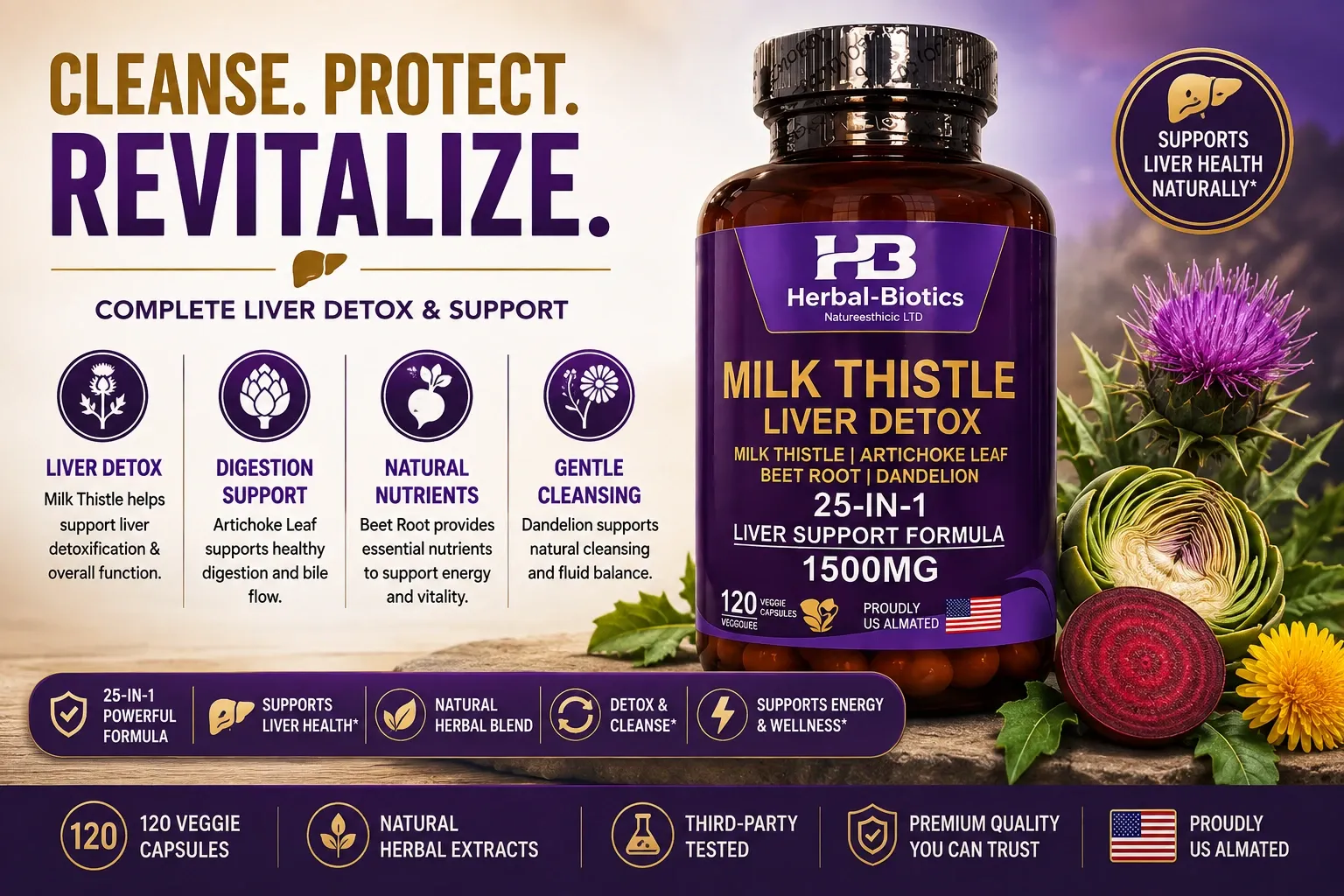
Yes, many adults can take a Milk Thistle Liver Detox Supplement daily when it is used according to the product directions and there are no individual reasons to avoid it. Milk thistle is generally well tolerated when taken orally, with digestive symptoms such as bloating, nausea, and gas among the more commonly reported side effects.
But there is an important distinction between being able to take a Milk Thistle Liver Detox Supplement every day and needing to take it every day indefinitely. Daily use is not automatically better, and a supplement marketed for liver detox should not be confused with something that literally cleanses or flushes toxins from the liver.
Milk thistle contains a group of plant compounds known as silymarin, which is the main reason it appears in many liver-support supplements. Research has looked at silymarin for several liver conditions, but the human evidence remains mixed and condition-specific.
Some studies suggest changes in certain liver markers, while other well-designed trials of a Heart Care CoQ10 Supplement have not found meaningful clinical benefits.
So the practical answer is simple: daily milk thistle may be reasonable for some adults, but the product, dose, reason for taking it, medications, allergies, and health circumstances all matter.
Can Milk Thistle Liver Detox Supplement Be Taken Daily?
For many healthy adults, taking a milk thistle supplement every day according to the label is generally considered well tolerated. That does not mean every person should take it daily, nor does it mean that taking it indefinitely is automatically a good idea.
The first question I would ask is not simply, "Is milk thistle safe every day?" It is, "Why am I taking it, and what exactly am I taking?"
A capsule containing a modest amount of standardized silymarin is not necessarily equivalent to another capsule containing a larger amount of whole milk thistle extract. Products can vary considerably in their extract concentration, standardization, serving size, and additional ingredients. Even the amount stated on the label may not always perfectly reflect the amount actually present.
Your circumstances matter too. Someone taking no medication and using a clearly labeled product is in a different situation from someone taking several prescription medicines, managing an existing liver condition, or combining multiple herbal supplements.
Another important distinction is tolerability versus necessity. If you tolerate milk thistle well, that tells you something about how your body is responding to it. It does not prove that you need it every day or that continued use will provide increasing liver protection.
There is also no established rule saying that everyone who takes milk thistle needs to cycle it, take regular breaks, or take it continuously. The sensible approach is to have a reason for using it, follow the product's directions, and reassess continued use when circumstances change.
What Is Milk Thistle and How Does It Relate to Liver Health?
What Is Milk Thistle?
Milk thistle is a flowering plant, scientifically known as Silybum marianum. Its seeds and fruit are used to produce extracts found in many dietary supplements.
It has a long history of traditional use for liver-related purposes, which helps explain why it has become such a familiar ingredient in modern liver-support formulas. Today, you will often see it combined with ingredients such as vitamins, minerals, herbs, or other plant extracts in products marketed for "liver health" or "detox."
The traditional reputation is one reason the ingredient is popular. It is not, however, proof that every modern claim made about milk thistle is established by clinical research.
What Is Silymarin?
Silymarin is the main mixture of active plant compounds found in milk thistle extract. It includes several flavonolignans, with silybin or silibinin being among the better-known components.
This distinction matters when reading a label. "Milk thistle extract" describes the material derived from the plant, while "silymarin" describes a group of compounds within that extract.
A product can therefore list a particular amount of milk thistle extract without that number telling you exactly how much silymarin it provides.
Why Is It Included in Liver Supplements?
Silymarin has antioxidant and other biological activities that have been investigated in laboratory and human research. These properties provide a reasonable scientific basis for studying milk thistle in relation to liver health.
The problem comes when a plausible biological effect gets turned into a much stronger marketing statement. A supplement containing an antioxidant compound is not automatically a liver cleanser, and evidence that a compound affects cells in a laboratory does not prove that taking it prevents or reverses liver disease in humans.
That distinction is worth keeping in mind whenever you see a Milk Thistle Liver Detox Supplement promising dramatic results.
How Long Can You Take Milk Thistle Daily?
There is no single universal answer to how long you can take milk thistle because different products, doses, purposes, and people have been studied.
Some research involving silymarin has lasted for several months, and clinical studies have generally found oral milk thistle to be well tolerated. LiverTox also notes that milk thistle has not been convincingly associated with clinically apparent acute liver injury.
That is reassuring, but "generally well tolerated" should not be translated into "proven safe for unlimited use in every person." Long-term safety data are not the same thing as evidence that indefinite supplementation is necessary.
Short-term daily use can make sense when someone has a specific reason for trying a supplement and is following the directions on a particular product. Longer-term use deserves more thought, particularly when a person has an existing health problem or takes regular medication.
So, does taking milk thistle daily mean you can take it forever? Not necessarily.
There is no universal expiration date for milk thistle use, but there is also no good reason to assume that a supplement should become a permanent part of your routine simply because you have tolerated it for a few months.
If you are continuing it for a specific health concern, especially an existing liver condition, the bigger question is whether that condition has been properly evaluated and whether the supplement is actually contributing anything useful. Milk thistle should not be used as a substitute for diagnosis or treatment.
Does a Milk Thistle Liver Detox Supplement Actually Detox the Liver?
This is where supplement marketing and biology often get their wires crossed.
When people hear "liver detox," they may imagine a product entering the liver, grabbing toxins, and carrying them out of the body. That is not how the liver works, and milk thistle has not been established as a substance that literally flushes toxins from the liver.
Your liver already performs a huge range of metabolic and detoxification functions. It chemically modifies many substances so they can be processed and eliminated through normal biological pathways. The kidneys, digestive system, lungs, skin, and other processes also play roles in handling and eliminating substances from the body.
So when a supplement company uses the phrase "liver detox," it is usually talking about a broader idea of supporting normal liver function rather than performing a literal internal cleanse.
Milk thistle is interesting because silymarin has antioxidant and other biological effects, and researchers have investigated whether those properties translate into useful effects in people with liver disease. The results, however, have not produced a simple answer. NCCIH states that clinical trials involving liver diseases such as alcohol-related liver disease, hepatitis B and C, and fatty liver disease have been conflicting or too limited to support firm conclusions. Two NCCIH-funded studies of silymarin in hepatitis C and nonalcoholic steatohepatitis did not show benefit from supplementation.
Other reviews have found modest changes in certain liver enzymes, but those changes have not consistently translated into clinically meaningful improvements.
That means milk thistle should not be viewed as something that repairs the liver after a weekend of heavy drinking, erases the effects of an unhealthy diet, or reverses liver damage simply because it contains silymarin.
A better way to think about it is potential liver support, not a chemical reset button.
What Are the Potential Benefits of Taking Milk Thistle Daily?
Liver Health Support
Milk thistle is most commonly taken because people want to support their liver. That interest is understandable because the liver is central to metabolism, processing nutrients, handling many chemicals, and producing substances the body needs.
Silymarin has been investigated extensively in liver research, but the evidence does not support treating milk thistle as a guaranteed liver-protection supplement. NCCIH currently describes the overall evidence as insufficient for definite conclusions about its effects on health conditions.
Silymarin and Antioxidant Activity
One reason silymarin attracts scientific interest is its antioxidant activity. In simple terms, antioxidants are substances that can interact with reactive molecules involved in cellular stress.
That sounds impressive, and biologically it is interesting. But there is a common mistake here: demonstrating antioxidant activity does not automatically demonstrate that taking a supplement will prevent liver disease or produce a noticeable health benefit.
The body is considerably more complicated than a supplement label.
Support for Normal Liver Function
People may reasonably choose milk thistle as part of a broader approach to general liver health. In that context, the word "support" is more appropriate than claims that the supplement will cure, repair, or cleanse the liver.
A supplement should sit alongside sensible habits rather than replace them. Maintaining a healthy weight when appropriate, eating a balanced diet, limiting excessive alcohol, being physically active, and getting medical evaluation for persistent health concerns are much more fundamental to liver health than relying on a detox capsule.
What the Research Does Not Prove
The research does not establish that everyone who takes silymarin will have healthier liver function, that daily supplementation prevents liver disease, or that a higher dose produces greater protection.
Some newer meta-analyses have reported improvements in certain laboratory markers among people with liver conditions, but the studies vary substantially in their formulations, doses, populations, and quality.
That is why it is reasonable to be interested in milk thistle without turning that interest into certainty.
What Is the Recommended Daily Dose of Milk Thistle?
Milk thistle dosage is confusing largely because supplement labels do not always describe their contents in the same way.
One product may emphasize the amount of milk thistle extract. Another may highlight the amount of silymarin. A third may provide a standardized extract with a stated percentage of silymarin. These numbers are related, but they are not interchangeable.
For example, 500 mg of milk thistle extract does not automatically mean 500 mg of silymarin. If an extract is standardized to a particular percentage of silymarin, the actual silymarin amount will be lower than the total extract amount.
This is why comparing products based only on the biggest milligram number on the front of the bottle can be misleading.
Clinical research has used a range of silymarin doses and formulations. One systematic review of randomized trials, for example, found doses ranging from 140 mg to 420 mg in the studies it examined. That does not create a universal milk thistle daily dose for everyone. Different products and purposes cannot simply be treated as interchangeable.
The safest practical rule is to follow the serving instructions for the specific supplement you are using rather than borrowing a dose from another product or assuming that more must be better.
Pay attention to whether the label gives the total extract, the silymarin content, or both. Also check whether the serving is one capsule or several capsules per day.
Increasing the dose without a clear reason is not a reliable way to increase the benefits. If you are considering a higher dose, particularly for a health condition, that is a good point to involve a healthcare professional rather than experimenting with increasingly concentrated amounts.
What Is the Best Time to Take Milk Thistle?
There is no universally established "best time" to take milk thistle. Morning, afternoon, or evening can all be reasonable depending on the specific product instructions and how you tolerate it.
If the label recommends taking the supplement with food, follow that direction. Taking it with a meal may also be more comfortable for someone who notices stomach upset when taking supplements on an empty stomach.
Consistency is generally more useful than obsessing over a particular hour. If a product is intended to be taken twice daily, for example, spreading the doses according to the label may make more sense than taking both at once.
If milk thistle causes stomach discomfort, taking it with food may be worth considering when permitted by the product directions. Persistent symptoms, however, should not simply be covered up by changing the timing.
What Are the Side Effects of Taking Milk Thistle Daily?
"Natural" is not another word for "incapable of causing side effects." Milk thistle is generally well tolerated orally, but unwanted effects can still occur.
Digestive Side Effects
The most commonly reported problems are relatively ordinary digestive complaints. These can include bloating, gas, nausea, diarrhea, indigestion, or general stomach discomfort.
For many people, these effects are mild or absent. But if symptoms begin after starting a supplement and continue after repeated doses, it is reasonable to reconsider whether the product agrees with you.
It is also worth remembering that a "milk thistle supplement" may contain several other ingredients. If a combination product causes digestive symptoms, milk thistle itself may not be the only possible explanation.
Allergic Reactions
Allergic reactions are possible, particularly in people who are sensitive to related plants in the Asteraceae family. NCCIH specifically notes potential concerns for people allergic to plants such as ragweed, chrysanthemum, marigold, and daisy.
A mild skin reaction deserves attention, while symptoms such as swelling, breathing difficulty, or a severe allergic reaction require prompt medical attention.
When Should You Stop Taking It?
You should not simply push through unusual, severe, or persistent symptoms because you assume the supplement is "detoxing" you.
If a reaction is significant or worsening, stop using the product and seek appropriate medical advice. A severe allergic reaction is an emergency.
Also remember that supplements can contain multiple active ingredients. If something changes after starting a new product, look at the entire ingredient list rather than assuming the highlighted ingredient is responsible.
Can Milk Thistle Interact With Medications?
Medication interactions are one of the biggest reasons to think twice before starting regular milk thistle use.
Milk thistle and silymarin can affect drug-metabolizing enzymes and transporters under laboratory conditions, although LiverTox notes that there is limited evidence that these effects routinely produce clinically significant herb-drug interactions in real-world use. That is different from saying interactions are impossible.
The practical answer is therefore straightforward: if you take prescription medicines or regular over-the-counter medicines, ask a doctor or pharmacist before making milk thistle a daily habit.
This is particularly sensible when a medication has a narrow safety margin, when you take several medicines, or when your treatment regimen has recently changed.
Do not rely on an internet interaction list to decide that a particular combination is definitely safe. Interaction information can depend on the exact medicine, dose, formulation, and individual circumstances.
The same principle applies to multiple supplements. If your liver product contains milk thistle plus several herbs, vitamins, minerals, or other compounds, you need to consider the combination rather than evaluating milk thistle in isolation.
Who Should Be Careful About Taking Milk Thistle Every Day?
People taking prescription medications should be especially cautious about starting regular milk thistle. A pharmacist or doctor can review the actual medicines involved and determine whether there is a meaningful concern.
People with an existing liver condition should also avoid treating milk thistle as a self-directed treatment. Having abnormal liver tests, suspected fatty liver disease, hepatitis, unexplained jaundice, or another liver concern is a reason to find out what is actually happening rather than assuming a supplement is the appropriate response.
People with allergies to milk thistle or related plants may need to avoid it. Cross-reactivity among related plants is a recognized concern.
Pregnancy and breastfeeding deserve additional caution because safety information is limited. NCCIH states that little is known about milk thistle's safety during pregnancy or breastfeeding. Lactation data are somewhat reassuring in limited respects, but that does not establish that every milk thistle preparation is appropriate during breastfeeding. Professional advice is therefore appropriate.
Finally, people taking several supplements should look at the entire combination. A product that seems reasonable by itself can become considerably more complicated when combined with other herbal ingredients.
How to Choose a Good Milk Thistle Liver Detox Supplement
Start with the label rather than the marketing on the front of the bottle.
Look for the actual amount of milk thistle extract per serving and check whether the label states the silymarin content or a standardization percentage. If a manufacturer provides both numbers, you have a much clearer idea of what you are actually getting.
Serving size matters too. A bottle might advertise a large amount of extract, but that number may represent two or four capsules rather than one.
Then look at the other ingredients. Some "liver detox" products contain long lists of herbs and nutrients. More ingredients do not automatically mean a better formula. In fact, a complicated formula can make it harder to identify what is responsible if you develop side effects or need to check medication interactions.
Quality information also matters. Look for a manufacturer that clearly identifies its ingredients, serving size, and formulation. Independent quality testing can provide additional information about whether a product meets stated specifications, although quality verification does not prove that a supplement is effective for a particular health condition.
One issue worth taking seriously is product consistency. NCCIH notes that some milk thistle supplements have been found to contain substantially different amounts of silymarin than stated on their labels, as well as potential contaminants.
And remember, a bigger milligram number is not automatically a better supplement. Extract concentration and standardization can matter more than the size of the number printed in bold.
When Should You Stop Taking a Milk Thistle Supplement?
New or persistent side effects are a reasonable reason to stop and reassess. Mild digestive symptoms may be enough to reconsider the product, while severe symptoms or signs of an allergic reaction warrant prompt medical attention.
Starting a new prescription medication is another good time to review your supplement routine. Rather than assuming an established supplement is harmless because you have already tolerated it, check whether the new medication changes the equation.
The same applies if your health circumstances change. A new diagnosis, abnormal liver test, pregnancy, breastfeeding, or the development of unexplained symptoms can all change whether continued supplementation makes sense.
Most importantly, do not continue taking milk thistle simply because you are using it to manage a suspected liver problem that has never been properly evaluated. A supplement may be tempting because it feels easier than getting an explanation, but liver problems can have many causes.
If you are no longer sure why you are taking milk thistle, that alone is a useful reason to reassess the habit.
Daily Milk Thistle vs. Occasional Use
Daily supplementation and occasional use are not necessarily interchangeable.
If someone chooses milk thistle as a dietary supplement, consistent use according to the product's directions is more logical than taking it randomly and expecting a predictable effect. At the same time, there is no established principle that taking it more frequently automatically gives the liver greater protection.
This is one of the problems with the way detox supplements are sometimes marketed. The language can make liver health sound as though it requires constant defensive action, with another capsule providing another layer of protection.
Real biology is not quite that simple.
If there is a sensible reason for using a supplement, consistent use may be appropriate for the period in which that reason applies. If there is no clear reason, taking a capsule every morning simply because it has become part of the routine is not necessarily providing a meaningful benefit.
The goal should be purposeful supplementation, not automatic supplementation.
Does Everyone Need a Liver Detox Supplement?
No. There is no general requirement for healthy adults to take a liver detox supplement.
People often become interested in these products after drinking alcohol, eating poorly for a period, feeling tired, taking medication, or worrying that their liver is "overloaded." Those concerns are understandable, but they do not all point toward the same solution.
If excessive alcohol use is the concern, reducing alcohol exposure matters more than trying to compensate afterward with a supplement. If an unhealthy diet is the issue, improving the diet is more fundamental than looking for a detox capsule.
If medication is causing concern, the answer may be a medication review with a healthcare professional rather than adding another supplement. And if symptoms or abnormal liver tests suggest an actual liver problem, the important step is appropriate evaluation.
Milk thistle can be considered as a supplement, but it should not become a substitute for addressing the reason someone is worried about their liver in the first place.
The current evidence also does not justify promising that milk thistle will prevent, reverse, or cure liver disease. Research remains mixed, and some important clinical trials have found no meaningful benefit for specific liver conditions.
Practical Tips for Taking Milk Thistle Daily
If you decide to take milk thistle regularly, start by reading the actual label carefully. Follow the stated serving rather than increasing the dose because you assume a larger amount will provide stronger liver support.
Check whether the label identifies the amount of milk thistle extract and the amount or percentage of silymarin. Look at the full ingredient list too, particularly if the product is marketed as a multi-ingredient liver detox formula.
Take it consistently according to the product instructions, and consider taking it with food if the label permits and you experience stomach discomfort. Keep your doctor or pharmacist informed about regular supplements, especially when you take prescription medicines.
Finally, periodically ask whether continued use still has a sensible purpose. If you develop side effects, start a new medication, develop a health condition, or find yourself using the supplement because you are worried about unexplained liver symptoms, it is time to reassess rather than simply continuing automatically.
Conclusion
Yes, many adults can take a Milk Thistle Liver Detox Supplement daily, particularly when they use a clearly labeled product according to its directions and have no relevant medication, allergy, pregnancy, breastfeeding, or health concerns. Oral milk thistle is generally well tolerated, and serious liver injury from milk thistle itself has not been established.
But daily use should not be confused with indefinite use or with a medical need for supplementation. The right decision depends on the particular formulation, the amount of extract and silymarin, the reason you are taking it, your medications, and your overall health. There is no universal daily dose or universal duration that applies to every milk thistle product.
Most importantly, keep the word "detox" in perspective. Milk thistle does not literally flush toxins from the liver, and current evidence does not establish it as a cure, guaranteed liver cleanser, or replacement for treatment of liver disease. If you use it, think of it as a supplement that may provide liver support, not as a reset button for the liver. That distinction makes daily use a much more sensible question.
FAQs
What is the best time of day to take milk thistle?
There is no universally proven best time of day to take milk thistle. Morning, afternoon, or evening may all be reasonable depending on the instructions for the particular supplement. The product label should take priority, especially when it specifies how many times per day it should be taken or whether it should be taken with food.
If milk thistle causes mild stomach discomfort when taken on an empty stomach, taking it with a meal may be more comfortable when this is consistent with the product directions. In practical terms, choosing a time that fits your daily routine can also make it easier to take the supplement consistently. There is no strong reason to believe that taking it at a particular hour provides a special "detox" or liver-supporting effect.
Can milk thistle detox your liver?
Milk thistle should not be understood as literally flushing toxins out of the liver. The liver already has complex metabolic and detoxification functions, and the term "detox" is often used loosely in supplement marketing. Silymarin, the main group of compounds studied in milk thistle, has biological properties that have attracted research into liver health, but that is different from proving that milk thistle cleanses the liver.
Clinical evidence for milk thistle in different liver conditions remains mixed, and it should not be treated as a substitute for medical care, lifestyle changes, or treatment prescribed for liver disease. If there is a genuine concern about liver health, identifying and addressing the underlying cause is much more important than relying on a supplement marketed as a liver detox.
What happens if you take too much milk thistle?
Taking more milk thistle than recommended is not a dependable way to increase its potential benefits. Higher amounts may increase the likelihood of unwanted effects, particularly digestive problems such as stomach upset, nausea, bloating, or diarrhea. The risk can also depend on the concentration of the extract, because the amount of raw milk thistle and the amount of active silymarin are not necessarily the same thing.
For this reason, comparing supplements only by the number of milligrams on the front of the bottle can be misleading. A concentrated extract may provide considerably more active compounds than a product containing a larger amount of ordinary plant material. It is best to follow the serving instructions for the specific product and avoid increasing the dose on your own. If you accidentally take a substantially excessive amount or develop concerning symptoms, seek appropriate medical advice.
Can milk thistle interact with medications?
Possible herb-drug interactions are an important reason to check with a doctor or pharmacist before using milk thistle regularly when you take prescription or other medicines. Laboratory research indicates that silymarin may affect certain drug-metabolizing enzymes and transport systems. However, laboratory findings do not always translate into clinically important interactions in people, and significant interactions have not been firmly established for most medicines.
The safest practical approach is therefore to consider the exact medication, dose, and milk thistle formulation rather than assuming that all combinations are either safe or unsafe. This is especially important when taking medicines that require precise dosing or have a narrow safety margin. A pharmacist can often provide a quick interaction review and tell you whether any additional monitoring or separation of doses is needed.
Should you take a break from milk thistle?
There is no universal rule requiring everyone to take periodic breaks from milk thistle. Whether you should continue using it depends on why you started taking it, how long you have used it, the product and dose, how well you tolerate it, and whether your health or medication routine has changed. Taking a break is not automatically necessary, but indefinite supplementation is not automatically justified either.
If you have been taking milk thistle for a long time without a clearly defined reason, that can be a useful point to reassess its role in your routine. Rather than following a fixed cycle of taking it for a certain number of weeks and then stopping, consider whether there is a meaningful purpose for continued use. If you are using it because of a liver-related concern or alongside regular medication, discussing continued use with a healthcare professional is the more appropriate approach.

 English
 Arabic
 French
 Spanish
 Portuguese
 Deutsch
 Turkish
 Italiano
 Russian
 Romaian
 Portuguese (Brazil)
 Greek
Greek
 Hrvatski
 Cehoslowakia