

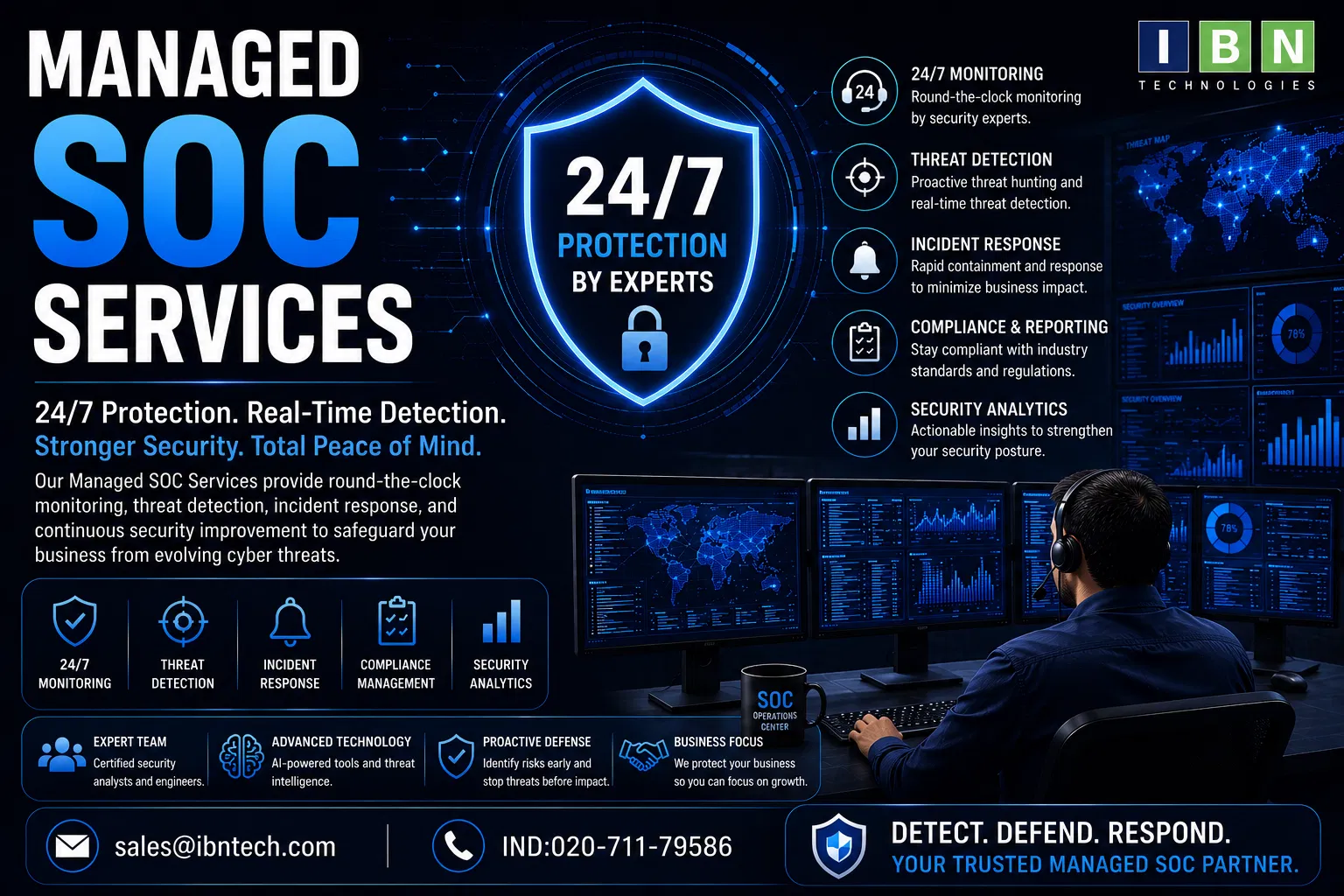

What Should Indian BFSI Firms Expect to Pay for a managed soc service?
For banks, financial institutions, and insurance businesses, security operations have a direct connection to customer trust and business continuity. Financial environments can contain sensitive information, critical applications, payment-related workflows, employee identities, and interconnected technology systems. That makes the question of security operations cost more complicated than simply comparing monthly service fees.
A managed soc service can give BFSI organizations access to dedicated security monitoring and operational support without requiring them to establish every capability internally. But before selecting a provider, decision-makers need to understand what actually influences cost and how to distinguish a lower price from better value.
What determines managed SOC pricing?
Managed SOC pricing is rarely based on one universal rate. The overall cost depends on factors such as the size and complexity of the environment, monitoring requirements, volume and type of security events, service scope, reporting expectations, and the level of operational support required.
For BFSI businesses, the important question is therefore not simply, "How much does the service cost?" It is, "What security coverage and operational capability does that cost provide?"
Two organizations with very different technology environments may have completely different requirements. A smaller financial operation with a focused technology footprint may need a different monitoring model from a larger organization with extensive infrastructure, applications, identities, and distributed operations.
Understanding the cost drivers helps procurement and security teams compare proposals on a like-for-like basis.
Why managed soc pricing varies across BFSI environments
The first major factor is the scope of monitoring.
An organization may require visibility across endpoints, servers, network infrastructure, cloud environments, identity systems, applications, or other relevant sources. Expanding the monitoring scope can increase operational complexity because analysts have more security information to assess.
The second factor is event volume. Security operations teams must process and investigate relevant alerts, and environments that generate significant amounts of security data may require greater operational capacity.
The third consideration is the depth of service. Monitoring and alert notification are not necessarily equivalent to investigation and response coordination. BFSI organizations should understand exactly where a provider's responsibility begins and ends.
Finally, reporting and operational requirements can influence the service model. Leadership may need recurring security reporting, while technical teams may require more detailed incident information.
This is why managed soc pricing should be evaluated alongside service scope rather than as an isolated number.
The hidden cost of building everything internally
An internal security operations model can appear attractive because the organization retains direct control over personnel and processes. However, the headline staffing cost does not represent the entire operating expense.
A sustainable security operation can involve recruitment, specialist skills, technology, monitoring processes, training, operational management, and the ongoing effort required to investigate and document security events.
There is also a capacity challenge. Security monitoring is an operational discipline, and an organization needs sufficient coverage to maintain consistency rather than relying on occasional attention from already-busy IT personnel.
For BFSI organizations, the cost of an internal model should therefore be assessed as a complete operating model rather than compared against a managed service invoice alone.
A better way to compare managed SOC proposals
A procurement team should avoid selecting a provider solely because its initial quote is lower.
Instead, compare the proposals according to the operational capability included in the price.
Monitoring scope
Identify what environments are actually covered. A low-cost service with limited visibility may not provide meaningful value if critical systems remain outside its monitoring scope.
Detection and investigation
Determine whether the service only forwards alerts or whether security personnel review and investigate potentially significant activity.
Escalation
Understand what happens when a serious event is identified. The organization should know who is contacted, how quickly escalation occurs, and which actions remain the customer's responsibility.
Reporting
Review the type of information management and security teams will receive. Reports should help decision-makers understand security activity rather than simply reproduce raw technical data.
Service flexibility
BFSI environments can change as applications, users, infrastructure, and business processes evolve. Ask how monitoring requirements can be adjusted when the technology environment changes.
Operational ownership
Clearly document the responsibilities of the provider and the internal organization. Cost comparisons become misleading when one proposal includes responsibilities that another leaves with the customer.
When the cheapest SOC option becomes expensive
A low initial price can become costly if it leaves important operational gaps.
Suppose a BFSI organization receives a large volume of alerts but has limited investigation support. Internal personnel may then spend significant time determining which events matter. If escalation procedures are unclear, additional management effort may be required during an incident.
Similarly, a service that covers only part of the technology environment can create blind spots. The organization may still need additional monitoring capabilities elsewhere, making the apparent saving less meaningful.
The objective should therefore be to evaluate total operational value rather than the lowest quoted amount.
A useful procurement question is: what work would our internal team still have to perform after purchasing this service?
That answer often reveals more about the true cost than the monthly fee itself.
A BFSI example: evaluating security operations during growth
Consider a financial business expanding its digital operations. Its technology environment becomes more complex as new applications, users, integrations, and infrastructure are introduced.
The security team may initially manage monitoring effectively. Over time, however, increasing event volume can make manual review more difficult. Security personnel may have to divide their attention between strategic security work and routine monitoring responsibilities.
At this stage, leadership could evaluate a managed SOC model.
The assessment should consider the organization's existing internal capabilities, the systems that require monitoring, the expected security workload, escalation requirements, and the level of investigation support needed.
The decision should not be based on whether outsourcing is inherently cheaper. It should be based on whether the combined model gives the organization stronger security operations for the resources available.
Questions procurement teams should ask before signing
A BFSI organization can use the following questions when comparing managed SOC proposals:
- What security environments are included in the service?
- Which events are monitored and investigated?
- How are alerts prioritized?
- What responsibilities remain with the internal security team?
- How are significant incidents escalated?
- What reporting is included?
- How does the service accommodate changes in the technology environment?
- What assumptions are built into the quoted price?
- Are there service components that require separate evaluation?
- How will performance and service quality be reviewed?
These questions help move the discussion from price alone toward operational suitability.
Compliance and risk considerations
BFSI organizations operate within security, privacy, governance, contractual, and regulatory environments that can vary according to the nature of their business and services.
A managed SOC should therefore be evaluated as one component of the organization's broader security program. Paying for security monitoring does not automatically mean that every applicable requirement has been satisfied.
Leadership should map the service to internal controls, governance expectations, incident-management processes, and applicable obligations. Responsibilities should also be clearly documented so that outsourcing operational functions does not create uncertainty over accountability.
From a risk perspective, the value of monitoring is connected to the organization's ability to identify and act on meaningful security events. Cost analysis should reflect that objective.
A practical cost-evaluation checklist
Before approving a managed SOC investment, BFSI decision-makers should review:
- Define the systems and security events that require monitoring.
- Separate essential coverage from optional requirements.
- Compare investigation capabilities, not just alert delivery.
- Document internal responsibilities alongside provider responsibilities.
- Assess reporting requirements for security leadership.
- Calculate the operational workload that remains in-house.
- Review scalability as the technology environment changes.
- Identify assumptions behind each provider's commercial proposal.
- Consider the cost of security gaps and operational delays.
- Establish criteria for reviewing service value after implementation.
This approach gives procurement, technology, and security stakeholders a common basis for evaluating proposals.
Choosing value over an attractive number
Security operations are difficult to reduce to a single price because the underlying requirement is operational rather than purely technological. A BFSI organization is paying for visibility, analysis, processes, expertise, and the ability to manage security events more consistently.
The right commercial decision is therefore unlikely to come from selecting the cheapest proposal without examining what it covers. A more useful comparison considers the security environment, monitoring scope, investigation depth, escalation process, internal workload, and long-term operational needs.
For Indian BFSI businesses, a managed soc service can make financial and operational sense when it closes identifiable security-monitoring gaps while providing a service model that fits the organization's risk profile, internal capabilities, and technology environment.
The strongest business case is not "outsourcing costs less." It is demonstrating that the chosen security operations model delivers the required capability with a clear understanding of what the organization receives, what it remains responsible for, and how the service will support security as the business evolves.
Contact Us:
IND- 02067680404
IBN Technologies Ltd.
E-mail: - sales@ibntech.com