
 О нас
О нас
 Условия использования
 Конфиденциальность
 Advertisment
 DMCA
DMCA
 Gmaps
Gmaps
 Rewards
 Refunds
 Разработчики
Southeast Asia Two-Wheeler E-Axle Market Size, Share, Trends & Research Report, 2033 | UnivDatos
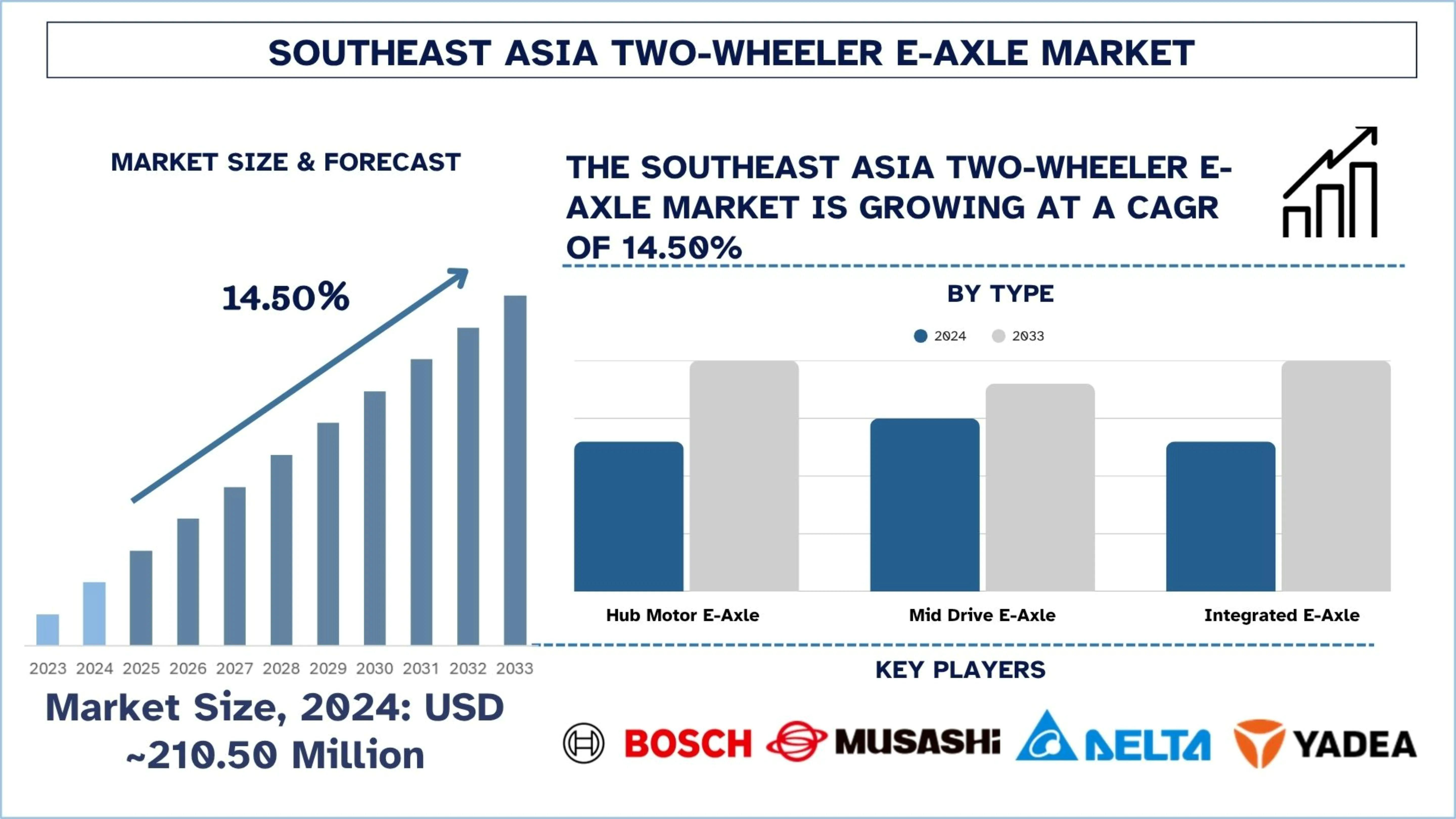
According to UnivDatos, rising electric two-wheeler adoption across urban Southeast Asia, government incentives supporting EV manufacturing and consumer purchases, expansion of battery swapping infrastructure for two-wheelers, increasing demand for low-cost urban mobility solutions, rapid growth of e-commerce and last-mile delivery fleets, localization of EV component manufacturing in ASEAN countries, shift from conventional hub motors to integrated drive systems drive the Southeast Asia Two-wheeler E-Axle market. As per their “Southeast Asia Two-wheeler E-Axle Market” report, the market was valued at USD 210.50 Million in 2024, growing at a CAGR of about 14.50% during the forecast period from 2025 to 2033 to reach USD Million by 2033.
The market for two-wheeler e-axles in Southeast Asia is at a critical stage of growth, with electric mobility nearing the transition from pilot to scaled commercial deployment in urban transport ecosystems. The increasing demand for electric scooters, the electrification of delivery fleets, and supportive EV industrial policies are compelling drive manufacturers to move beyond traditional hub-motor designs toward smaller electric axle designs that enhance efficiency, torque delivery, and vehicle size. Two-wheelers are the primary mode of transport in critical ASEAN economies; thus, drivetrain innovation will become a central focus in the next phase of electric-vehicle competitiveness. The market is also becoming increasingly defined by integrated drive architectures, which integrate motor, controller, and transmission functions into a single modular unit as production volumes rise.
Access sample report (including graphs, charts, and figures): https://univdatos.com/reports/southeast-asia-two-wheeler-e-axle-market?popup=report-enquiry
Urban Electrification Is Expanding the Core Demand Base
Electric two-wheelers are emerging as a viable mobility option in large Southeast Asian cities where the economics of fuel, traffic, and movement, and consumer and fleet buying decisions have a strong impact. Also, the trend of high daily usage in overcrowded cities is straining demand for electric drivetrains, which offer low maintenance, constant torque output, and higher reliability. This applies especially to scooters and motorcycles used for personal commuting, ride-hailing, and short-route commercial mobility, where drivetrain efficiency directly impacts the cost of ownership. Moreover, the rising adoption of e-axles is increasingly associated with mass-market electric vehicles rather than niche technologies.
Integrated E-Axle Implementation Is Becoming a Competitive Advantage
Manufacturers are using integrated e-axles to simplify component complexity and enhance drivetrain compactness. Compared with the standalone hub motor layout, the integrated one enables superior thermal control, improved torque transmission, and easier construction during vehicle manufacturing. This application is becoming relevant in intermediate and high-end electric scooters, with consistent performance and battery efficiency being significant purchase factors. Also, there is a gradual shift in the market towards 3-in-1 windows that combine an electric motor, an inverter, and a reduction gear into a single, compact propulsion module, enabling vehicle manufacturers to enhance design flexibility and production standardization.
Investment Is Moving Toward Localized Drivetrain Production
The emerging focus of investment activity in Southeast Asia is on regional production of motors, controllers, and electric axle assemblies in order to minimize the reliance on imports and conform to local content requirements. The investments in production are focused on the expansion of assembly, integration of components, and sourcing of electronics to facilitate the increased production of electric vehicles. Also, the market players are enhancing supply alliances on motor electronics and drive modules to ensure long-term competitiveness with increased region-level electric mobility. The localized production also enhances the control of cost, reduces lead-time, and provides strategic access to high-growth two-wheeler markets in ASEAN.
For example, on March 1, 2026, YADEA inaugurated its Smart Manufacturing Plant with a total Phase 1 investment exceeding USD 100 million at Tan Hung Industrial Park, Bac Ninh Province. The YADEA Osta, a flagship electric motorcycle designed for the Vietnamese market, features a Neo-Retro design language and a riding range of up to 180 km. Also, announced its strategic partnership with Grab Vietnam and unveiled initiatives supporting Vietnam’s green mobility transition.
Strategic Alliances Accelerating Commercial Adoption
The implementation partnerships among the drivetrain suppliers, the electronics manufacturers, and the mobility-oriented vehicle manufacturers are also benefiting the market. These partnerships are aiding the scaling of battery-compatible electric two-wheelers that are fleet-oriented and particularly applicable in cargo transportation and last-mile delivery. Also, the demands of commercial operators are for vehicles with high uptime and consistent performance, and therefore, durable e-axle systems are becoming increasingly valuable. Therefore, this has increased demand for drivetrain solutions optimized for repeated use and compatible with quick battery changes throughout the day.
Click here to view the Report Description & TOC https://univdatos.com/reports/southeast-asia-two-wheeler-e-axle-market
According to Southeast Asia Development Solutions (SEADS), on 14 January 2025, almost 250 million motorcycles and other light motorized vehicles cruise through Southeast Asia’s streets, accounting for around 80% of all vehicles in the region. These two and three-wheeler vehicles are popular across the region for a reason: they are affordable and widely available.
Strategic Growth Perspective
The Southeast Asia two-wheeler e-axle market is expected to experience sustained growth as electric mobility increasingly penetrates everyday transport and commercial delivery networks across the region. Further investments in localized production, drivetrain efficiency, and battery-compatible vehicle platforms will enhance long-term market competitiveness. Also, the increased electrification of its fleet and the development of policy-based EV ecosystems in key ASEAN economies will also help it grow. With technological maturity, e-axle systems will become a standardized solution in the next generation of electric two-wheelers, as both consumers and business segments adopt them as the new standard for their drivetrains.
Related Report:-
Southeast Asia Two-Wheeler Market: Current Analysis and Forecast (2023-2030)
Automotive Axle Market: Current Analysis and Forecast (2022-2028)
Electric Vehicle (EV) Relay Market: Current Analysis and Forecast (2022-2030)
Smart Electric Drive Market: Current Analysis and Forecast (2021-2027)
In Wheel Motor Market: Current Analysis and Forecast (2023-2030)
Contact Us:
UnivDatos
Contact Number - +1 978 733 0253
Email - contact@univdatos.com
Website - www.univdatos.com
Linkedin- https://www.linkedin.com/company/univ-datos-market-insight/mycompany/


 Croatian
 English
 Arabic
 French
 Spanish
 Portuguese
 Deutsch
 Turkish
 Dutch
Dutch
 Italiano
 Romaian
 Portuguese (Brazil)
 Greek
Greek
 Chech
Chech
 Afganistan
