About
About
 Termeni
 Confidențialitate
 Advertisment
 DMCA
DMCA
 Gmaps
Gmaps
 Rewards
 Refunds
 Developers
Space Sensor Market Size Projected to Reach USD 14,525.56 Million by 2032
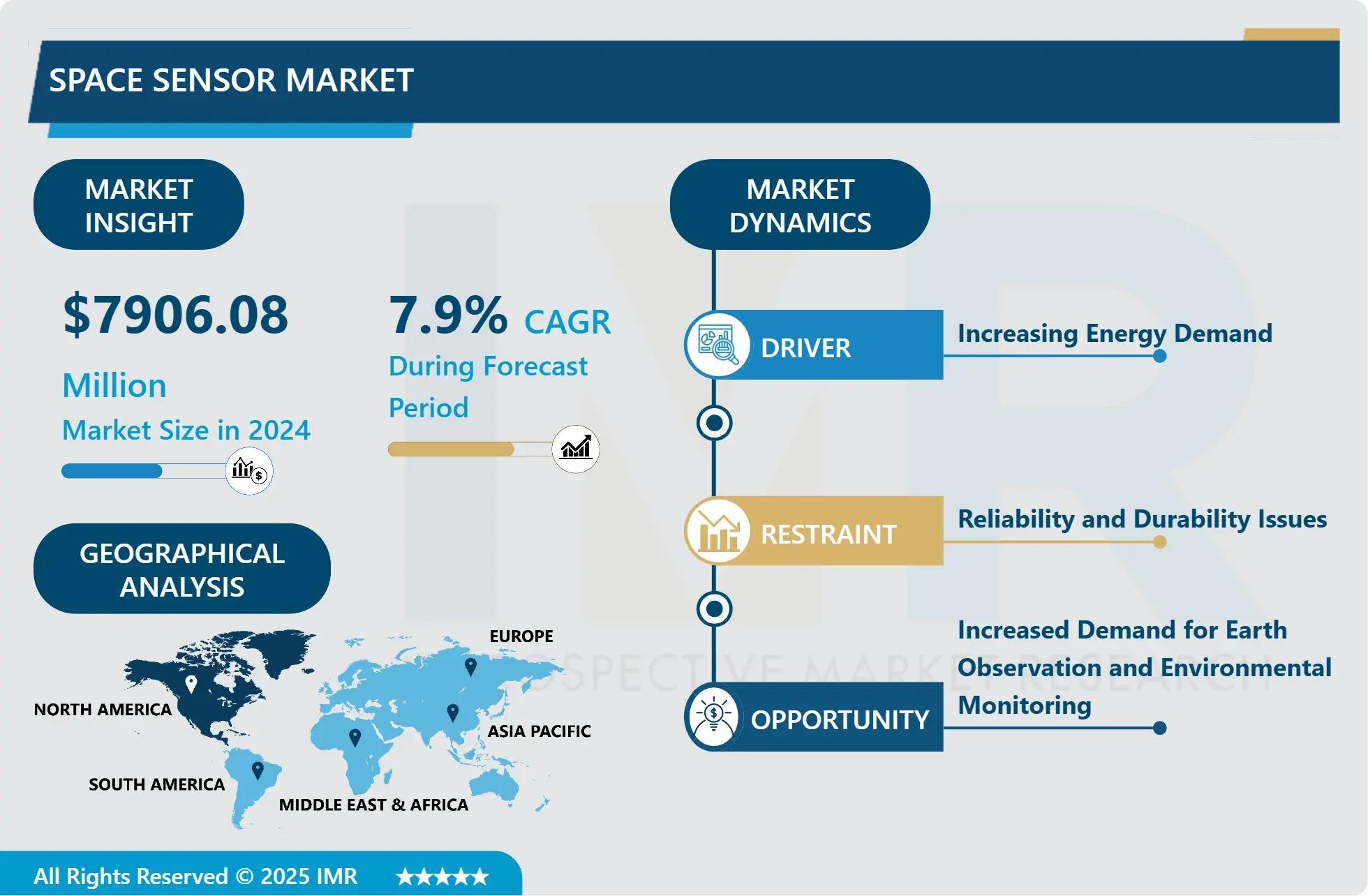
According to a new report published by Introspective Market Research, Space Sensor Market by Sensor Type, Platform, Application, and Region, The Global Space Sensor Market Size Was Valued at USD 7906.08 Million in 2024 and is Projected to Reach USD 14525.56 Million by 2032, Growing at a CAGR of 7.9%.
Market Overview:
The global Space Sensor market comprises highly specialized, radiation-hardened electronic devices designed to measure, detect, and monitor physical phenomena in the extreme environment of space. This includes electro-optical/infrared (EO/IR) sensors, star trackers, sun sensors, inertial measurement units (IMUs), magnetometers, and spectrometers. The critical advantage of these sensors over terrestrial counterparts is their ability to withstand intense radiation, extreme thermal cycles, vacuum, and microgravity while delivering unparalleled precision and reliability. They are the "eyes and ears" of spacecraft, enabling navigation, attitude control, scientific discovery, and Earth observation.
Growth Driver:
The foremost growth driver for the space sensor market is the explosive proliferation of small satellite constellations, particularly for Earth Observation (EO) and broadband communication, driven by both commercial entities and national space agencies. Companies like SpaceX (Starlink), Planet Labs, and others are launching hundreds to thousands of smallsats that require compact, high-performance, and cost-effective sensors for attitude determination, navigation, and primary payload functions. This mass production of satellites creates a corresponding surge in demand for sensors. Additionally, renewed global interest in lunar and deep-space exploration missions necessitates advanced sensors for navigation, landing, and scientific instrumentation, further amplifying demand from government space programs worldwide.
Market Opportunity:
A significant and high-value market opportunity lies in the development of next-generation, miniaturized, and AI-integrated smart sensors tailored for the new space economy. As satellite constellations grow, there is a pressing need for sensors that are smaller, lighter, more power-efficient, and capable of on-board data processing to reduce downlink bandwidth. Integrating artificial intelligence (AI) and machine learning (ML) directly into sensor payloads can enable real-time anomaly detection, automatic object recognition in imagery, and adaptive data collection. Furthermore, the emerging market for In-Space Servicing, Assembly, and Manufacturing (ISAM) and active debris removal creates demand for advanced proximity and docking sensors, opening a new frontier for sensor technology in dynamic, close-proximity space operations.
Space Sensor Market, Segmentation
The Space Sensor Market is segmented on the basis of Sensor Type, Platform, and Application.
Platform
The Platform segment is further classified into Satellites, Launch Vehicles, Deep Space Probes, and Others. Among these, the Satellites platform sub-segment accounted for the highest market share in 2024. Satellites represent the largest and most diverse platform, encompassing everything from massive geostationary communications satellites to nano-satellites in Low Earth Orbit (LEO). Every satellite requires a suite of sensors for attitude control, navigation, and its primary mission, making this platform the primary driver of sensor volume, innovation, and revenue in the market.
Application
The Application segment is further classified into Earth Observation & Remote Sensing, Navigation & Communication, Scientific Exploration, and Surveillance & Security. Among these, the Earth Observation & Remote Sensing application segment accounted for the highest market share in 2024. This segment is fueled by the massive commercial and governmental demand for geospatial data used in agriculture, forestry, urban development, environmental monitoring, and climate science. The high-resolution optical, hyperspectral, and radar sensors required for these missions represent a major portion of the market's value.
Some of The Leading/Active Market Players Are-
• Honeywell International Inc. (USA)
• Teledyne Technologies Incorporated (USA)
• Raytheon Technologies Corporation (USA)
• Lockheed Martin Corporation (USA)
• Northrop Grumman Corporation (USA)
• Safran S.A. (France)
• Thales Group (France)
• L3Harris Technologies, Inc. (USA)
• BAE Systems plc (UK)
• Airbus Defence and Space (Netherlands)
• Ball Aerospace & Technologies Corp. (USA)
• SpaceX (USA)
• Planet Labs PBC (USA)
• ICEYE (Finland)
• Satellogic (Argentina)
• and other active players.
Key Industry Developments
News 1:
In March 2024, Raytheon announced the successful demonstration of a new, miniaturized hyperspectral sensor for small satellites that uses AI onboard to classify land use and detect environmental changes in real-time, dramatically reducing the time to deliver actionable intelligence from orbit.
News 2:
In January 2024, Honeywell unveiled its latest "Micro Sun Sensor" designed for CubeSats and small satellite constellations. The sensor is 50% smaller and uses 30% less power than previous models, addressing the critical need for miniaturization and efficiency in the booming smallsat market.
Key Findings of the Study
• The Satellites platform segment dominates, driven by the rapid deployment of large constellations, especially in LEO.
• North America holds the largest market share, supported by leading aerospace primes, NASA, and dominant commercial space companies.
• The proliferation of small satellite constellations for Earth Observation and communication is the primary growth driver.
• Key trends include the miniaturization of sensors for smallsats, the integration of AI for on-orbit data processing, and increasing investment in lunar and deep-space exploration sensors.
Sponsor
Sponsor

Sponsor
Sponsor
Sponsor
Sponsor
Virtuala FansOnly
CDN FREE
Cloud Convert
Categorii
Citeste mai mult
headphones, audio quality, noise cancellation, portable listening, earbuds, wired headphones, audio technology, sound experience, music enjoyment, tech reviews ## The Portable Listening Revolution: A Deep Dive into My Favorite Headphones In a world where audio technology is continuously evolving, headphones have become more than just a simple accessory; they are a vital part of our daily...

According to a new report published by Introspective Market Research, Online Entertainment Market by Type, Platform, and Revenue Model, The Global Online Entertainment Market Size Was Valued at USD 302.18 Billion in 2023 and is Projected to Reach USD 1,149.18 Billion by 2032, Growing at a CAGR of 16.00% From 2024-2032. Market Overview Online entertainment refers to digital media...
Polaris Market Research has introduced the latest market research report titled Content Services Platform Market Share, Size, Trends, Industry Analysis Report, By Deployment Type (Cloud, On-premises); By Component (Solution, Services); By Organization Size; By End-Use; By Region; Segment Forecast, 2022 - 2030 that highlights the major revenue stream for the forecast period. The report contains...

Von Floorflex, Cushion-Vinyl, asbesthaltigem Vinylboden bis zum Abschliff von asbesthaltigen Bodenklebern. 48h Sanierung in Düsseldorf. Floorflexplatten Düsseldorf - The Ultimate Guide to Floorflexplatten in Düsseldorf: Durable Solutions for Your Flooring Needs When it comes to choosing the right flooring materials, the quality, durability, and ease of installation are crucial...

Ovo je jako osobna i delikatna tema, koja ovisi od različitim vrjednostima, uverenjima, i iskustvima parova. Intimnost, uključujući seks, igra značajnu ulogu u mnogim bračnim zajednicama, ali nije nužno ključna za sve brakove. Postoji mnogo faktora koji mogu utjecati na to kako se intimnost izražava unutar odnosa, a pitanje uskraćivanja intimnih trenutaka može imati različita značenja i...