India Decarbonization HVAC Market Size, Trends, Growth, Forecast & Segments 2034 | UnivDatos
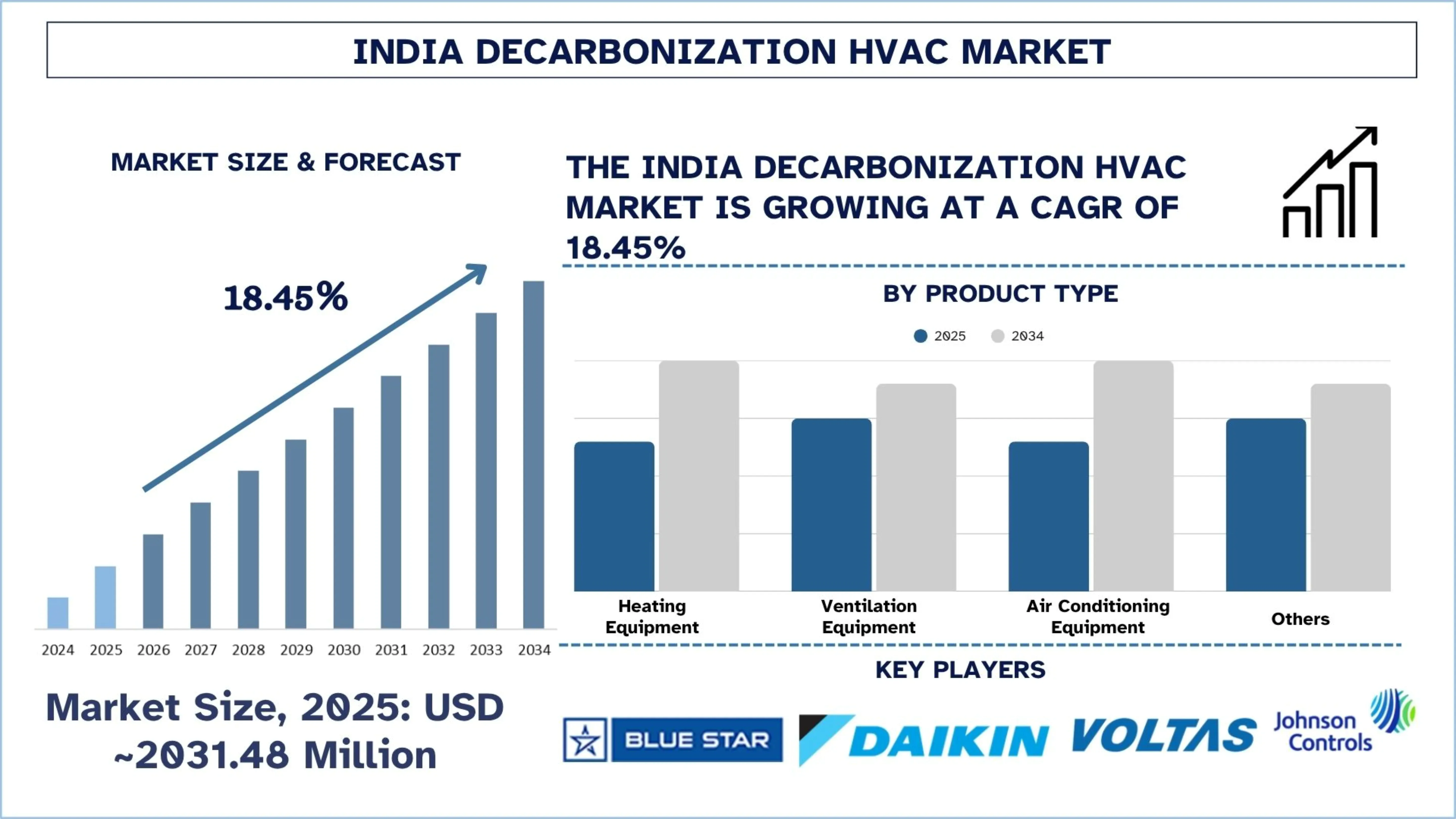
The India Decarbonization HVAC Market was valued at USD 2031.48 million in 2025 and is expected to grow at a strong CAGR of around 18.45% during the forecast period (2026-2034F),
The India Decarbonization HVAC market is driving growth by rapid adoption of energy-efficient cooling technologies, the growing electrification of HVAC systems, and the increasing adoption of low-emission thermal solutions in commercial, industrial, and institutional infrastructure.
The air conditioning equipment held the largest market share because of its widespread use in commercial buildings, healthcare facilities, high-end residential developments, and public infrastructure. Also, the heating equipment sector is powered by increased use of heat pumps, industrial electrification, and low-carbon thermal replacement.
North India held a regional market with high commercial construction, growth, and development of public infrastructure, and high cooling demand, but West India is growing as a high-growth region, driven by increased industrial decarbonization, hyperscale investments in digital infrastructure, and the growth of centralized cooling systems.
The intensity of rivalry is increasing because major HVAC manufacturers are expanding localized manufacturing, shifting product lineups toward inverter-based and low-global-warming-potential technologies, and focusing on sophisticated controls, precision cooling, and combined thermal-efficiency solutions to enhance market positioning.
Manufacturing investments, technology alliances, distribution growth, and project-based alliances in support of green buildings, smart infrastructure, and high-efficiency cooling applications are strategically growing as sources of growth and present more powerful long-term prospects in both replacement demand and new infrastructure deployment.
The market is expanding due to the increase in urbanization, robust growth in commercial real estate, growing demand for data center cooling, strengthening building energy codes, and increasing pressure to cut electricity use in the infrastructure, which consumes a lot of energy. Moreover, the replacement of old HVAC systems, increased penetration of high-end residential cooling, growth in healthcare and hospitality facilities, and government backing through cooling efficiency standards and refrigerant transition systems.
Access sample report (including graphs, charts, and figures): https://univdatos.com/reports/india-decarbonization-hvac-market?popup=report-enquiry
Driver: Increasing Government Regulations and Incentives
Government Regulations and Incentives are also powerful forces driving the Indian decarbonization of the HVAC market, as policy regimes are now fostering the uptake of energy-efficient and low-emission cooling systems in buildings and industrial infrastructure. Also, regulations such as building energy codes, appliance efficiency standards, and refrigerant transition policies are compelling end users to install advanced technologies rather than traditional HVAC systems. Additionally, government-initiated efficiency labeling and compliance requirements are affecting procurement choices for commercial and institutional projects. Furthermore, the rising investment in sustainable infrastructure and the integration of clean energy are driving the adoption of energy-efficient HVAC systems. Moreover, the regulatory advances are accelerating technological upgrades and enhancing long-term market growth.
As per the India Cooling Action Plan (ICAP), 2025:-
In 2024, air conditioning (AC) systems in India were responsible for about 156 million tonnes (Mt) of carbon dioxide equivalent (CO₂e) emissions. These emissions come from both electricity use and leaks of refrigerants with high global warming potential. If unchecked, cooling-related emissions are expected to reach 329 Mt CO₂e by 2035.
To tackle this challenge, ICAP set the following key goals for 2037–38:
Reduce cooling demand across sectors by 20 to 25 percent.
Reduce refrigerant demand by 25 to 30 percent.
Reduce cooling energy requirements by 25 to 40 percent.
Promote research and development in cooling and related areas under national science programs.
Train and certify 100,000 technicians in the servicing sector by 2022–23, in alignment with the Skill India Mission.
Click here to view the Report Description & TOC: https://univdatos.com/reports/india-decarbonization-hvac-market
According to the report, the impact of India Decarbonization HVAC has been identified to be high in the West India area. Some of how this impact has been felt include:
West India is expected to grow with a significant CAGR during the forecast period (2026-2034). The decarbonization HVAC market is also growing strongly in West India due to high industrial growth, commercial infrastructure development, and rising hyperscale digital investments in Mumbai, Pune, and Ahmedabad. The adoption of high-efficiency chillers, centralized cooling systems, and advanced HVAC controls is increasing in large commercial complexes, industrial facilities, and logistics infrastructure. Also, the rising demand for continuous and energy-efficient cooling systems is growing in response to growth in pharmaceuticals, manufacturing, financial services, and data center construction. The robust individual investment in green buildings and high-end commercial projects is further boosting the adoption of low-emission HVAC technologies. With the increasing pace of industrial decarbonization, West India is becoming one of the rapidly developing areas of high-capacity HVAC applications. For example, on March 19, 2025, Copeland, a global provider of sustainable climate solutions, inaugurated a new state-of-the-art Engineering and Technology Center in Pune, Maharashtra, as part of its broader INR 500 crore (~USD 54.0 million) India investment plan. This new Engineering and Technology Center will focus on advancing energy-efficient and low-GWP and natural refrigerant technologies for global deployments across the HVAC and Refrigeration industry.
Key Offerings of the Report
Market Size, Trends, & Forecast by Revenue | 2025−2033.
Market Dynamics – Leading Trends, Growth Drivers, Restraints, and Investment Opportunities
Market Segmentation – A detailed analysis By Product Type, By Decarbonization Type, By Capacity, By End User, By Region
Competitive Landscape – Top Key Vendors and Other Prominent Vendors
Related Report:
HVAC Software Market: Current Analysis and Forecast (2025-2033)
HVAC Services Market: Current Analysis and Forecast (2021-2027)
MENA HVAC Solutions Market: Current Analysis and Forecast (2023-2030)
Automotive HVAC Market: Current Analysis and Forecast (2023-2030)
Contact Us:
UnivDatos
Email: contact@univdatos.com
Contact no: +1 978 7330253
Website: www.univdatos.com
Linked In: https://www.linkedin.com/company/univ-datos/
 Arabic
 English
 French
 Spanish
 Portuguese
 Deutsch
 Turkish
 Dutch
Dutch
 Italiano
 Russian
 Romaian
 Portuguese (Brazil)
 Greek
Greek
 Hrvatski
 Cehoslowakia