

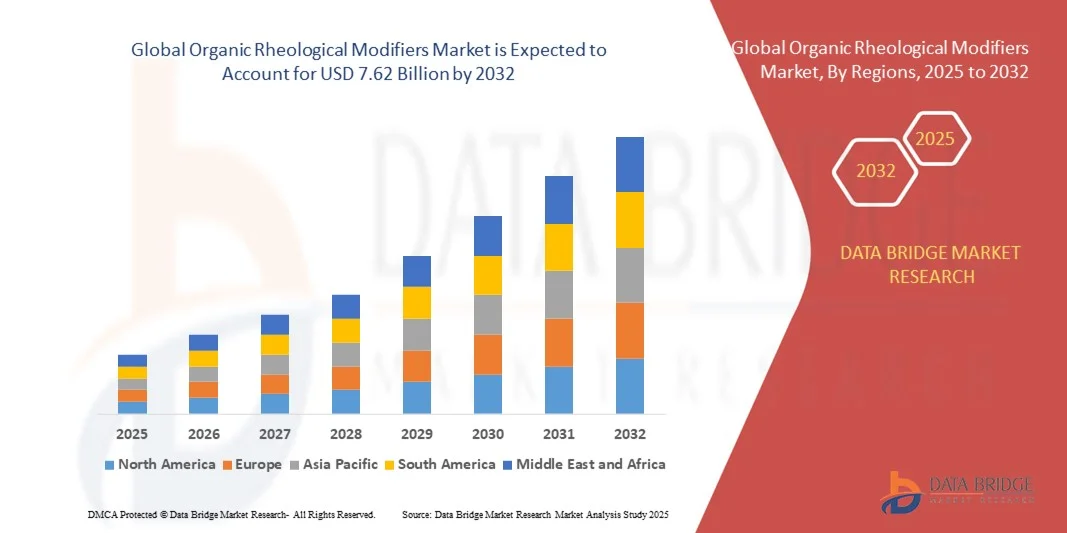

According to the latest report published by Data Bridge Market Research, the Organic Rheological Modifiers Market
The global organic rheological modifiers market size was valued at USD 4.57 billion in 2024 and is expected to reach USD 7.62 billion by 2032, at a CAGR of 4.10% during the forecast period
A number of aspects that are kept into view while creating an outstanding Organic Rheological Modifiers Market report include the market type, organization size, availability on-premises, end-users’ organization type, and the availability in areas such as North America, South America, Europe, Asia-Pacific and Middle East & Africa. The market size, revenue generated from the sales and technologies by various application segments are also evaluated in this business report. The credible Organic Rheological Modifiers Market report showcases the trends that are in vogue, the regions that are growing, the various types of products available and the potential of the industry to provide solutions for a large population.
Stay informed with our latest keyword market research covering strategies, innovations, and forecasts. Download full report: https://www.databridgemarketresearch.com/reports/global-algae-protein-market
Organic Rheological Modifiers Market Segmentation and Market Companies
Segments
- The Global Organic Rheological Modifiers Market can be segmented by Type into Inorganic and Organic. The Organic segment is further divided into Cellulose derivatives, Microcrystalline cellulose, Sodium carboxymethyl cellulose, Methylcellulose, Hydroxypropyl methylcellulose, and Guar gum. By Application, the market can be categorized into Adhesives and Sealants, Paints and Coatings, Personal Care, Pharmaceutical, Construction, and Others.
Market Players
- Some of the key market players in the Global Organic Rheological Modifiers Market include Ashland, Dow, BASF SE, Clariant, The Lubrizol Corporation, Elementis PLC, Akzo Nobel N.V., Croda International Plc, BYK Additives & Instruments, Arkema, San Nopco Limited, Cabot Corporation, Cargill, Incorporated, and CP Kelco.
The Global Organic Rheological Modifiers Market is witnessing steady growth due to the rising demand for environmentally friendly products. The market is segmented based on type, including inorganic and organic. The organic segment further includes cellulose derivatives such as microcrystalline cellulose, sodium carboxymethyl cellulose, methylcellulose, hydroxypropyl methylcellulose, and guar gum. These rheological modifiers find applications in various industries like adhesives and sealants, paints and coatings, personal care, pharmaceutical, construction, and others.
Organic rheological modifiers are gaining popularity as they offer superior performance compared to their inorganic counterparts. They are biodegradable, non-toxic, and eco-friendly, making them preferred choices in industries striving for sustainable solutions. The rise in construction activities, coupled with the increasing use of organic rheological modifiers in paints and coatings, is expected to drive market growth. The pharmaceutical sector is also a significant consumer of organic rheological modifiers for their use in formulations.
Market players in the Global Organic Rheological Modifiers Market are actively engaged in research and development activities to launch innovative products and expand their product portfolios. Ashland, Dow, BASF SE, Clariant, The Lubrizol Corporation, and Elementis PLC are some of the leading companies in the market. These players focus on strategic collaborations, partnerships, and acquisitions to strengthen their market presence and gain a competitive edge.
In conclusion, the Global Organic Rheological Modifiers Market is poised for significant growth driven by the increasing awareness regarding environmental concerns and the shift towards sustainable products. The market players are anticipated to introduce advanced organic rheological modifiers to cater to the diverse requirements of end-users across different industries.
https://www.databridgemarketresearch.com/reports/global-organic-rheological-modifiers-marketThe Global Organic Rheological Modifiers Market is experiencing a notable surge in demand due to the increasing emphasis on environmentally friendly solutions across various industries. Organic rheological modifiers, particularly cellulose derivatives like microcrystalline cellulose, sodium carboxymethyl cellulose, methylcellulose, hydroxypropyl methylcellulose, and guar gum, are garnering attention for their superior performance qualities compared to their inorganic counterparts. These organic modifiers are biodegradable, non-toxic, and eco-friendly, aligning well with the sustainability goals of modern businesses. They find wide applications in sectors such as adhesives and sealants, paints and coatings, personal care, pharmaceuticals, and construction due to their versatility and effectiveness.
As market players strive to meet the escalating demand for organic rheological modifiers, companies like Ashland, Dow, BASF SE, Clariant, and Elementis PLC are actively involved in research and development efforts to introduce innovative products and enhance their product offerings. Collaborations, partnerships, and acquisitions are key strategies adopted by these players to consolidate their market presence and gain a competitive advantage in the global market landscape. The growing usage of organic rheological modifiers in construction activities and the rising adoption in paints and coatings applications are anticipated to be significant drivers for market growth in the coming years. Additionally, the pharmaceutical sector stands out as a key consumer of these modifiers for their unique formulation needs.
Looking ahead, the Global Organic Rheological Modifiers Market is poised for substantial expansion fueled by the growing awareness surrounding environmental issues and the increasing demand for sustainable alternatives. Market players are expected to focus on launching advanced organic modifiers tailored to cater to the evolving requirements of diverse industries, further driving the market forward. With the market dynamics favoring organic rheological modifiers and with industry leaders spearheading innovation and strategic initiatives, the future outlook for this market segment appears promising with ample opportunities for growth and development.The Global Organic Rheological Modifiers Market is expected to witness robust growth in the coming years, driven by several key factors. One of the primary drivers for the market is the increasing shift towards sustainable and environmentally friendly products across various industries. As awareness about environmental concerns continues to rise globally, there is a heightened demand for organic rheological modifiers that offer superior performance while being biodegradable, non-toxic, and eco-friendly. This trend is expected to fuel the adoption of organic modifiers in applications such as adhesives and sealants, paints and coatings, personal care products, pharmaceuticals, and construction materials.
Furthermore, the competitive landscape of the market is characterized by key players such as Ashland, Dow, BASF SE, Clariant, and Elementis PLC, who are actively engaged in research and development efforts to introduce innovative products and expand their product portfolios. These companies are focusing on strategic partnerships, collaborations, and acquisitions to enhance their market presence and gain a competitive edge. Such initiatives are likely to drive market growth and innovation within the organic rheological modifiers segment.
Moreover, the construction sector presents a significant opportunity for market growth, as organic rheological modifiers find extensive applications in construction materials, contributing to improved performance and durability. Additionally, the paints and coatings industry is another key consumer of organic modifiers, where the emphasis on eco-friendly and high-performance products is driving the demand for these materials. The pharmaceutical sector also stands out as a major consumer of organic rheological modifiers, utilizing them in various formulations for their unique properties.
As the market continues to evolve, the increasing focus on sustainable practices, coupled with the development of advanced organic rheological modifiers tailored to diverse industry needs, is expected to further propel market growth. With industry leaders driving innovation and strategic initiatives, the outlook for the Global Organic Rheological Modifiers Market appears promising, offering ample opportunities for expansion and development. By addressing the growing demand for environmentally friendly solutions and providing superior performance characteristics, organic rheological modifiers are poised to play a significant role in shaping the future of various industries and driving sustainable practices worldwide.
Frequently Asked Questions About This Report
What is the PESTLE analysis for the global Organic Rheological Modifiers Market industry?
What is the projected impact of autonomous shipping on Organic Rheological Modifiers Market margins?
How is the Organic Rheological Modifiers Market expected to change by 2033?
What is the projected valuation for the in the Organic Rheological Modifiers Market by 2033?
Which technology segment had the highest valuation in the Organic Rheological Modifiers Market in 2025?
What are the disruptive technologies expected to emerge in the Organic Rheological Modifiers Market?
How is the Buy Local trend impacting the Organic Rheological Modifiers Market in Australia?
What is the influence of social media on Organic Rheological Modifiers Market demand?
What are the primary offensive strategies in the Organic Rheological Modifiers Market?
How does product-level segmentation impact the overall Organic Rheological Modifiers Market CAGR?
What was the historical growth rate of the Organic Rheological Modifiers Market over the last five years?
How is the Organic Rheological Modifiers Market life cycle different in emerging markets?
Browse More Reports:
Middle East and Africa Food Bags Market
North America Food Bags Market
India Food Ingredients Market
Asia-Pacific Frozen Fruit and Vegetable Mix Market
Europe Frozen Fruit and Vegetable Mix Market
Middle East and Africa Frozen Fruit and Vegetable Mix Market
North America Frozen Fruit and Vegetable Mix Market
Asia-Pacific Gelcoat Market
Europe Gelcoat Market
Middle East and Africa Gelcoat Market
North America Gelcoat Market
Asia-Pacific Golf Apparel, Footwear, and Accessories Market
Europe Golf Apparel, Footwear, and Accessories Market
Middle East and Africa Golf Apparel, Footwear, and Accessories Market
North America Golf Apparel, Footwear, and Accessories Market