

Ambulatory Electronic Medical Records (EMR) Market Forecast and Key Insights

According to the latest report published by Data Bridge Market Research, the Ambulatory Electronic Medical Records (EMR) Market
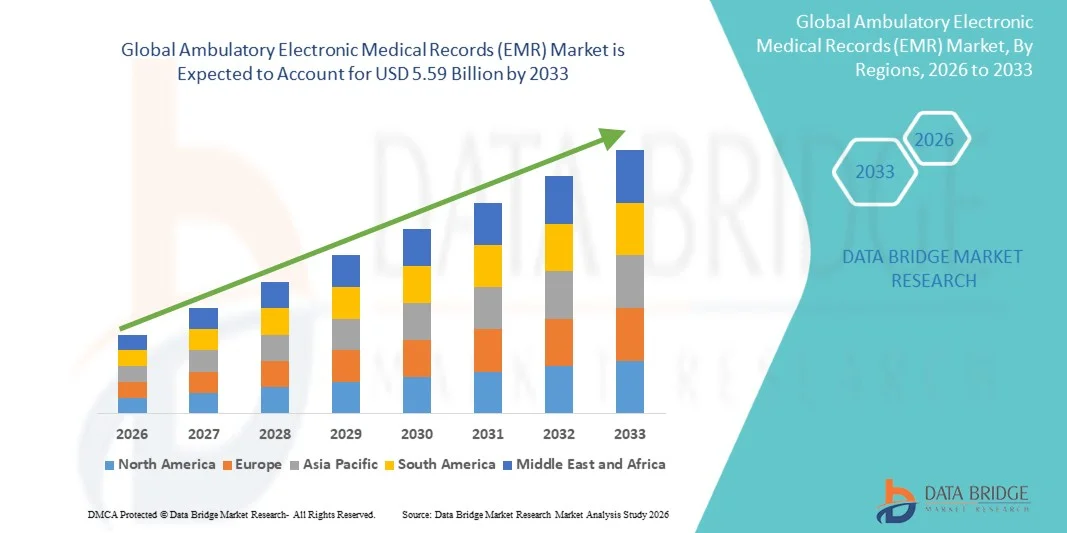
As per Data Bridge Market Research Analysis the Global ambulatory electronic medical records (EMR) market size was valued at USD 3.28 billion in 2025 and is expected to reach USD 5.59 billion by 2033, at a CAGR of 6.90% during the forecast period
An influential Ambulatory Electronic Medical Records (EMR) Market report contains a specific study of the Ambulatory Electronic Medical Records (EMR) Market industry which defines what the market definition, classifications, applications, engagements, and global industry trends are. The market drivers and restraints have also been described using SWOT analysis. The report demonstrates important product developments and tracks recent acquisitions, mergers and research in the Ambulatory Electronic Medical Records (EMR) Market industry by the chief market players. The global Ambulatory Electronic Medical Records (EMR) Market survey report consists of all the company profiles of the major players and brands in the market place. This marketing report not only gives an advantage to develop business but also helps to outshine the competition.
Stay informed with our latest keyword market research covering strategies, innovations, and forecasts. Download full report: https://www.databridgemarketresearch.com/reports/global-ambulatory-emr-market
Ambulatory Electronic Medical Records (EMR) Market Segmentation and Market Companies
Segments
- Based on component type, the ambulatory electronic medical records (EMR) market can be segmented into software and services. The software segment includes cloud-based and on-premise solutions, which cater to the different needs of healthcare facilities. Services segment comprises implementation, training, consulting, and maintenance services that are essential for the successful deployment and utilization of EMR systems. The increasing adoption of cloud-based solutions due to their cost-effectiveness and scalability is driving the growth of the software segment in the market.
- On the basis of deployment mode, the market can be categorized into cloud-based and on-premise solutions. Cloud-based solutions are gaining traction among ambulatory care providers due to their flexibility, accessibility, and reduced maintenance costs. On-premise solutions, although traditional, are still preferred by some healthcare organizations that prioritize data security and compliance with regulatory requirements.
- In terms of end-user, the ambulatory EMR market is segmented into hospitals, specialty clinics, ambulatory surgical centers, and others. Hospitals account for a significant share of the market as they deal with a large volume of patients and require advanced EMR systems to streamline their operations. Specialty clinics and ambulatory surgical centers are also adopting EMR solutions to enhance patient care, improve efficiency, and reduce paperwork.
Market Players
- Cerner Corporation
- Allscripts Healthcare, LLC
- eClinicalWorks
- NextGen Healthcare
- Greenway Health, LLC
- Epic Systems Corporation
- CPSI
- MEDITECH
- athenahealth
- McKesson Corporation
The global ambulatory EMR market is highly competitive, with key players focusing on new product developments, strategic partnerships, and acquisitions to strengthen their market presence. These companies are continuously investing in research and development activities to innovate their product offerings and stay ahead in the market. The increasing demand for integrated healthcare solutions and the growing emphasis on interoperability are driving the competition among market players to provide comprehensive EMR solutions that meet the evolving needs of ambulatory care providers.
The global ambulatory electronic medical records (EMR) market is witnessing significant growth driven by factors such as the increasing need for efficient and streamlined healthcare operations in ambulatory care settings. One key trend that is reshaping the market landscape is the integration of advanced technologies like artificial intelligence (AI) and machine learning (ML) into EMR systems. These technologies are revolutionizing the way healthcare data is processed, analyzed, and utilized, leading to improved clinical decision-making, personalized patient care, and enhanced operational efficiency. Market players are increasingly investing in integrating AI and ML capabilities into their EMR solutions to cater to the evolving demands of ambulatory care providers.
Another emerging trend in the ambulatory EMR market is the focus on interoperability and data exchange. As healthcare systems become more interconnected, the seamless exchange of patient data between different providers and systems is crucial for delivering coordinated and patient-centric care. Market players are developing interoperable EMR solutions that enable healthcare professionals to access and share patient information across various care settings securely. This emphasis on interoperability is driving the market towards more open and collaborative approaches, fostering better care coordination and improving patient outcomes.
Moreover, with the rising adoption of telehealth and remote patient monitoring services, there is a growing need for EMR systems that can support virtual care delivery. Ambulatory care providers are increasingly relying on telemedicine to reach and treat patients in remote locations, monitor chronic conditions, and provide timely consultations. EMR vendors are incorporating telehealth capabilities into their solutions to enable healthcare providers to deliver care beyond the traditional clinical setting, expanding access to healthcare services and improving patient engagement.
Furthermore, the shift towards value-based care models in healthcare is influencing the development of ambulatory EMR solutions that focus on outcomes, quality, and cost-effectiveness. Market players are designing EMR systems that support population health management, predictive analytics, and performance tracking to assist ambulatory care providers in delivering high-quality care while optimizing resource utilization. By aligning their EMR offerings with value-based care principles, market players can help healthcare organizations achieve better clinical outcomes, enhance patient satisfaction, and drive operational efficiencies.
In conclusion, the global ambulatory EMR market is evolving rapidly, propelled by technological advancements, changing healthcare dynamics, and the increasing emphasis on patient-centered care. Market players need to be proactive in addressing these trends and challenges by delivering innovative, interoperable, and value-driven EMR solutions that meet the diverse needs of ambulatory care providers. The future of the ambulatory EMR market lies in harnessing the power of advanced technologies, promoting data exchange and interoperability, supporting telehealth services, and enabling value-based care delivery to transform the way healthcare is delivered and experienced in ambulatory settings.The ambulatory electronic medical records (EMR) market is witnessing a transformation driven by technological innovations and changing healthcare paradigms. One crucial factor shaping the market is the integration of advanced technologies like artificial intelligence (AI) and machine learning (ML) into EMR systems. AI and ML capabilities are revolutionizing data processing and analysis in healthcare, leading to enhanced decision-making, personalized care, and operational efficiency. Market players are increasingly investing in incorporating these capabilities to meet the evolving needs of ambulatory care providers, driving competition and differentiation in the market.
Interoperability and data exchange are becoming pivotal in the ambulatory EMR market as healthcare systems become more interconnected. Seamless sharing of patient data among providers and systems is essential for coordinated care delivery. Market players are focusing on developing interoperable EMR solutions that facilitate secure data exchange, enabling healthcare professionals to access and utilize patient information across different care settings. This emphasis on interoperability is fostering collaboration, improving care coordination, and ultimately enhancing patient outcomes in ambulatory settings.
The rise of telehealth and remote patient monitoring services is also influencing the ambulatory EMR market. With the increasing adoption of telemedicine for remote consultations and monitoring, there is a growing demand for EMR systems that support virtual care delivery. EMR vendors are integrating telehealth capabilities into their solutions to enable healthcare providers to expand their reach, improve patient engagement, and deliver care beyond traditional clinical settings. This shift towards virtual care is expanding access to healthcare services and reshaping the way ambulatory care is delivered.
Value-based care models are playing a significant role in the development of ambulatory EMR solutions. Market players are designing EMR systems that align with value-based care principles by focusing on outcomes, quality, and cost-effectiveness. These solutions support population health management, predictive analytics, and performance tracking to help ambulatory care providers deliver high-quality care efficiently. By emphasizing value-based care, market players are assisting healthcare organizations in improving clinical outcomes, enhancing patient satisfaction, and optimizing resource utilization in ambulatory settings.
In conclusion, the ambulatory EMR market is undergoing rapid evolution driven by technological advancements and shifting healthcare dynamics. Market players must adapt to these trends by delivering innovative, interoperable, and value-driven EMR solutions that cater to the diverse needs of ambulatory care providers. By embracing technologies like AI and ML, promoting data exchange and interoperability, supporting telehealth services, and enabling value-based care delivery, market players can play a pivotal role in transforming healthcare delivery and quality in ambulatory settings.
Frequently Asked Questions About This Report
How are manufacturers reducing their carbon footprint in the Ambulatory Electronic Medical Records (EMR) Market?
What is the market value of the global Ambulatory Electronic Medical Records (EMR) Market industry as of the most recent pay cycle?
How is Social Responsibility impacting the Ambulatory Electronic Medical Records (EMR) Market share?
How is Artificial Intelligence (AI) being integrated into the Ambulatory Electronic Medical Records (EMR) Market?
What is the impact of [Specific Macroeconomic Factor] on the Ambulatory Electronic Medical Records (EMR) Market?
What is the impact of brand equity on the Ambulatory Electronic Medical Records (EMR) Market drivers?
How do high initial costs act as a restraint for the Ambulatory Electronic Medical Records (EMR) Market?
What is the impact of 5G on the Ambulatory Electronic Medical Records (EMR) Market valuation?
How is the Ambulatory Electronic Medical Records (EMR) Market addressing Accessibility for all users?
How will Hydrogen Energy change the Ambulatory Electronic Medical Records (EMR) Market supply chain?
How will the integration of [Technology] create new Ambulatory Electronic Medical Records (EMR) Market niches?
What will be the market value for Hardware offerings in the Ambulatory Electronic Medical Records (EMR) Market by 2033?
Browse More Reports:
Asia-Pacific Exosome Therapeutics Market
Europe Exosome Therapeutic Market
Latin America Exosome Therapeutics Market
North America Exosome Therapeutics Market
Turkey Exosome Therapeutics Market
Asia-Pacific Feed Flavours and Sweeteners Market
Europe Feed Flavors and Sweeteners Market
Middle East and Africa Feed Flavors Sweeteners Market
North America Feed Flavors and Sweeteners Market
Asia-Pacific Fertility Testing Devices Market
Europe Fertility Testing Devices Market
North America Fertility Testing Devices Market
North America Floor Adhesive Market
Asia-Pacific Food Bags Market
Europe Food Bags Market