

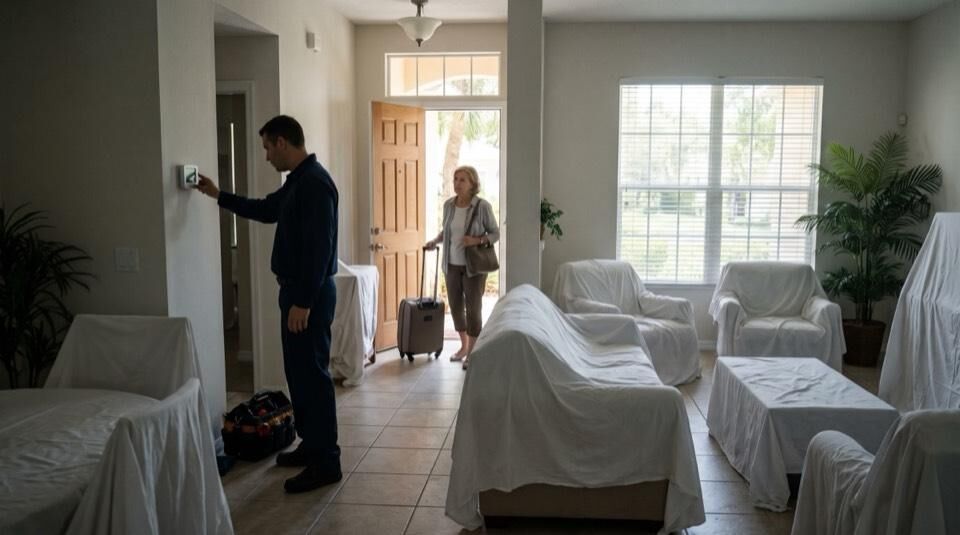

The biggest threat to an empty Florida house between May and October is not a break-in. It is moisture. Mildew on the furniture, musty closets and swollen cabinet doors all come from the air the house sits in for five months, which is why closing up well starts with the air conditioner and the water main.
Work through this list in three stages: a few weeks out, the last day, and the week you come back.
Four to Six Weeks Before You Leave
1. Get the AC serviced
While you are gone, the air conditioner is the only thing keeping humidity in check. A failure in July, with nobody home, can mean weeks of damp air before anyone notices. Have a technician check the refrigerant, the capacitor, the condensate drain and the float switch before you go, not after.
Snowbirds in the North Port area can book that visit with Roman's Service, which answers calls 24/7 from its shop at 2735 Commerce Pkwy and holds Florida license CAC1818567. Leave the company's number, (941) 877-5976, with whoever checks on the house, so a breakdown in August gets a local call instead of a long-distance worry.
Ask the technician to show you the float switch. If the drain clogs while you are away, that switch shuts the AC off to keep water from overflowing, which protects the ceiling but leaves the house without dehumidification. That is why your watcher should check that the system is actually cooling on every visit, not just glance at the setpoint.
2. Line up a house watcher
A neighbor, a friend or a paid home watch service should walk through the house on a regular schedule. Ask them to check for water on the floors, musty smells, the thermostat reading and any signs of pests. Also call your insurance agent, because some homeowner policies have conditions for homes left empty for long periods.
3. Decide on hurricane protection
Hurricane season runs from June 1 to November 30, which covers almost your entire time away. Decide now whether shutters go up before you leave or whether your watcher will install them when a storm threatens. If it is the watcher, label every panel and show them where the hardware is kept.
While you are planning for storms, photograph each room and the outside of the house. Dated photos make an insurance claim much easier if something happens while you are a thousand miles away.
4. Handle mail and accounts
Set up mail forwarding with the Postal Service, pause any deliveries, and keep the internet on if you use a smart thermostat or cameras. Move bill payments to autopay so a missed electric bill never shuts off the AC.
Setting the Thermostat and Humidity
Do not turn the air conditioner off. A house closed up without cooling can reach dangerous humidity levels within days during a Florida summer.
- Pick a higher setpoint, not "off." Many homeowners leave cooling somewhere in the high 70s to low 80s. Too high, and the AC barely runs, which lets humidity creep up.
- Watch humidity, not just temperature. The U.S. Environmental Protection Agency recommends keeping indoor humidity below 60 percent to limit mold growth. A cheap digital hygrometer, or a smart thermostat with humidity readings, lets your watcher see the number.
- Leave the fan on "auto." Running the fan constantly can blow moisture off the cold coil and back into the house.
- Let air move. Leave interior doors open and closet and cabinet doors cracked, so cooled air reaches every room.
The EPA's guide to mold and moisture explains why humidity control matters more than any cleaning product.
The Last Day
| Task | Why |
|---|---|
| Shut off the main water valve | A burst supply line in an empty house can run for weeks |
| Turn the water heater off or to vacation mode | Saves energy and reduces leak risk |
| Cover toilet bowls with plastic wrap | Slows evaporation so the water seal does not dry out |
| Empty the fridge, or leave it nearly empty and running | Spoiled food and a closed, unplugged fridge both grow mold |
| Clear the pantry of open food | Ants, roaches and rodents find it fast |
| Unplug electronics | Protects them from summer lightning surges |
| Bring in patio furniture, grills and planters | Loose items become projectiles in a storm |
| Confirm the thermostat setting | Cooling mode, your chosen setpoint, fan on "auto" |
If you have irrigation that needs to keep running, find out whether it can stay on with the house supply closed. On many homes it is a separate valve, but not on all of them.
The Week You Come Back
- Walk the house before unpacking. Look for water stains under the air handler and around sinks, and notice any musty smell.
- Open the water main slowly and check under every sink and behind the toilets for drips.
- Replace the AC filter. Even an empty house loads it with dust over five months.
- Check the drain line. Pour a cup of distilled white vinegar into the cleanout to clear any growth from the summer.
- Restore your normal thermostat schedule and watch the humidity reading for a few days.
If the system struggles to bring the house back to temperature, or water is pooling near the indoor unit, call for service before you settle in for the season.
Five months is a long time for a house to look after itself. Keep the air dry, keep the water off and leave someone with a key and a phone list, and the house you return to in the fall should smell the way it did in spring.














