

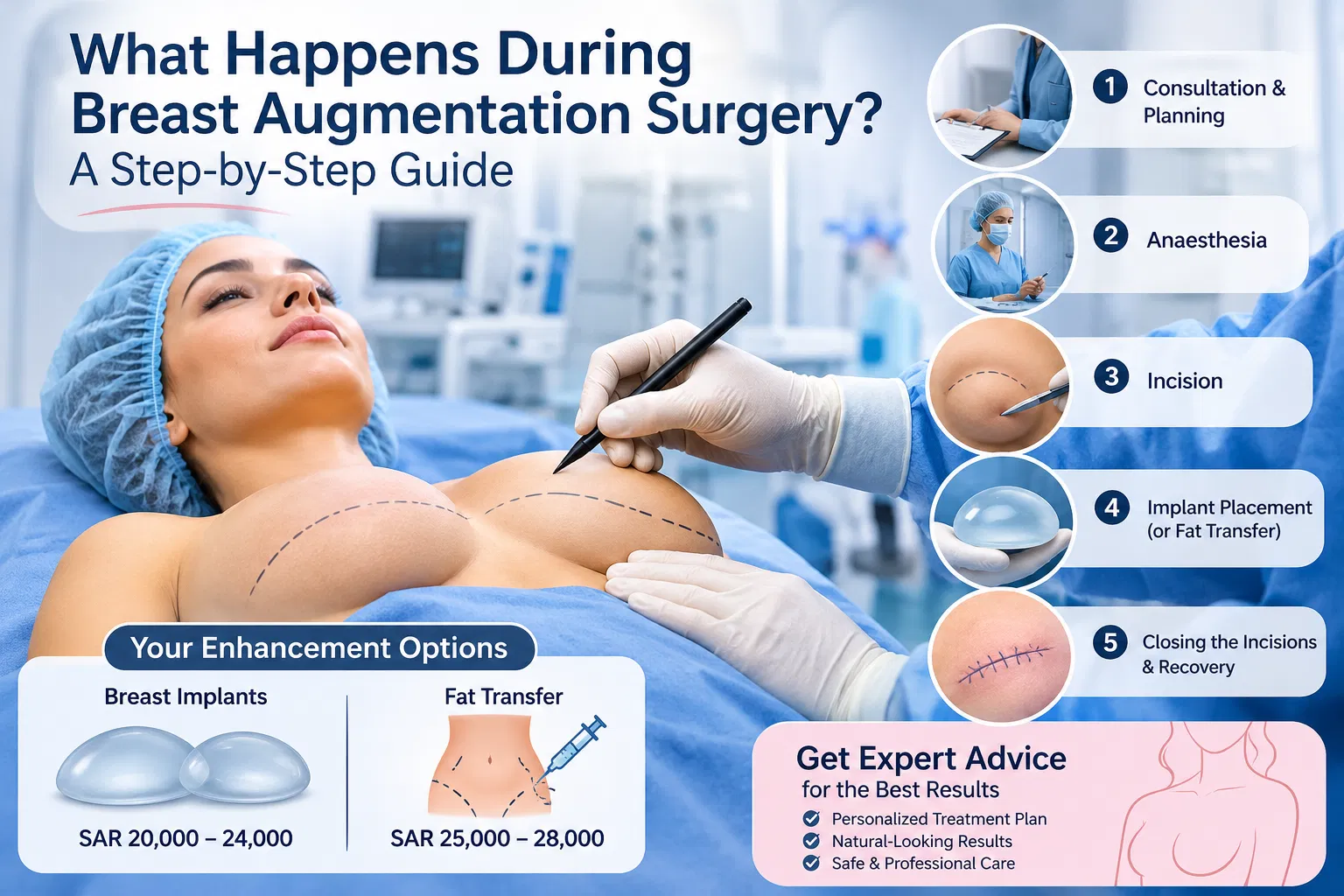
What Happens During Breast Augmentation Surgery? A Step-by-Step Guide

Considering breast augmentation often brings up one important question: what actually happens inside the operating room? Understanding the procedure can make the decision less intimidating and help patients prepare for each stage, from the first surgical assessment to the initial recovery period.
Breast Augmentation in Jeddah, also called augmentation mammoplasty, is a surgical procedure designed to increase breast volume, improve proportions, or restore fullness after pregnancy, breastfeeding, or significant weight changes. Depending on the patient's anatomy and goals, enhancement may involve silicone implants, saline implants, or fat transfer.
For women researching breast augmentation in Jeddah, knowing how the operation is planned and performed is an important part of making an informed decision.
Before Surgery: Planning the Result, Not Just Choosing a Size
Breast augmentation begins well before the day of surgery. The consultation helps the plastic surgeon understand what the patient wants to change and whether the procedure is appropriate.
Step 1: Medical Consultation and Breast Assessment
The surgeon reviews medical history, previous operations, medications, allergies, lifestyle factors, and any history of breast conditions. Patients should also discuss pregnancy plans, breastfeeding history, smoking, and future weight changes.
A physical assessment may include:
-
Breast volume, shape, and natural asymmetry
-
Skin quality and elasticity
-
Nipple and areola position
-
Chest width and breast base measurements
-
Existing breast tissue and soft-tissue coverage
-
General health and suitability for anaesthesia
The assessment helps determine whether augmentation alone is suitable or whether a breast lift may also be needed. Implants add volume, but they do not reliably correct significant breast sagging.
Step 2: Selecting the Implant or Enhancement Method
If implants are chosen, the surgeon discusses silicone versus saline, implant size, shape, and profile. Round and anatomical implants may be considered according to the patient's anatomy and preferred appearance.
The implant profile describes how far the implant projects from the chest wall. A higher profile may create more forward projection, while other profiles can provide a different balance of width and fullness.
Patients who prefer not to have an implant may discuss fat transfer breast augmentation. This technique uses liposuction to collect the patient's own fat, which is processed and injected into the breasts. It generally provides a more modest increase in volume and requires sufficient donor fat.
The final choice should be based on medical suitability, not cup-size expectations alone.
On the Day of Breast Augmentation: What Happens in the Operating Room?
The exact surgical sequence depends on the selected technique, implant type, and whether another procedure is being performed. A typical implant-based operation follows several stages.
Step 3: Preoperative Preparation
On arrival, the clinical team confirms the treatment plan and reviews relevant medical information. The surgical area is prepared, and the surgeon may mark the planned incision locations while the patient is standing.
These markings help guide implant positioning and support the planned breast proportions. The patient changes into surgical clothing, and the anaesthesia team completes its safety checks.
Patients should follow the clinic's instructions about fasting, medication adjustments, bathing, and what to bring. Blood-thinning medication or supplements should never be stopped without advice from the prescribing clinician or surgical team.
Step 4: Administration of Anaesthesia
Breast augmentation is commonly performed under general anaesthesia, meaning the patient is asleep and does not feel the operation. The anaesthesia professional monitors breathing, heart rate, blood pressure, oxygen levels, and other vital signs throughout surgery.
The appropriate anaesthesia plan depends on the patient's health, procedure complexity, and the clinical team's assessment. Patients can discuss anaesthesia concerns during the preoperative consultation.
Step 5: Making the Surgical Incision
After the area is cleaned and prepared using sterile techniques, the surgeon makes an incision at the location selected during planning.
Common breast augmentation incision approaches include:
-
Inframammary incision: Placed in the natural crease beneath the breast. It provides direct access for creating the implant pocket.
-
Periareolar incision: Made along the border of the areola, where the transition in skin colour may help conceal the scar.
-
Transaxillary incision: Made in the armpit, allowing access to the breast without placing the incision directly on the breast.
Not every incision method is appropriate for every patient. Implant type, breast anatomy, desired enlargement, and surgeon preference all influence the decision.
Step 6: Creating the Implant Pocket
Once the incision is made, the surgeon carefully creates a pocket to hold the implant. This pocket may be positioned:
Subglandular placement: The implant sits behind the breast tissue but in front of the pectoral chest muscle.
Submuscular placement: The implant is positioned beneath the pectoral muscle.
The choice depends on existing breast tissue, soft-tissue coverage, body proportions, implant characteristics, and the desired result. Each approach has advantages and limitations that should be discussed before surgery.
Step 7: Inserting and Positioning the Implant
The selected implant is placed into the prepared pocket. Saline implants are generally inserted before being filled with sterile saline solution, while silicone gel implants are inserted already filled.
The surgeon checks the implant's position, breast symmetry, and overall contour. Adjustments may be made to improve balance between the two sides.
Perfect symmetry cannot be guaranteed because natural differences in breast shape, chest wall structure, and tissue distribution may remain. The goal is to achieve a proportionate result that suits the patient's anatomy.
Step 8: Closing the Incisions
After the implant is positioned, the surgeon closes the incision in layers using surgical sutures. Depending on the technique, skin adhesive or surgical tape may also be used.
Dressings are applied, and a surgical bra or compression garment may be provided according to the postoperative plan. Incision scars gradually change as healing progresses, although their final appearance varies between individuals.
What If the Patient Chooses Fat Transfer Instead?
Fat transfer breast augmentation follows a different surgical sequence because it does not involve creating an implant pocket.
First, the surgeon identifies a suitable donor area, such as the abdomen, thighs, or flanks. Liposuction is used to collect fat, which is then processed to prepare it for transfer. The surgeon injects small amounts into selected breast areas to improve volume and contour.
Not all transferred fat survives, so the final increase may be smaller than the initial postoperative appearance. Some patients may require another session to achieve their desired result.
How Long Does Breast Augmentation Surgery Take?
The duration depends on the technique and whether additional procedures are included. The clinic's published guide estimates that breast augmentation usually takes approximately one to three hours. A combined breast lift, more complex surgical planning, or additional treatment may affect the operating time.
After surgery, patients are monitored while recovering from anaesthesia. The surgical team decides when it is appropriate to discharge the patient or whether further observation is required.
Recovery Timeline: What Happens After the Operation?
Healing does not happen all at once. Swelling, bruising, and temporary tightness are common during the early recovery period.
| Recovery Stage | What Patients May Experience |
|---|---|
| Days 1–3 | Swelling, bruising, tightness, and a need for rest |
| First week | Soreness may begin to improve; gentle activities can gradually resume if approved |
| Weeks 2–3 | Many patients may return to office-based work, depending on recovery |
| Months 2–3 | Swelling continues to settle and implants may move toward a more settled position |
Patients are generally advised to wear the recommended surgical bra, avoid heavy lifting for the period specified by their surgeon, sleep on their back with the upper body slightly elevated if advised, and attend follow-up appointments.
The recovery timeline is not identical for everyone. Strenuous exercise and chest-focused workouts should only resume when the surgeon confirms that healing is sufficiently advanced.
Understanding the Risks and Safety Considerations:
Breast Augmentation is surgery, so it carries potential risks. These may include infection, bleeding, anaesthesia complications, scarring, temporary or persistent changes in nipple sensation, and differences in breast shape.
Implant-specific complications include capsular contracture, implant displacement, rupture, and the possibility of future revision surgery. Breast implants are not lifetime devices, and patients should understand the recommended monitoring and long-term follow-up requirements.
Contact the surgical team promptly if you experience increasing pain, fever, unusual redness, wound discharge, sudden swelling, or symptoms that concern you. Severe or rapidly worsening symptoms require urgent medical assessment.
Breast Augmentation Cost in Jeddah:
The published treatment-specific estimated prices at Enfield Royal Clinic Jeddah are:
| Procedure | Estimated Cost |
|---|---|
| Saline Implant Augmentation | SAR 20,000–22,000 |
| Silicone Implant Augmentation | SAR 22,000–24,000 |
| Fat Transfer Breast Augmentation | SAR 25,000–28,000 |
| Breast Augmentation with Lift | SAR 28,000–30,000 |
The clinic also publishes a general breast augmentation price range of SAR 20,000–29,999. The final quotation is confirmed during a personal consultation and may depend on implant selection, surgical technique, and whether a breast lift or another procedure is included.
Patients should ask what the quoted fee covers, including anaesthesia, operating-room charges, investigations, medication, surgical garments, and follow-up appointments.
Meet the Medical Expert:
Dr. Mohamed Asem is the medical expert listed on the clinic's breast augmentation page. His stated credentials include Plastic and Reconstructive Surgeon, SCFHS-Licensed Consultant, and Irish Medical Council Registered.
The clinic describes an individualised approach that considers breast anatomy, volume, shape, body proportions, and patient preferences when planning augmentation. During consultation, patients can discuss implant options, placement, incision location, fat transfer suitability, and whether a breast lift may be beneficial.
Frequently Asked Questions:
Will I be awake during breast augmentation?
Breast augmentation is commonly performed under general anaesthesia, so patients are asleep during the operation. The anaesthesia plan is determined by the treating team.
Where are breast augmentation scars located?
Scars depend on the selected incision. They may be located beneath the breast, around the edge of the areola, or in the armpit. Their visibility changes as healing progresses.
Can breast augmentation be combined with a breast lift?
Yes. Patients who have both volume loss and breast sagging may be assessed for combined augmentation and mastopexy. The decision depends on skin quality, nipple position, breast tissue, and surgical suitability.
When can I return to work?
The clinic's recovery guide indicates that many patients resume office-based work within two to three weeks. Physically demanding jobs may require a longer break, and individual medical advice should determine the return date.
Are breast augmentation results permanent?
Breast augmentation can provide long-lasting changes, but results may change with ageing, pregnancy, weight fluctuations, and natural tissue changes. Implants may also require monitoring or further surgery over time.
Final Thoughts: Being Prepared Makes the Experience Clearer
Breast augmentation involves more than placing an implant. It includes medical assessment, careful surgical planning, anaesthesia, incision selection, implant positioning, closure, and structured aftercare. Fat transfer follows a different process but also requires detailed planning and realistic expectations.
For anyone considering breast augmentation in Jeddah, understanding each stage can make the consultation more productive. Discuss your goals, medical history, possible complications, recovery needs, and long-term expectations with a qualified plastic surgeon before deciding whether surgery is right for you.














