

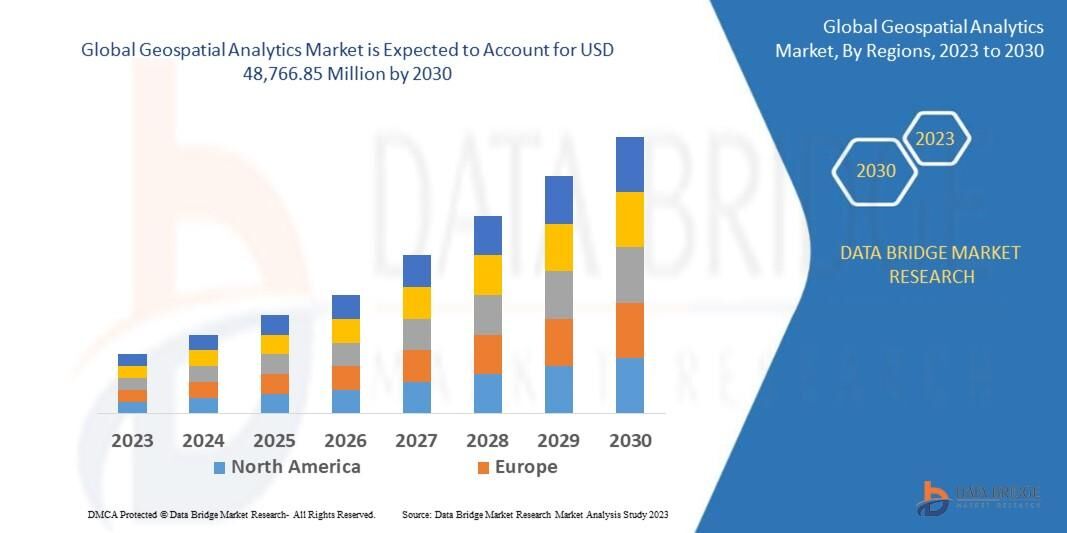

According to the latest report published by Data Bridge Market Research, the Geospatial Analytics Market
Data Bridge Market Research analyses that the global geospatial analytics market which was USD 22,585.31 million in 2022, and is expected to reach USD 48,766.85 million by 2030, and expected to undergo a CAGR of 10.1% during the forecast period of 2023 to 2030.
Geospatial Analytics Market report is a window to the industry which talks about what market definition, classifications, applications, engagements and market trends are. This report analyzes the status and future forecast involving sales, value (revenue), growth rate (CAGR), market share, historical and forecast in the major regions of the world. While building this market report, client business competence is understood adeptly to identify tangible growth opportunities. It provides the key manufacturers, presenting the sales, revenue, market share, and recent development for key players. The world class Geospatial Analytics Market report makes some important proposals for a new project of Geospatial Analytics Market industry before evaluating its feasibility.
Stay informed with our latest keyword market research covering strategies, innovations, and forecasts. Download full report: https://www.databridgemarketresearch.com/reports/global-geospatial-analytics-market
Geospatial Analytics Market Segmentation and Market Companies
Segments
- On the basis of Component, the Global Geospatial Analytics Market can be segmented into Software, Services.
- Based on Type, the market is categorized into Surface & Field Analytics, Network & Location Analytics, Geovisualization.
- By Technology, the market can be divided into Remote Sensing, GPS, GIS.
- Regarding Application, the market segments include Surveying, Disaster Risk Reduction & Management, Climate Change Adaptation.
- In terms of End-User, the market is segmented into Government, Defense & Intelligence, Utility & Communication, Business.
- Geographically, the market is segmented into North America, Europe, Asia-Pacific, South America, Middle East & Africa.
Market Players
- The key players in the Global Geospatial Analytics Market include Trimble Inc., Hexagon AB, Harris Corporation, DigitalGlobe, Esri, Google, General Electric, Fugro N.V., RMSI, Bentley Systems Incorporated, and others. These players are focusing on partnerships, collaborations, and new product launches to enhance their market presence and expand their customer base.
The Global Geospatial Analytics Market is witnessing significant growth due to the increasing adoption of location-based data and spatial analytics across various industries. Geospatial analytics helps organizations in making informed decisions by analyzing and visualizing geographical data. The demand for geospatial analytics is rising in sectors such as urban planning, natural resource management, transportation, and agriculture, driving market growth.
North America holds a significant share in the geospatial analytics market due to the presence of major players and the early adoption of advanced technologies in the region. Europe is also witnessing substantial growth in the market with increasing investments in smart city projects and infrastructure development. The Asia-Pacific region is expected to experience the highest growth rate during the forecast period, attributed to rapid urbanization, technological advancements, and government initiatives to promote digitalization.
The software segment dominates the market due to the increasing demand for advanced analytics tools for processing spatial data efficiently. Services segment is also growing rapidly as organizations opt for consulting, training, and support services to effectively implement geospatial analytics solutions. Remote sensing technology is widely used for collecting spatial data, while GIS technology is essential for data integration and analysis.
Overall, the Global Geospatial Analytics Market is poised for significant growth in the coming years, driven by the increasing use of location-based data in decision-making processes across industries. With technological advancements and the development of innovative solutions, the market is expected to witness continued expansion and new opportunities for market players.
Geospatial analytics has increasingly become a critical tool for various industries, enabling them to gain insights and make informed decisions based on geographical data. One notable trend in the market is the growing integration of geospatial analytics with other technologies such as artificial intelligence and machine learning, enhancing the capabilities of spatial data analysis. This integration allows for more accurate predictions and better decision-making, driving the demand for geospatial analytics solutions across different sectors.
Another emerging trend is the focus on sustainability and environmental applications of geospatial analytics. Organizations are leveraging these tools to monitor and manage natural resources, track environmental changes, and support conservation efforts. The use of geospatial analytics in climate change adaptation and disaster risk reduction is becoming increasingly important, highlighting the versatility and significance of these solutions in addressing global challenges.
The market is also witnessing an increase in the adoption of geospatial analytics in the healthcare and retail sectors. In healthcare, geospatial analytics is utilized for optimizing healthcare delivery, resource allocation, and disease surveillance. Retail companies are leveraging location-based data to improve customer targeting, optimize store locations, and enhance supply chain management. These emerging applications indicate the expanding utility of geospatial analytics beyond traditional industries.
Furthermore, the competitive landscape of the geospatial analytics market is characterized by intense competition among key players vying for market share. Companies are focusing on product innovation, strategic partnerships, and expansion into new geographic regions to strengthen their competitive position. Mergers and acquisitions are also prevalent in the market as players seek to enhance their technological capabilities and broaden their service offerings.
As the global economy continues to evolve, the demand for geospatial analytics is expected to grow exponentially, driven by the need for data-driven decision-making, digital transformation initiatives, and the increasing importance of location intelligence. The market is poised for sustained growth as organizations recognize the value of geospatial analytics in gaining a competitive edge, improving operational efficiency, and driving innovation across various sectors. With ongoing technological advancements and a growing focus on sustainability and resilience, the geospatial analytics market is set to witness continued expansion and transformation in the years to come.The Global Geospatial Analytics Market is a dynamic and rapidly evolving sector with various segments catering to different components, types, technologies, applications, end-users, and geographical regions. Market players such as Trimble Inc., Hexagon AB, and Esri are leading the market through strategic partnerships, collaborations, and innovative product launches. The increasing adoption of geospatial analytics across industries like urban planning, transportation, and agriculture is fueling market growth, with North America currently holding a significant market share due to the presence of major players and advanced technologies. Europe and the Asia-Pacific region are also experiencing substantial growth, driven by investments in smart city projects and rapid urbanization, respectively.
One notable trend in the market is the integration of geospatial analytics with artificial intelligence and machine learning technologies, enhancing spatial data analysis capabilities and enabling more accurate predictions. Sustainability and environmental applications are emerging trends, with organizations using geospatial analytics for natural resource management, environmental monitoring, and climate change adaptation. The healthcare and retail sectors are increasingly leveraging geospatial analytics for optimizing operations, resource allocation, customer targeting, and supply chain management, demonstrating the versatile applications of these solutions beyond traditional industries.
In the competitive landscape, key players are focusing on product innovation, strategic partnerships, and geographic expansion to solidify their market positions. Mergers and acquisitions are common strategies employed by companies to enhance technological capabilities and broaden service offerings. As organizations worldwide recognize the value of geospatial analytics in driving data-driven decision-making, operational efficiency, and innovation, the market is projected to witness significant growth in the coming years. With ongoing technological advancements and a growing emphasis on sustainability and resilience, the geospatial analytics market is poised for continuous expansion and transformation, offering new opportunities for market players and contributing to the global economy's digital transformation.
Frequently Asked Questions About This Report
What is the long-term future outlook for the Geospatial Analytics Market (2033 and beyond)?
How is the Geospatial Analytics Market responding to inflation?
What percentage of the global food/tech/healthcare economy does the Geospatial Analytics Market represent?
How is the Geospatial Analytics Market expected to change by 2033 regarding sentiment?
How does the Geospatial Analytics Market in Europe address data privacy concerns?
How is Artificial Intelligence (AI) being integrated into the Geospatial Analytics Market?
How are companies using Customer Data Platforms (CDP) in the Geospatial Analytics Market?
What is the market valuation of the Geospatial Analytics Market industry in China and India?
How is the Geospatial Analytics Market catering to Remote Work needs?
How are market leaders addressing the shortage of raw materials?
Which region has the highest per-capita spending on Geospatial Analytics Market products?
Browse More Reports:
Global Oracle Services Market
Global Mobile Phone Accessories Market
Global Aquaculture Equipment Market
Global Electron Microscope Market
Global Myopia Treatment Market
Global VSaaS Market
Global Glass Tableware Market
Global Thermal Management Market
Global Microfluidics Market
Global Surface Mount Technology (SMT) Equipment Market
Global Electronic Data Capture (EDC) Systems Market
Global Epoxy Resin Market
Global Automation and Control Market
Global Agricultural Drones Market
Global Iodine Market