

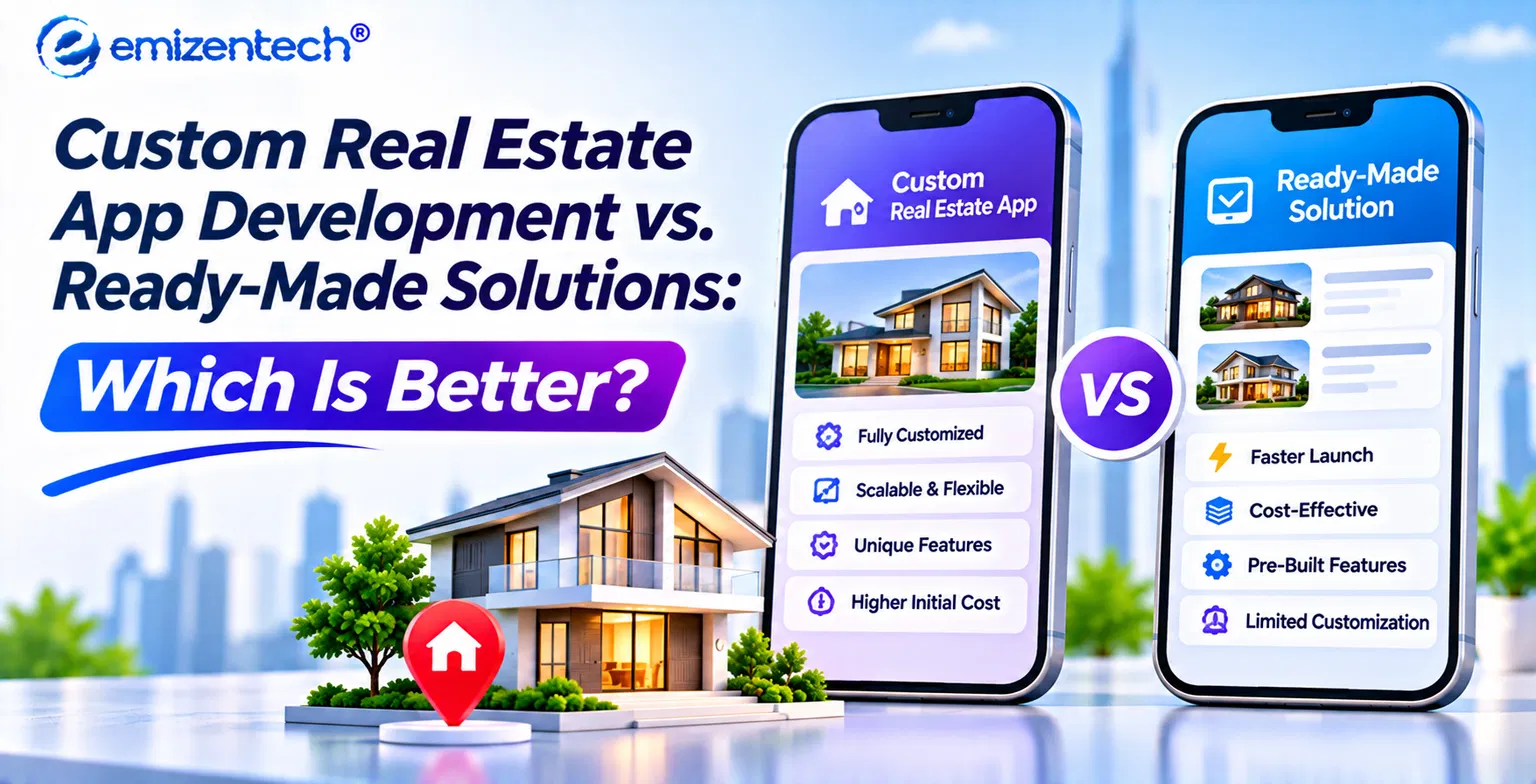
Custom Real Estate App Development vs. Ready-Made Solutions: Which Is Better?

Every property platform starts with one decision: build something tailored or launch on a ready-made script. Both routes can work, but they lead to very different results in cost, control, and growth. A template gets you live quickly, while a custom build gives you a product shaped around your users. This guide compares the two so you can match the approach to your goals, budget, and timeline.
What Is Custom Real Estate App Development?
Custom development means building an app from the ground up, with its architecture, features, and design tailored to your business requirements. Instead of relying on fixed templates, you get greater control over the app's functionality, appearance, and user experience. The result is a product that fits your target market and business goals.
A dedicated real estate app development company starts with discovery, maps user journeys, and builds the app in agile sprints. This approach supports property marketplaces, rental platforms, agent tools, and investor dashboards. It also allows advanced features such as AI-powered recommendations, valuation models, and AR property tours.
What Are Ready-Made Real Estate App Solutions?
Ready-made solutions are pre-built platforms or scripts that come with a fixed set of features. You install them, add your branding, and publish listings within weeks. They suit simple use cases, though the feature set, design, and data structure are largely decided before you begin.
Typical examples include white-label listing portals, clone scripts, and subscription-based property software. You usually pay license or monthly fees, and the vendor controls updates, hosting rules, and the product roadmap.
Custom vs. Ready-Made: Side-by-Side Comparison
The differences become clear once you compare both routes across the factors that shape long-term success. Some favor speed; others favor control. Use this table as a quick reference before reading the detail that follows.
|
Factor |
Custom Development |
Ready-Made Solution |
|
Upfront cost |
Higher investment |
Lower entry price |
|
Launch time |
Months, delivered in phases |
Weeks |
|
Features |
Built around your needs |
Fixed set, limited add-ons |
|
Scalability |
Architected for growth |
Often capped by the base code |
|
Integrations |
MLS, IDX, CRM, payments built to spec |
Limited to what the vendor supports |
|
Ownership |
Full code and IP transfer |
License only |
|
Long-term cost |
Predictable maintenance |
Recurring fees and upgrade charges |
Where Custom Development Delivers More Value
Custom builds pay off when the app is central to your revenue or when your workflow is unique. The upfront effort is larger, but the control you gain tends to compound as your user base grows.
Integrations are the first advantage. Property apps depend on MLS and IDX feeds, CRM tools, e-signatures, maps, and payment gateways, and a custom build connects each one cleanly instead of working around vendor limits.
Scale is the second. Multi-branch workflows, role-based access, and heavy listing traffic need architecture designed for load, not a script stretched past its limits.
Ownership is the third. With custom work you receive the full codebase and intellectual property, protected by an NDA, so no vendor can change pricing or remove features from under you.
Where Ready-Made Solutions Make Sense
Ready-made options are not a bad pick, just a narrower one. They fit specific situations where speed and low cost matter more than differentiation. Knowing those situations helps you avoid paying for flexibility you do not need.
They work for testing a niche idea, running a small local listing site, or launching a proof of concept to gather feedback. Once traffic grows or users ask for features the script cannot support, migration becomes the next problem, and moving data to a new platform costs time and often hurts search visibility.
How to Decide Which Option Fits Your Goals
There is no universal winner, only a better fit for your situation. Answer the questions below honestly, and the right direction usually becomes obvious. If you are still unsure, a short consultation can save months of rework.
-
Is the app your core product or a supporting tool? A core product that drives revenue usually deserves a custom build.
-
Do you need MLS, IDX, CRM, or AI features? Complex integrations and intelligent features are far easier to deliver on custom architecture.
-
How fast will your user base grow? Rapid growth exposes the limits of ready-made code quickly.
-
Do you want to own the code and data? If ownership matters, custom development is the only route that provides it.
Before committing to either path, talk through your roadmap with an experienced development team, since an honest audit often shows which route saves more over time.
Conclusion
Ready-made solutions get you live fast, but custom development gives you control over features, integrations, scale, and ownership. Start with your revenue model and growth plan, then pick the route that supports both. Emizentech builds tailored real estate platforms with AI features, MLS and IDX integrations, and long-term support, so your app keeps pace as your market changes.
FAQs
1. Is custom real estate app development more expensive than ready-made software?
The upfront cost is higher. However, ready-made software adds license fees, paid add-ons, and migration costs over time, which can narrow the gap.
2. How long does it take to build a custom real estate app?
A focused MVP usually takes three to four months, while a feature-rich platform can take six to nine months. Ready-made options can go live in a few weeks.
3. Can I start with a ready-made app and switch to custom later?
Yes, but it means rebuilding and migrating your data. Planning for data export from day one makes that move smoother.
4. Do ready-made apps support MLS and IDX integration?
Some offer limited feeds, but customization is restricted. A custom build can connect MLS, IDX, and third-party data sources exactly as your platform needs.
5. Who owns the code in a custom project?
You do. A professional agreement includes an NDA and full intellectual property transfer, covering the codebase, datasets, and project components after completion.














