


Safe System of Work: How to Make Workplace Safety Part of Every Task
Safe System of Work: How to Make Workplace Safety Part of Every Task
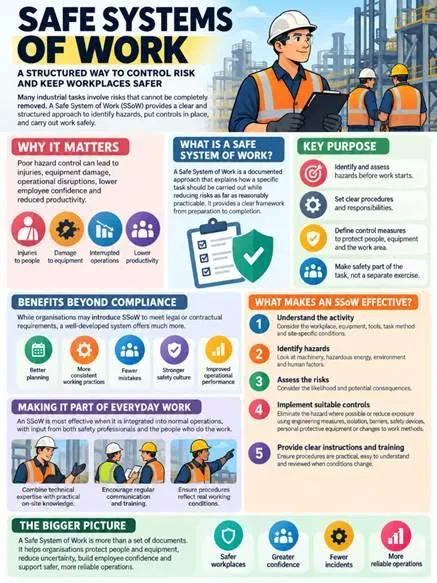
Industrial environments often contain tasks where risk cannot be eliminated entirely. Performing the same activity repeatedly does not remove the hazards connected with it. Workers may use heavy machinery, maintain essential equipment, carry out work at height, or operate close to energised systems, making disciplined execution and effective controls necessary. These activities may be routine and essential to keeping work moving, but familiarity should never encourage complacency. Before any task begins, possible sources of harm still need to be recognised, assessed, and controlled.
Workplace safety therefore has to be more than documentation prepared for inspections, audits, or compliance purposes. Construction sites, manufacturing facilities, utility operations, offshore locations, and similarly demanding workplaces need practical arrangements that help necessary work continue safely without creating avoidable disruption. Weak hazard controls can affect far more than the individual performing the task. An incident may lead to injuries, equipment damage, operational delays, reduced confidence among employees, and falling productivity, with effects that can remain long after the event itself.
A Safe System of Work (SSoW) provides a structured method for addressing these risks before they turn into an incident. Its purpose is not merely to demonstrate that safety was discussed. It creates a defined process for preparing, organising, controlling, and completing a particular activity. By replacing assumptions and informal decisions with clear procedures, responsibilities, and precautions, an SSoW can reduce uncertainty and encourage workers to think about hazards before starting. Safety therefore becomes part of the task itself rather than something considered only after a problem appears.
Understanding the Purpose of a Safe System of Work
A Safe System of Work is a documented method describing how a specific activity should be completed while reducing its related risks as far as reasonably practicable. It gives employees a consistent framework covering the work from initial preparation through completion. Setting expectations in advance can remove uncertainty and reduce the likelihood that workers will make rushed, inconsistent, or improvised decisions once the activity is underway.
In practical terms, an SSoW acts as a task specific working guide. It can explain the sequence in which activities should happen, identify the conditions that must be satisfied before work starts, and assign responsibility for particular duties. It may also outline the precautions and protective measures needed to protect employees, equipment, and the surrounding work area.
Once these arrangements become part of normal working practice, safety does not need to operate as a separate activity beside production or operations. Safe performance becomes part of how work is prepared, coordinated, supervised, and completed. Employees have a clearer picture of what is expected, while supervisors and managers gain a practical framework for controlling and directing the activity.
Moving Beyond Compliance
Organisations may establish Safe Systems of Work to meet legal responsibilities, contractual conditions, recognised industry practices, or internal expectations. Meeting those obligations is important, yet compliance represents only part of the value a properly developed SSoW can provide. A strong system can bring additional structure to tasks, strengthen control, and help create more consistent working practices across teams and locations.
Advance planning is one of its major benefits. When hazards are considered before work starts and suitable controls are prepared in advance, employees are less likely to encounter unfamiliar situations without guidance. They are also less likely to make decisions under pressure with little time to consider the consequences. Standardised procedures can give teams, shifts, and sites a common method for completing comparable activities. Greater consistency can reduce preventable errors and make the expected way of working easier to recognise and follow.
A well planned SSoW can also contribute to a stronger safety culture. Employees may be more likely to follow procedures when they understand that controls are based on actual workplace hazards and are designed to protect them, rather than being created solely for management or external review. Clear arrangements can also encourage workers to report concerns, share practical observations, and cooperate more effectively with supervisors and colleagues.
When employees and management begin to view safe work as a responsibility shared throughout the organisation, safety can become part of ordinary behaviour. It is no longer simply a rule passed down by senior management. Instead, it becomes a normal consideration whenever work is planned, communicated, coordinated, or performed.
There can also be operational benefits. Fewer incidents can reduce interruptions, investigations, corrective measures, and unexpected downtime. Better organised working conditions can help activities move forward more reliably and support productivity. Keeping clear records provides useful evidence for audits while also helping organisations review existing methods, identify weaknesses, and determine where further improvement could be required.
What Makes an SSoW Effective?
An SSoW should never be reduced to a standard form completed simply because a procedure requires it. It needs to start with a detailed understanding of the activity. This involves considering the workplace, equipment, tools, task method, and site specific circumstances that may affect how the work is performed. Thorough preparation is important because hazards overlooked during planning can remain unnoticed until the task is already in progress. This becomes particularly important when conditions change, several people are involved, or multiple controls must operate together.
Once the activity is understood, potential hazards should be identified systematically. This includes anything capable of causing harm, such as machinery, hazardous energy, environmental conditions, and human factors. Attention should also be given to circumstances that influence employee behaviour and performance. Fatigue, demanding workloads, deadline pressure, and the temptation to finish quickly can all affect the way a task is carried out.
Each identified risk should then be assessed by considering both the likelihood of an unwanted event and the seriousness of the resulting consequences. This allows the organisation to distinguish risks requiring greater attention and determine where stronger controls may be needed.
The next step is selecting appropriate controls. Where reasonably practicable, removing the hazard completely is preferable to depending solely on measures that limit exposure. Where elimination cannot be achieved, controls should reduce the opportunity for exposure or minimise the potential consequences if an event occurs. Depending on the task, these may include engineering controls, equipment isolation, physical barriers, safety devices, personal protective equipment, or changes to existing work methods.
The procedure itself must also be practical and clear enough for real working conditions. It should reflect situations employees are genuinely likely to encounter instead of presenting an idealised version of the job. At the same time, instructions need to be simple enough for workers to understand and apply correctly.
Training is equally important to the effectiveness of the system. A procedure cannot deliver its intended protection if employees do not understand the requirements or how those requirements should be applied. The SSoW should also be reviewed at appropriate intervals and whenever significant changes occur. New equipment, technologies, processes, or workplace circumstances may introduce different hazards and can make an existing procedure unsuitable.
Making Safe Systems Part of Everyday Work
An SSoW delivers the greatest value when it is integrated into normal operations instead of being kept as a document separate from the work itself. Achieving that requires contributions from different people across the organisation. Safety professionals can provide technical expertise, risk management knowledge, and specialist advice. Employees performing the task bring another critical perspective: direct practical knowledge of how the work actually happens.
Bringing these perspectives together can produce procedures that manage hazards effectively while still being realistic for the people expected to follow them. A system can look appropriate on paper yet become difficult to use when its instructions do not reflect the conditions workers face in practice.
Ongoing communication, suitable training, and regular reinforcement can help safe methods become established habits. When Safe Systems of Work are genuinely incorporated into daily operations, duties can become clearer, coordination can improve, and the likelihood of incidents may be reduced.
Over time, this way of working can influence the broader workplace culture. Safety becomes part of everyday planning and decision making rather than a separate programme that employees consult only when a specific requirement tells them to do so.
Ultimately, a Safe System of Work is not simply a set of documents created to prove compliance. It is a structured approach for identifying workplace hazards, assessing associated risks, establishing controls, and providing consistent direction for employees carrying out tasks. Through this approach, organisations can help protect people and equipment while supporting more dependable operational performance.
When an SSoW is thoughtfully developed, clearly communicated, regularly reviewed, and fully integrated into everyday work, it can reduce uncertainty and strengthen employee confidence. Most importantly, it helps make safe working part of the way an organisation prepares and performs its activities, rather than treating safety as something separate from the work itself.
Book a free demo @ https://toolkitx.com/blogsdetails.aspx?title=Safe-System-of-Work-(SSoW)-Meaning,-Definition,-Examples-and-HSE-Requirements

 English
 Arabic
 French
 Spanish
 Portuguese
 Deutsch
 Turkish
 Dutch
Dutch
 Italiano
 Romaian
 Portuguese (Brazil)
 Greek
Greek
 Hrvatski
 Cehoslowakia