


Workplace Incident Reporting Under RIDDOR: What Organisations Need to Know
Workplace Incident Reporting Under RIDDOR: What Organisations Need to Know
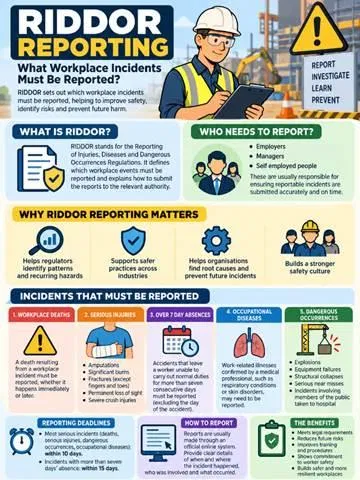
Even with careful planning and strong workplace controls, no organisation can remove every possible risk. Unforeseen incidents can still occur, and UK law requires certain workplace events to be formally reported. RIDDOR reporting provides a structured way to document, review, and understand serious incidents. Recording major injuries, occupational diseases, and dangerous near misses helps organisations understand what happened and reduce the chance of similar events happening again across the organisation and over time as well.
RIDDOR stands for the Reporting of Injuries, Diseases and Dangerous Occurrences Regulations. It defines workplace events that require notification and explains how reports should be submitted. In many situations, reports are sent to the Health and Safety Executive, although certain workplaces may fall under local authority responsibility depending on the work and setting involved.
The reporting responsibility does not normally sit with everyone present at a workplace. It generally falls on those responsible for managing work, activities, or workplace conditions. Employers, managers, and self employed individuals are typically expected to ensure applicable incidents are reported accurately and within the relevant timeframe.
RIDDOR serves a purpose beyond satisfying a legal obligation. Reports can help regulators identify recurring hazards, detect patterns, and encourage better safety practices across industries. This can be particularly valuable in sectors such as construction, manufacturing, oil and gas, and facilities management, where incident information supports ongoing risk reduction and safety improvements.
Organisations also gain practical value from dependable incident records. Accurate information makes recurring issues easier to recognise, underlying causes easier to investigate, and hidden weaknesses easier to uncover. Businesses can then introduce preventive actions before minor concerns develop into serious safety problems.
Failing to report an incident that meets the requirements can have serious legal consequences, including fines, investigations, and damage to an organisation’s reputation. Accurate reporting, by contrast, shows that an organisation recognises its responsibilities, values worker protection, and is committed to maintaining safe working conditions.
RIDDOR reporting can also support a positive safety culture. Every recorded incident creates an opportunity to review procedures, strengthen training, and improve controls. Over time, this process can shift attention towards preventing incidents rather than simply dealing with their consequences after an accident.
Not every workplace event is covered by RIDDOR. An incident must meet defined legal criteria, generally connected with its seriousness or potential impact, before formal reporting becomes necessary. A death resulting from a workplace incident must be reported, whether the person dies immediately or later because of the event.
Certain serious injuries are also reportable, including amputations, significant burns, fractures excluding those involving fingers and toes, permanent loss of sight, and severe crush injuries. An accident may also become reportable when it leaves a worker unable to perform normal duties for a prolonged period. When an employee cannot carry out usual responsibilities for more than seven consecutive days after an accident, the event must be reported, with the accident day excluded from that period.
Occupational diseases may require notification when a medical professional confirms that workplace exposure caused the condition or made it worse. Examples can include respiratory conditions and skin disorders associated with particular working environments.
Dangerous occurrences, sometimes called near misses, can fall under reporting requirements when an incident had the potential to cause serious harm. Examples include explosions, equipment failures, and structural collapses, even when nobody was injured. Incidents involving members of the public may also be reportable when a non worker is taken directly to hospital because of an accident connected with workplace activities.
The formal reporting duty generally rests with the person or organisation responsible for the workplace. Usually, this is the employer or an appointed manager. Self employed individuals running their own businesses are similarly responsible for meeting the reporting obligations that apply to their activities.
Employees, contractors, and visitors are not usually required to submit the formal report. However, they should inform the appropriate responsible person when an incident occurs, helping ensure reporting duties are completed within the required timeframe.
Meeting reporting deadlines is an important part of compliance. Major incidents, fatalities, dangerous occurrences, occupational diseases, and serious injuries generally need to be reported promptly, usually within ten days. Incidents resulting in an absence lasting more than seven days generally need to be reported within fifteen days.
Reports are generally made through an official online reporting system. Providing accurate details, including when and where the incident happened, who was involved, and what occurred, makes the report more useful for formal review. The information can also support an organisation’s internal safety investigations and improvement efforts.
Ultimately, RIDDOR reporting should be viewed as more than paperwork. It strengthens accountability, supports transparency, and contributes to workplace safety improvement. Organisations that fulfil their reporting responsibilities can meet legal duties while using incident information to create working environments that are safer, better prepared, and more resilient for everyone.
Book a Free Demo @ https://toolkitx.com/blogsdetails.aspx?title=RIDDOR-Reporting:-What-Must-Be-Reported-and-How
 English
 Arabic
 French
 Spanish
 Portuguese
 Deutsch
 Turkish
 Dutch
Dutch
 Italiano
 Russian
 Romaian
 Portuguese (Brazil)
 Greek
Greek
 Hrvatski
 Cehoslowakia