


JHA vs. TRA: Choosing the Right Approach to Workplace Safety
JHA vs. TRA: Choosing the Right Approach to Workplace Safety
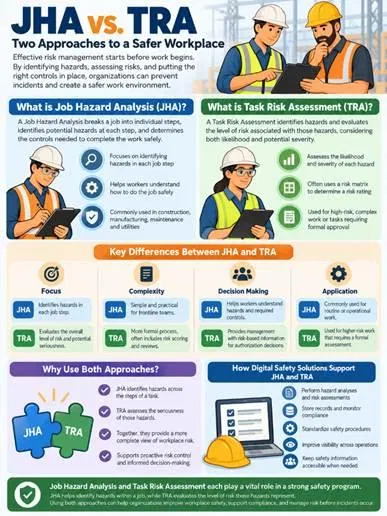
Effective workplace risk management starts before an incident occurs. Safety focused organizations do not wait for failures or injuries to reveal weaknesses. Instead, they use structured processes to recognize hazards, evaluate risks, and establish controls before work begins. Two common approaches within safety programs are Job Hazard Analysis (JHA) and Task Risk Assessment (TRA).
Understanding the distinction can help organizations strengthen safety practices, support compliance, and reduce workplace incidents.
What Is Job Hazard Analysis?
Job Hazard Analysis examines how a job is performed by breaking the activity into individual steps. For each step, the team identifies potential hazards and determines which controls should be used to prevent harm.
The main goal of a JHA is hazard identification. Looking at the job one stage at a time can reveal dangers that might be missed during a general review. It can also help workers understand the safest way to perform the task and confirm that preventive measures are prepared before work begins.
JHAs are frequently used in construction, manufacturing, maintenance, and utilities, particularly when a job contains multiple steps that may expose employees to different hazards.
What Is Task Risk Assessment?
Task Risk Assessment gives more emphasis to the level of risk associated with identified hazards. Like a JHA, it looks for hazards, but it also considers how likely an incident may be and how severe the consequences could be.
Organizations may use a risk matrix to combine these factors and produce a risk rating. That rating can help determine whether additional controls, precautions, or approvals are needed before the activity moves forward.
TRAs are especially useful for higher risk work, complicated activities, and tasks that require formal approval before execution.
JHA vs. TRA: What Sets Them Apart?
Both approaches support safer operations, but several distinctions separate them.
Focus
A JHA concentrates on the hazards associated with each stage of the job. A TRA gives more attention to the level of risk those hazards create and the potential seriousness of their outcomes.
Complexity
JHAs are generally straightforward and practical, making them suitable for frontline teams. TRAs often involve a more structured evaluation that can include risk ratings, scoring, and additional review steps.
Decision Making
JHAs help workers see the hazards involved and understand the controls needed to perform the task safely. TRAs provide management with risk based information that can guide decisions and help determine whether an activity should be formally authorized.
Application
JHAs are commonly used for routine and operational activities. TRAs are more often applied to work where the potential risk is higher and a formal assessment is needed before the task starts.
Why Combine JHA and TRA?
Organizations do not have to choose between the two methods. They can be used together to create a complete view of workplace risk. A JHA can identify hazards throughout the steps of a task, while a TRA can assess the seriousness of those hazards and show whether additional protections are required.
Used together, they support a proactive approach in which hazards are identified early, risks are evaluated, and decisions are made with greater confidence.
How Digital Safety Solutions Can Help
As organizations move away from paper based safety processes, digital workflows can make these activities easier to manage. Digital safety systems can support hazard analysis, risk assessment, record storage, and compliance monitoring within a single platform.
Such tools can help standardize procedures, improve visibility across operations, and make safety information easier to access when needed.
Job Hazard Analysis and Task Risk Assessment each have a valuable place in a strong safety program. JHA focuses on finding hazards within the steps of a job, while TRA evaluates the level of risk connected to those hazards through a structured process. Recognizing how the two approaches differ and complement one another can help organizations strengthen workplace safety, support compliance, and manage risk before problems occur.
Book a free demo @ https://toolkitx.com/blogsdetails.aspx?title=job-hazard-analysis-vs-task-risk-assessment
 English
 Arabic
 French
 Spanish
 Portuguese
 Deutsch
 Turkish
 Dutch
Dutch
 Italiano
 Russian
 Romaian
 Portuguese (Brazil)
 Greek
Greek
 Hrvatski
 Cehoslowakia