


How Incident Management Helps Organizations Reduce Risk and Disruption
How Incident Management Helps Organizations Reduce Risk and Disruption
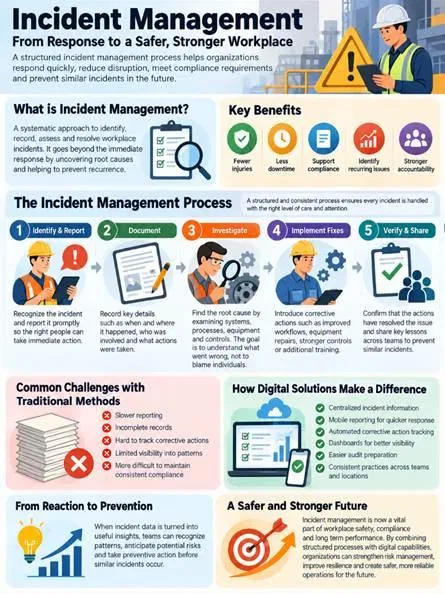
Workplace incidents and interruptions to normal operations cannot always be prevented, yet the way an organization handles them reveals how prepared, resilient, and serious it is about protecting its workforce. A well established incident management process allows teams to respond quickly, reduce disruption, meet compliance expectations, and make repeat events less likely. As business environments become more complex and fast moving, paper based procedures and isolated systems often struggle to provide the speed and visibility organizations need. This is driving interest in digital approaches that connect people, information, and actions.
At its core, incident management gives an organization a method for recognizing, recording, reviewing, and resolving incidents. Immediate action matters because it helps bring a situation under control, but management should go beyond the initial response. It should also reveal why the event occurred and what can be changed to prevent a repeat. The principle applies across industries, whether a factory is dealing with equipment hazards or a service business is managing an operational failure. In every case, the aim is to restore normal activity efficiently while using the experience to improve safety and performance.
An incident management approach delivers benefits beyond regulatory compliance. By giving teams a process, organizations can identify warning signs earlier and address risks before they grow into more serious events. Clear procedures may reduce injuries, minimize lost time, support compliance, uncover recurring issues, and reinforce responsibility across the business. Even an event that appears minor can create greater consequences when it is ignored or handled inconsistently. A structured approach ensures that each incident receives suitable attention and important lessons are not overlooked.
The process typically follows connected steps. It starts when an event is recognized and reported quickly, allowing personnel to understand what has happened and respond to immediate risks. Careful documentation comes next, capturing information such as the location, timing, people involved, circumstances, and actions already taken. Accurate records serve a wider purpose than satisfying documentation requirements. They provide a dependable history that can later be examined to compare incidents, identify trends, and establish a clearer understanding of what took place.
After the facts have been captured, attention turns to investigation and root cause analysis. The goal is not to identify who was involved or assign fault. Instead, the investigation should uncover shortcomings in processes, equipment, systems, procedures, or safety controls that may have contributed to the event. Once contributing factors are understood, corrective measures can be selected and put into practice. These may include changing workflows, fixing or replacing equipment, improving controls, or providing employee training. Closing the incident should depend on verification that the chosen actions have addressed the underlying issue rather than merely being assigned. Relevant lessons should then be shared with other teams or departments, allowing one event to support broader organizational learning. Repeating this cycle can gradually improve workplace safety and operational effectiveness.
Even with these advantages, many organizations still handle incidents through paper forms or separate applications. These methods can create reporting delays, incomplete records, and poor visibility into outstanding corrective actions. They may also make it harder to recognize recurring patterns, turn information into useful insight, or maintain a consistent view of performance. When information is fragmented, managers may have less evidence for decisions, while maintaining consistent compliance across departments and locations becomes more difficult.
Digital technology provides another way to organize this work. Cloud based platforms can place incident information in one central environment while automating routine activities, helping teams respond faster and maintain consistent follow up. Functions such as mobile reporting, automated corrective action monitoring, centralized dashboards, and easier audit preparation can simplify the process and improve visibility. With information more accessible, managers can see which actions remain open, examine previous incidents, and apply consistent practices across teams or locations without excessive administrative effort.
One of the most valuable advantages of digital incident management is its ability to support prevention as well as response. When incident information is organized and transformed into practical insight, teams can identify patterns, recognize emerging concerns, and act before comparable events happen again.
As organizations adapt to changing operating conditions, incident management has become more than a supporting administrative function. It plays an important role in workplace safety, compliance, resilience, and long term operational performance. Organizations that pair a disciplined incident process with digital capabilities can better understand risk, improve performance, and respond to changing demands. The real value lies in treating every incident as an opportunity to learn, strengthen controls, and make future operations safer and more reliable.
Book a free demo @ https://toolkitx.com/blogsdetails.aspx?title=Incident-Management-Process:-Step-by-Step-Guide-to-Improve-Workplace-Safety-and-Compliance

 English
 Arabic
 French
 Spanish
 Portuguese
 Deutsch
 Turkish
 Dutch
Dutch
 Italiano
 Russian
 Romaian
 Portuguese (Brazil)
 Greek
Greek
 Cehoslowakia