
How NGOs Can Manage Donor Information and Donation Records Efficiently

Managing donor information is an important responsibility for every non-governmental organization. As an NGO grows, it may receive contributions from individuals, corporate partners, community groups, and fundraising campaigns. Keeping track of these relationships requires more than recording donation amounts. Organizations also need reliable information about contributors, payment histories, communication preferences, and issued acknowledgments.
A well-organized donor record management system helps NGOs maintain accurate information, improve communication, and make fundraising activities more efficient. It also supports better financial administration and helps organizations build stronger relationships with their supporters.
What Is Donor Information Management?
Donor information management refers to the process of collecting, organizing, updating, and protecting information related to people and organizations that contribute to an NGO.
Depending on the organization's requirements, donor records may include:
-
Donor name or organization name.
-
Contact information.
-
Donation dates.
-
Contribution amounts.
-
Payment methods.
-
Transaction references.
-
Receipt numbers.
-
Donation frequency.
-
Campaign or project preferences.
-
Communication preferences.
NGOs should collect only the information necessary for legitimate organizational activities and applicable compliance requirements.
Why Organized Donor Records Matter for NGOs
When donor information is scattered across notebooks, spreadsheets, emails, and separate payment reports, administrative teams may struggle to find accurate details.
A centralized system can improve daily operations in several ways.
1. Better Donor Communication
Accurate contact information helps NGOs send acknowledgments, fundraising updates, and relevant project information to the intended recipients.
2. Easier Donation History Tracking
Organizations can review previous contributions and understand how individual supporters have participated in their activities.
3. Fewer Documentation Errors
Maintaining consistent records reduces the risk of duplicate donor profiles, incorrect names, and mismatched transaction information.
4. Improved Fundraising Planning
Historical contribution information can help NGOs understand fundraising patterns and plan future campaigns more effectively.
5. Stronger Financial Accountability
Connecting donor information with transaction records makes it easier to verify contributions and retrieve relevant documentation.
How to Build a Centralized Donor Database
A donor database does not necessarily need to be complicated. Small NGOs can begin with a well-organized spreadsheet, while larger organizations may require dedicated donor management software.
The first step is to establish a consistent record structure.
Create Individual Donor Profiles
Each donor should have an identifiable record. This helps prevent information from being scattered across multiple files.
Maintain Accurate Contact Details
Organizations should periodically review contact information and correct outdated entries.
Record Contribution Histories
Each successful donation should be connected to the appropriate donor profile. Include the date, amount, payment method, transaction reference, and relevant acknowledgment number.
Separate Individual and Institutional Donors
Individual supporters and corporate contributors may require different communication and documentation procedures. Keeping their records appropriately categorized can improve administrative efficiency.
Establish an Update Process
Assign responsibility to authorized staff members for updating donor information and correcting errors.
Connecting Donor Records with Donation Receipts
Donor information and donation acknowledgments should be connected through a reliable recordkeeping process.
For example, when a supporter contributes Rs. 3,000 to an NGO, the organization should verify the payment, identify the donor, record the transaction, and prepare the appropriate acknowledgment.
A properly prepared NGO donation receipt can help document the contribution and provide the donor with a record of the transaction.
The NGO should retain its own supporting records and ensure that the receipt amount, donor details, date, and payment information match the verified transaction.
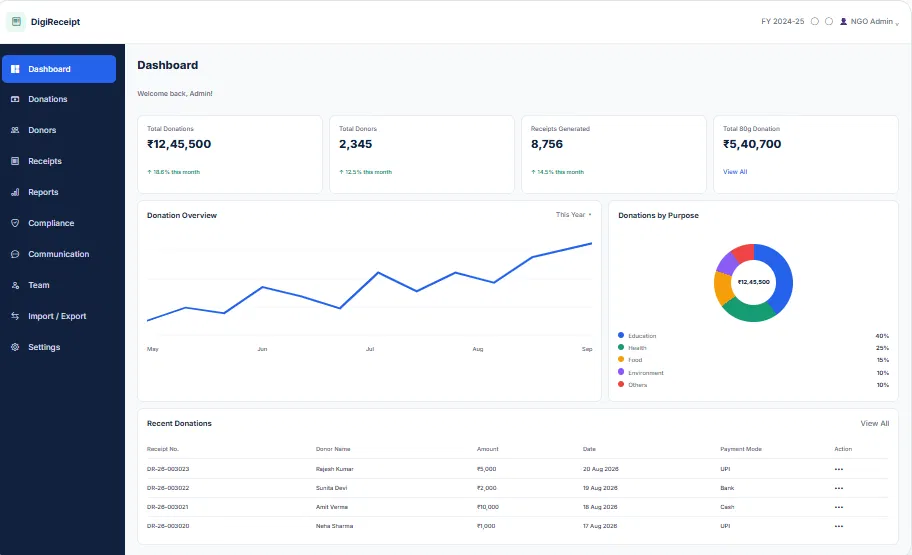
How Digital Tools Can Improve Donor Record Management
Managing a large donor database manually can become difficult, especially when multiple employees handle fundraising and administrative responsibilities.
Digital tools may help NGOs organize information and reduce repetitive work.
Some capabilities worth evaluating include:
-
Centralized donor profiles.
-
Searchable contribution histories.
-
Receipt preparation and record retrieval.
-
Donation categorization.
-
Communication tracking.
-
Data export options.
-
User access permissions.
-
Backup and security controls.
Before choosing a platform, NGOs should compare its features with their actual operational needs. They should also examine data protection practices and ensure that sensitive information is accessible only to authorized users.
Maintaining Donor Communication History
A donor relationship involves more than receiving financial contributions. Organizations may communicate with supporters through acknowledgment messages, newsletters, project updates, fundraising invitations, and annual reports.
Keeping a basic communication history can help teams avoid unnecessary repetition and provide more relevant information.
For example, an NGO may record whether a donor has received a receipt, requested a particular communication channel, or asked to receive updates about a specific project.
However, organizations should respect communication preferences and applicable consent requirements. Donor information should not be used for unrelated purposes without an appropriate legal basis.
How NGOs Can Handle Donor Information Changes
Donor information may change over time. Individuals may update their email addresses, change telephone numbers, or request corrections to their names.
Organizations should have a clear procedure for handling such requests.
Verify the Requested Change
Confirm that the request is genuine before updating important donor information.
Update the Central Record
Make the correction in the primary donor database rather than changing only one isolated spreadsheet or document.
Maintain Relevant History
Where necessary, preserve an appropriate record of the correction so that older transactions remain traceable.
Review Future Communications
Ensure that subsequent acknowledgments and communications use the updated information.
This process helps reduce communication errors and prevents inconsistent donor records.
Protecting Donor Privacy and Confidential Information
Donor databases contain personal and sometimes financial information. NGOs must take reasonable steps to protect these records from unauthorized access, misuse, or accidental disclosure.
Important practices include:
-
Restrict access according to staff responsibilities.
-
Use strong passwords and appropriate authentication.
-
Maintain secure backups.
-
Avoid storing unnecessary personal information.
-
Establish procedures for data correction and access requests.
-
Review permissions when employees or volunteers leave.
-
Follow applicable privacy and data protection laws.
Organizations should also be careful when sharing donor lists with external agencies or fundraising partners. Information should only be shared when legally permitted and appropriately authorized.
Common Donor Management Mistakes NGOs Should Avoid
Poor donor record management can create unnecessary administrative difficulties.
Duplicate donor profiles: The same person may be entered multiple times using slightly different names or contact details.
Outdated contact information: Incorrect email addresses and phone numbers can prevent donors from receiving important acknowledgments.
Missing transaction references: Without payment references, matching contributions with financial records can become difficult.
Unorganized receipt copies: Missing acknowledgment records can create delays when donors request documentation.
Excessive information collection: Collecting unnecessary personal details increases data management responsibilities.
Unrestricted database access: Allowing too many people to access donor information increases the risk of accidental disclosure.
Regular reviews and clear internal procedures can help prevent these problems.
Donor Records and Tax Documentation in India
Indian NGOs should maintain donor and contribution records according to their applicable accounting and statutory obligations.
A general donation receipt confirms that a contribution has been received. It does not automatically establish that the donor is entitled to a tax deduction.
For eligible contributions under the applicable 80G provisions, the organization and donation must satisfy the relevant legal conditions. Prescribed reporting and certification requirements must also be followed.
The Income-tax Act, 2025 came into effect on 1 April 2026. NGOs should verify the forms and procedures applicable to the relevant tax year rather than relying automatically on older documentation requirements.
Organizations receiving foreign contributions should also maintain the records and follow the procedures required under applicable FCRA provisions.
Consulting a qualified tax professional can help organizations understand their specific obligations.
Best Practices for Effective Donor Information Management
NGOs can strengthen their donor management process by following these practices:
-
Create a centralized donor database.
-
Use consistent formats for donor records.
-
Link contributions with verified transaction details.
-
Maintain appropriate receipt references.
-
Update contact information when necessary.
-
Record communication preferences.
-
Restrict access to authorized personnel.
-
Review donor records periodically.
-
Maintain secure backups.
-
Follow applicable compliance requirements.
These steps can help organizations maintain more dependable records as their donor networks expand.
Conclusion
Donor information management is an important part of building a sustainable and transparent NGO. Accurate donor profiles, organized contribution histories, properly prepared receipts, and responsible data protection practices can improve administrative efficiency and strengthen donor relationships.
Organizations should establish clear procedures for collecting, updating, storing, and using donor information. By combining reliable recordkeeping with suitable digital tools, NGOs can manage their supporters more effectively and dedicate greater attention to their social objectives.
Frequently Asked Questions (FAQs)
1. What information should an NGO maintain about its donors?
An NGO may maintain donor names, necessary contact details, contribution histories, payment references, receipt numbers, and communication preferences, depending on its legitimate requirements.
2. Why is a donor database important?
A donor database helps organizations organize supporter information, track contribution histories, improve communication, and retrieve relevant records.
3. Can a small NGO maintain donor records in Excel?
Yes. A spreadsheet can be sufficient for a small organization with limited records, provided access is controlled and information is updated regularly.
4. Should donation receipts be linked to donor profiles?
Yes. Connecting receipts with the relevant donor and transaction records makes documentation easier to retrieve and verify.
5. How often should NGOs update donor information?
Organizations should update information whenever verified changes are received and review their records periodically to identify outdated or duplicate entries.
6. How can NGOs prevent duplicate donor profiles?
They can use consistent identification fields, search existing records before creating new profiles, and periodically review possible duplicates.
7. Can NGOs use donor information for fundraising messages?
They should follow applicable privacy laws, consent requirements, and communication preferences before sending fundraising messages.
8. How should NGOs protect confidential donor information?
They should use appropriate access controls, secure storage, backups, staff permissions, and data protection procedures.
9. Is a donation receipt sufficient for claiming a tax deduction?
Not necessarily. Deduction eligibility depends on the applicable legal provisions, the organization's status, and the nature of the contribution.
10. What is the difference between donor management and donation tracking?
Donor management focuses on supporter information and relationships. Donation tracking focuses on recording and monitoring financial contributions. Both processes should work together.